Yamauba
山姥
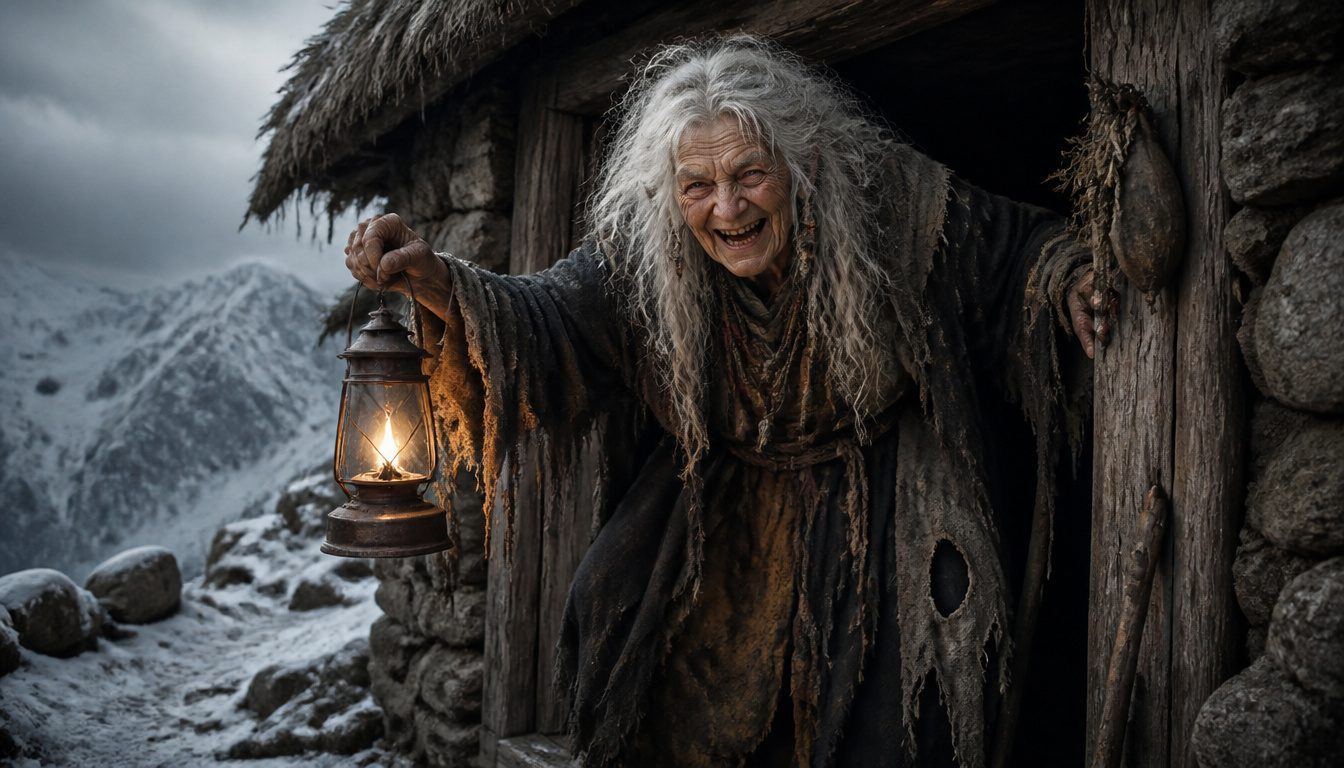
Illustration — Yamauba, the Japanese mountain hag: a grinning wild-haired old woman in rags holds a lantern at a snowy mountain hut's door. About our pictures
Nature spiritThe old woman of the mountains, with wild white hair and a hungry mouth, who offers lost travellers shelter and then tries to eat them. Yet she can also be generous - rewarding the kind, helping in childbirth, and raising the strong boy Kintarō.
At a glance
Who is the yamauba?
The yamauba (山姥), also read yamanba, is the woman of the mountains: a wild old woman who lives deep in the hills, beyond the edge of village life. She is one of the most widespread figures in Japanese folklore, and one of the hardest to pin down. In some stories she lures travellers into her hut and eats them. In others she helps women in childbirth, brings wealth to a household, or raises the strongest boy in Japan. Sometimes she does both in the same region.
The folklorist Komatsu Kazuhiko, writing in Heibonsha's encyclopedia, puts this double nature at the centre. People feared the yamauba as a man-eater, but they also believed she could bring good fortune. He lists other names for her, including yamaonna ("mountain woman"), yamahime ("mountain princess"), yamajorō and yamahaha ("mountain mother"). He also notes that some places imagine her as young rather than old.
How she looks
The picture varies from place to place, but Komatsu gives a common core. She is tall, with long hair, skin so white it is almost transparent, piercing eyes and a mouth split to the ears. She is said to have a taste for human children, and anyone who meets her in the mountains may fall ill or meet some other misfortune.
Medieval writers could be even more vivid. Heibonsha quotes the Muromachi-period tale Hanayo no hime. There the yamauba has a face like a flat tray and deep-sunk eyes that bulge out. Her fangs grow up beside her nose, her nose is like a bird's beak, and her red, shaggy hair has fourteen or fifteen horn-like lumps in it. The same entry records a Kyoto sideshow of 1609 near Tōfuku-ji temple that claimed to exhibit a live yamauba. She turned out to be a human woman, but the crowds of every class who came to see her suggest that many people thought such a creature real.
The yamauba of the folktales
In folktales (mukashibanashi) the yamauba is most often a villain. In Ushikata yamauba ("The Ox-driver and the Yamauba"), a man leading an ox or packhorse over a mountain pass meets her. She eats his load of fish or salt, then eats the animal. He flees and hides in a lonely house, which turns out to be hers, and in the end he tricks her and burns her to death in her own bath-kettle. The Nipponica encyclopedia notes that ox- and packhorse-drivers were really travelling peddlers and probably spread the story themselves. It also compares the ending to tales such as "Hansel and Gretel".
In Kuwazu nyōbō ("The Wife Who Doesn't Eat"), a stingy man marries a woman who eats nothing. Then he spies on her and sees her pouring rice into a second mouth on top of her head. She carries him off to the mountains in a tub, but he escapes and hides in a patch of iris and mugwort. That, the tale explains, is why these plants are hung from the eaves at the festival on the fifth day of the fifth month. Heibonsha notes that the wife is a yamauba or an oni in many tellings, but a spider more and more often as one moves west. In one tale recorded in Gifu Prefecture, the yamauba-wife threatens to come back that night as a spider and bind her husband with thread.
The best-known chase is Sanmai no ofuda ("The Three Charms"). A young temple novice is pursued by a monstrous old woman and throws down, one by one, the three paper charms he carries. One becomes a mountain and one a river, and the woman crosses both. The third becomes a fire that finally stops her. Nipponica's summary calls the pursuer an onibaba (ogress), but its entry on the yamauba lists this tale among hers. It also notes that this "magical flight" pattern is found around the world, and that the Kojiki myth of Izanagi's escape from the underworld is a classic example.
Yet other tales show her kind side. In Ubakawa ("The Old-Woman Skin") and Nukafuku Komefuku, she helps the hero of the story with magical gifts and changes their fortune.
Kintarō's mother
The yamauba's gentlest role is as a mother. Nipponica records traditions of a yamauba who bears six or twelve children on a mountain rock and nurses them. It also mentions one who helps at the mountain birth of Emperor Ōjin, and the yamauba who raises the boy Kintarō in the mountains of Hakone.
Kintarō grew up to be Sakata no Kintoki, one of the four retainers of Minamoto no Raikō who appear in the legend of Shuten-dōji and fight the tsuchigumo. The stage made the yamauba his mother. According to Heibonsha, the first work to do so was Chikamatsu Monzaemon's puppet play Komochi Yamanba (1712). In it the courtesan Yaegiri becomes a yamauba and raises Kaidōmaru, the future Kintoki, in the hills, and Raikō himself comes to stay at her hut. A Heibonsha entry on Kintoki adds that the warrior tale Zentaiheiki has the yamauba conceive him after dreaming of a red dragon amid thunder. A whole family of kabuki dances, the yamanba-mono, grew from this. The version most often staged today, the "new Yamanba", dates from 1848.
Printmakers loved the pair. The Metropolitan Museum of Art holds several prints by Kitagawa Utamaro, all dated about 1795, that show the yamauba playing with Kintarō or blackening her teeth beside him.
The Noh play Yamanba
The yamauba is also the subject of one of the great Noh plays, Yamanba. The-noh.com gives its author as Zeami "according to one tradition", and Japanese encyclopedias differ between "traditionally attributed to Zeami" and "author unknown". The play is certainly old. Zeami's recorded talks, the Sarugaku dangi of 1430, already name it.
A courtesan from the capital has become famous for a song-and-dance about the yamauba's wanderings through the mountains, and she is nicknamed "Hyakuma Yamanba" for it. On a pilgrimage to the temple Zenkō-ji, she and her party reach Mount Agero, on the border of Echigo and Etchū. There night falls suddenly in the middle of the day. A woman offers them shelter and reveals that she is the real yamauba. She darkened the sky herself, she says, so that she could hear the song sung about her. Late that night she appears in her true, fearsome form. She describes her life among peaks and gorges, preaches that good and evil are ultimately one, and dances her endless circuit of the mountains before she disappears.
Heibonsha's entry observes that in the play's own words the yamauba, usually thought a terrible ogress, is in fact a mountain woman who helps people unseen. The role is played in a special mask named after her, the yamanba mask.
Local beliefs
Folklore reports collected in the Nichibunken database show how differently communities lived with her. A record from Ehime Prefecture tells of a yamauba who came every year to help pound the New Year rice cakes, which brought prosperity. The villagers disliked her shabby clothes and changed the pounding day to avoid her. After that, disasters and epidemics struck. To appease her they built a shrine, Uba Daimyōjin, and gave up rice cakes for the first three days of the year.
In Kagawa Prefecture, people were not to cross the mountains on the twentieth day of the twelfth month, because the yamauba was doing her washing. Nipponica records a similar washing day on the island of Iki, when people avoided using water. In Kagawa people were also told never to smile at a yamauba if they met one, but to walk past as if they had not seen her. In Ibaraki, a yamauba living in a cave was said to lend out trays and bowls until someone broke one and did not replace it. Heibonsha adds that in parts of Nagano she was expected to appear at the year-end market.
Komatsu traces the figure to several roots at once: villagers' awe of people who lived and worked in the mountains, women who served the mountain god or wandered as shrine maidens, and the many local traditions in which the mountain god is herself a woman.
The modern yamanba
The name lives on. In the 1990s, a street style among teenage girls in Tokyo's Shibuya took the name yamanba-gyaru. Noriko T. Reider's Mountain Witches: Yamauba (2021), the first book-length study of the figure in English, discusses them in its chapter on the yamauba in modern culture. Her other relatives on this site include Yuki-onna, the woman of the snow.
Frequently asked questions
Is the yamauba good or evil?
She is both. Folktales such as Ushikata yamauba and Sanmai no ofuda make her a man-eater. Other stories show her helping at births, raising Kintarō, giving magical gifts or bringing wealth to a household that treats her well. Folklorists see this double nature as her defining trait.
What is the difference between yamauba and yamanba?
They are two readings of the same characters, 山姥, "mountain old woman". Yamanba is commonly used for the Noh play and the kabuki dances, and both readings are used for the folklore figure.
Is the yamauba Kintarō's mother?
In popular tradition, yes. Chikamatsu's puppet play Komochi Yamanba (1712) made her the mother of Kaidōmaru, the future Sakata no Kintoki. Folk tradition also tells of a yamauba raising the boy in the mountains of Hakone.
Who wrote the Noh play Yamanba?
It is traditionally attributed to Zeami, but the attribution is not certain, and some reference works list the author as unknown. The play existed by 1430, when Zeami's recorded talks mention it.
What does a yamauba look like?
In most regional accounts she is tall, with long hair, very pale skin, glaring eyes and a mouth split to her ears. Some places imagine her as a young woman instead of an old one.
Sources & further reading
- 山姥 (*yamauba* and *yamanba*): *Nihon Kokugo Daijiten*, Heibonsha (Komatsu Kazuhiko, Yokomichi Mario), Nipponica, Britannica Japan and related entries (Kotobank)
- 牛方山姥 (Nipponica) (Kotobank)
- 食わず女房 (Heibonsha, Nipponica, Kodansha) (Kotobank)
- 三枚のお札 (Nipponica) (Kotobank)
- *Yamamba* (Mountain Crone): synopsis, the-noh.com
- *Yamamba*: play details and attribution, the-noh.com
- Kitagawa Utamaro, *Yamauba and Kintarō*, ca. 1795, Metropolitan Museum of Art
- Kitagawa Utamaro, *Yamauba Playing with Kintarō*, ca. 1795, Metropolitan Museum of Art
- Kitagawa Utamaro, *Yamauba Blackening her Teeth, with Kintarō*, ca. 1795, Metropolitan Museum of Art
- Nichibunken record C3820135-000: the yamauba's New Year rice cakes, Ehime (1984)
- Nichibunken record 0470249: the yamauba's washing day, Kagawa (2001)
- Nichibunken record 0870054: never smile at a yamauba, Kagawa (1983)
- Nichibunken record 0640009: the bowl-lending yamauba, Ibaraki (1913)
- Nichibunken record 2363105: the yamauba-wife who becomes a spider, Gifu (1972)
- Review of Noriko T. Reider, *Mountain Witches: Yamauba* (2021), Supernatural Studies
- Wikipedia: Yama-uba (pointer to further reading)
- metmuseum.org — 54859
- mfaboston6.emuseum.com — kintaro-combing-the-hair-of-yamauba