Namazu
鯰
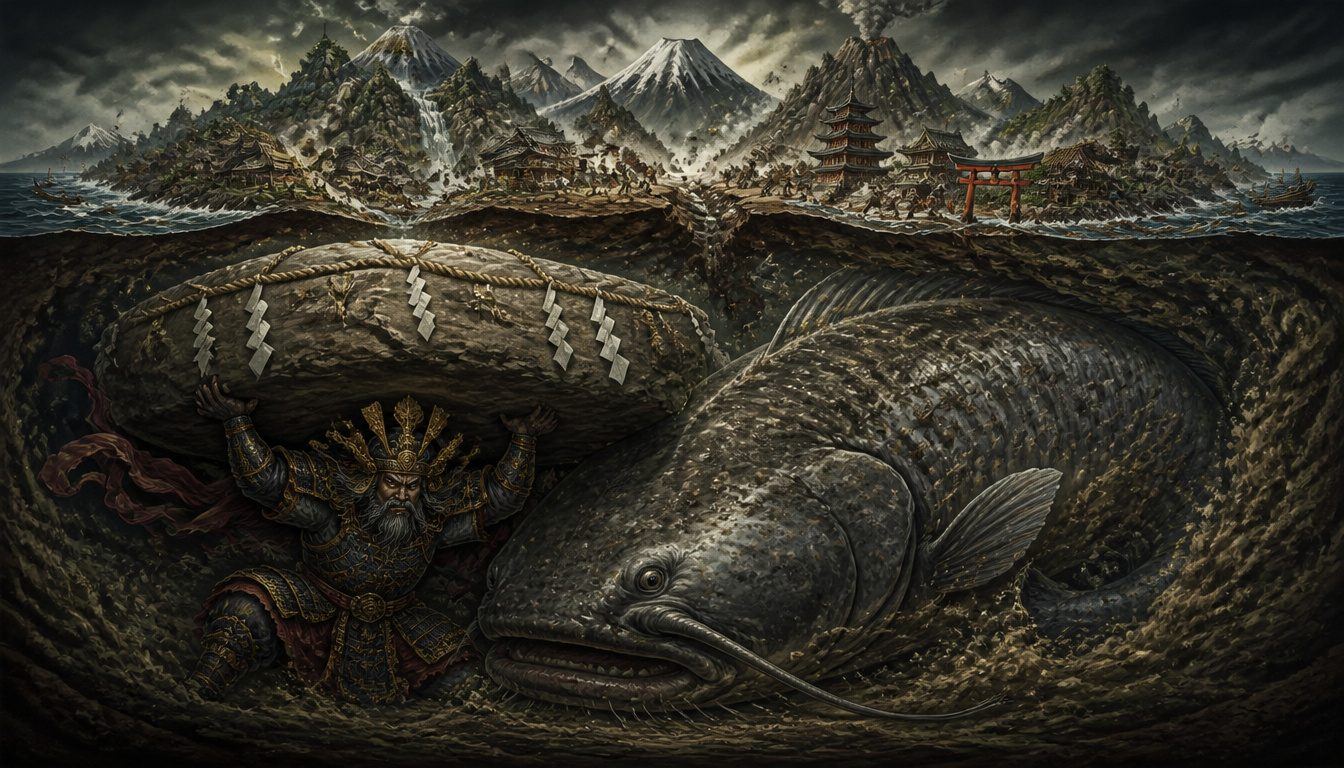
Illustration — Namazu, the Japanese earthquake catfish: a giant catfish writhes underground beneath villages while an armoured god pins it with a sacred stone. About our pictures
Animal yokaiA gigantic catfish living in the mud beneath Japan, whose thrashing causes earthquakes. The god of Kashima Shrine keeps it pinned with a great 'keystone' rock - and when his attention slips, the ground shakes.
At a glance
What is the namazu?
The namazu (鯰) is the giant catfish that lies in the mud beneath Japan and makes the earth shake when it thrashes. A god keeps it in check. In the best-known version this is the deity of Kashima Shrine in Ibaraki Prefecture, who pins the fish down with a rock called the kaname-ishi, the "pivot" or "keystone" stone. When the god's grip loosens, the catfish moves and an earthquake follows.
The idea was strong enough to enter the language. The Nihon Kokugo Daijiten records namazu as a word for an earthquake itself. Its earliest example is a comic verse of 1702 that sums up the belief in a phrase: the whole of Japan rides on the catfish's back. The namazu is best known today, though, from the hundreds of cheap prints called namazu-e ("catfish pictures") that flooded Edo after the great earthquake of 1855.
Before the catfish: dragons and earthquake gods
The catfish is a fairly late arrival. In a guide published by the Hyōgo Prefectural Museum of Nature and Human Activities, Katō Shigehiro points out that Japan's oldest myths include stories of thunder, storms and wildfire but none about earthquakes. The first earthquake in the Nihon Shoki is a bare entry for the year 416. Under the year 599 the chronicle records a quake that destroyed buildings, after which worship was ordered for the gods of earthquakes. The Kokugakuin University Encyclopedia of Shinto adds that no specific god is named.
Before the catfish took over, Katō writes, many people believed that a dragon under the ground caused earthquakes, and Buddhist teaching also blamed dragons. A book published just after the 1855 quake, Jishin kō, reproduces an "earthquake creature" coiled like a dragon around the islands of Japan, with a poem about Kashima's keystone beside it. Its source was said to be a calendar of 1198, but that calendar has since been shown to be a later fake. A letter of Toyotomi Hideyoshi about building his castle at Fushimi tells his official to take care against the namazu, using the fish as a figure for earthquakes. But the shift from dragon to catfish is usually placed in the middle of the Edo period. Katō notes that a 1679 linked verse in which Matsuo Bashō took part is counted as the first text in which the earthquake dragon turns into a catfish.
Kashima and the keystone
The kaname-ishi stands in the woods of Kashima Jingū, some distance from the main shrine buildings. The Nipponica encyclopedia describes it as a round stone about 25 centimetres across and 15 centimetres high, with a slight hollow in its top. Its roots are said to run deep underground. A well-known legend says that the Mito lord Tokugawa Mitsukuni once had his men dig around it for seven days and nights without reaching the bottom.
The stone's original meaning was probably different. Nipponica cites a shrine record saying that the Kashima deity sat on this stone when he came down to earth, and notes that it was once called the "seat stone". In other words it began as an iwakura, a rock where a god descends, and only later became the lid on the earthquake fish. The Kokugakuin encyclopedia makes a similar point about the god. Kashima's deity, Takemikazuchi, appears in the Kojiki and Nihon Shoki as the god who wins the land of Izumo for the heavenly gods, with no link to earthquakes. That role grew later out of legends about the keystone. Heibonsha's encyclopedia gives the popular explanation in its fullest form. The stone is a nail that holds the catfish by its head and tail, and if it works loose, the fish stirs.
The keystone was firmly in popular culture by the seventeenth century. A kana-zōshi book titled Kaname-ishi (1663) contains a charm-poem that was still being reproduced two centuries later. Roughly translated: "Though it may shake, the keystone will never come out, as long as the god of Kashima endures." Nipponica adds that other shrines around Japan have stones of their own said to hold down earthquakes.
The catfish prints of 1855
The Ansei Edo earthquake struck the shogun's capital on the night of the second day of the tenth month of Ansei 2, 11 November 1855. It was a shallow quake directly beneath the city. Katō gives its magnitude as 6.9 and the deaths as more than four thousand. The historian Gregory Smits, quoted by Penn State University, estimates it at about 7.0 and puts the deaths at no fewer than seven thousand.
Prints and broadsheets went on sale almost at once. Smits writes that hastily printed, anonymous sheets were selling two days after the quake. Among them were the namazu-e, colour woodblock prints built around the earthquake catfish. Katō notes that a catfish had already appeared on broadsheets after the Zenkōji earthquake of 1847, but it was the Ansei prints that fixed the image of the earthquake catfish in the popular mind. They were published without the censors' approval and without names. The Nipponica entry suggests that leading artists of the day, and writers such as Kanagaki Robun, were probably involved. Counts of the designs vary: about 200 according to Nipponica and the National Museum of Japanese History, more than 400 according to Smits. The authorities soon moved against them. Nipponica says the shogunate seized the printers' woodblocks in the twelfth month, about two and a half months after the quake. Smits says it acted within a month.
What the prints show
The prints treat the disaster with startling humour. Some are protective charms that show the Kashima god pinning the fish under his stone, sometimes helped by the thunder god Raijin. In others, people who lost everything beat the catfish or turn it into grilled eel-style kabayaki. Remorseful catfish apologise for the damage they caused. One print in the National Diet Library offers a clever excuse for the god's absence. The quake fell in Kannazuki, the "month without gods", when the gods were believed to leave their shrines and gather at Izumo. So the god Ebisu, left on duty, pins the catfish with a gourd so that it can be taken to Izumo.
Many prints are about money. After the quake, builders and other craftsmen were suddenly in demand, and the prints show them doing well while the rich lose their hoards. Some even show the catfish as a bringer of good fortune. Heibonsha's encyclopedia, drawing on the Dutch scholar Cornelius Ouwehand, explains that the earthquake catfish in these prints is both destroyer and saviour. The quake was imagined as yonaoshi, "world renewal", that set an unbalanced society right. Smits reads the prints as a coded way of commenting on politics. They showed the shogunate as helpless before the forces of nature, a dozen years before it fell.
The catfish after 1855
Katō notes that in the Meiji era the catfish stopped being drawn as an earthquake. It returned as a cartoon of the new bureaucrats, whose drooping moustaches looked like whiskers. After the great quakes of 1891 and 1923, catfish cartoons appeared again. He also records the cries people once gave when the ground shook, yonaori ("the world is mended") and manzairaku ("ten thousand years of joy"). Local folklore kept its own versions of the story. A 1931 report from Iwate says the Kashima god once held the great catfish down with a golden sword. When that sword rotted, earthquakes became frequent, until he replaced it with one of stone.
The belief that catfish sense earthquakes in advance also survived. Smits notes that government-funded studies of catfish in aquariums continued as late as 1993. Large collections of the 1855 prints can be seen online through the University of Tokyo Library's Ishimoto Collection, assembled by the seismologist Ishimoto Mishio, and in 2021 the National Museum of Japanese History exhibited a private collection of them for the first time.
Frequently asked questions
Why is the catfish linked to earthquakes in Japan?
Folk belief held that a giant catfish lived beneath the ground and that its thrashing caused earthquakes. The idea seems to have replaced an older belief in an earthquake dragon during the Edo period. It became the dominant image after the 1855 Ansei Edo earthquake, when hundreds of catfish prints went on sale.
What is the kaname-ishi?
It is a small, round, partly buried stone at Kashima Jingū in Ibaraki Prefecture. It is said to reach deep into the earth and to hold down the earthquake catfish. Scholars think it was originally a seat for the shrine's god to descend upon, and only later became the catfish's keystone.
What are namazu-e?
They are colour woodblock prints of the earthquake catfish, published anonymously in Edo after the earthquake of November 1855. They range from protective charms to satire about the rich losing money and tradesmen growing prosperous. Estimates of the number of designs range from about 200 to more than 400.
Who holds down the namazu?
Usually the god of Kashima Shrine, Takemikazuchi, using the kaname-ishi. In some 1855 prints, Ebisu stands in for him, because the quake struck in the month when the gods were away at Izumo.
Can catfish predict earthquakes?
The belief is old. Accounts of the 1855 quake already included reports of catfish behaving oddly beforehand. Japan funded aquarium studies of catfish as late as 1993, but they did not produce a reliable way to forecast earthquakes.
Sources & further reading
- 鯰絵: Nipponica, Heibonsha *Sekai Daihyakka Jiten* and other entries (Kotobank)
- 要石: *Nihon Kokugo Daijiten*, Nipponica, Britannica Japan and Heibonsha entries (Kotobank)
- 鯰: *Nihon Kokugo Daijiten* and *Daijisen* entries (Kotobank)
- Katō Shigehiro, "Namazu-e ni miru Nihonjin no jishinkan no hensen", Hyōgo Prefectural Museum of Nature and Human Activities (PDF)
- "Researcher examines the history and impacts of earthquakes in Japan" (Gregory Smits), Penn State University
- Nainokami (earthquake kami), Kokugakuin University *Encyclopedia of Shinto*
- Takemikazuchi, Kokugakuin University *Encyclopedia of Shinto*
- *Namazu-e no imajinēshon* (2021), National Museum of Japanese History, via the National Art Center Art Commons
- University of Tokyo: digital release of the Ishimoto Collection of disaster broadsheets and namazu-e
- Takahashi Yukio, "Kaname-ishi to Kashima Jingū", NICT (PDF)
- Nichibunken record 1232127: Kashima-sama's golden and stone swords, Iwate (1931)
- Wikipedia: Namazu (pointer to further reading)
- digital.archives.caltech.edu — FA-PR-0002
- rom.on.ca — aftershocks-japanese-earthquake-prints
- pinktentacle.com — namazu-e-earthquake-catfish-prints