Chapter One
In the Beginning
When heaven and earth first began, the young earth had no firm shape: it drifted about like oil floating on water, like a jellyfish. Three deities came into being in the Plain of High Heaven, then two more from something that sprouted up like a reed shoot, and after them seven generations of gods. The last of these were Izanagi and Izanami—"the Male Who Invites" and "the Female Who Invites"—the divine couple tasked with bringing order to creation.
The heavenly gods gave them a jewelled spear, Ame-no-Nuboko, and charged them to make the drifting land firm and bring it to completion.
Chapter Two
The Floating Bridge
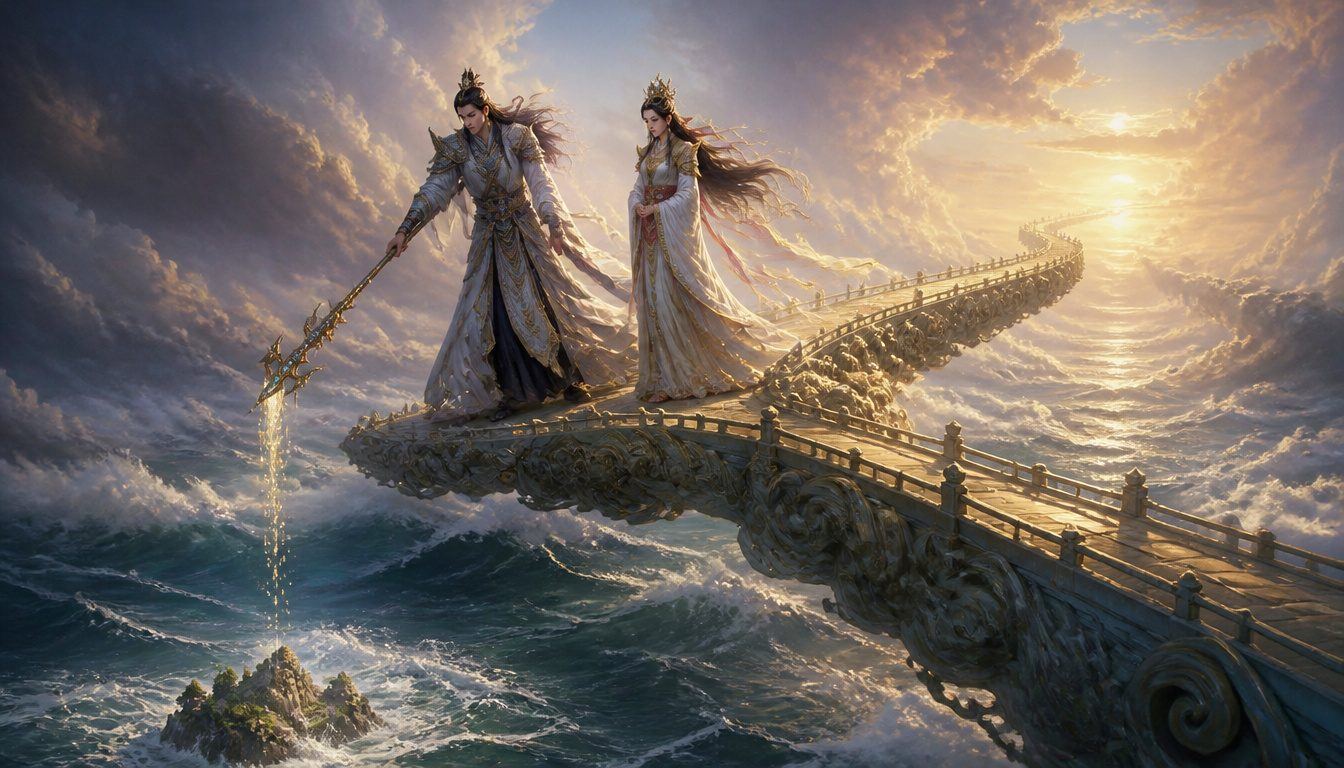
Standing on the Floating Bridge of Heaven, Izanagi and Izanami pushed the jewelled spear down into the brine below and stirred until it thickened and curdled. When they drew the spear up, the brine dripping from its tip piled up and became the first island: Onogoro, the "self-congealed" island.
Here they prepared to bring forth the land and the gods who would fill it.
Chapter Three
The Birth of Islands
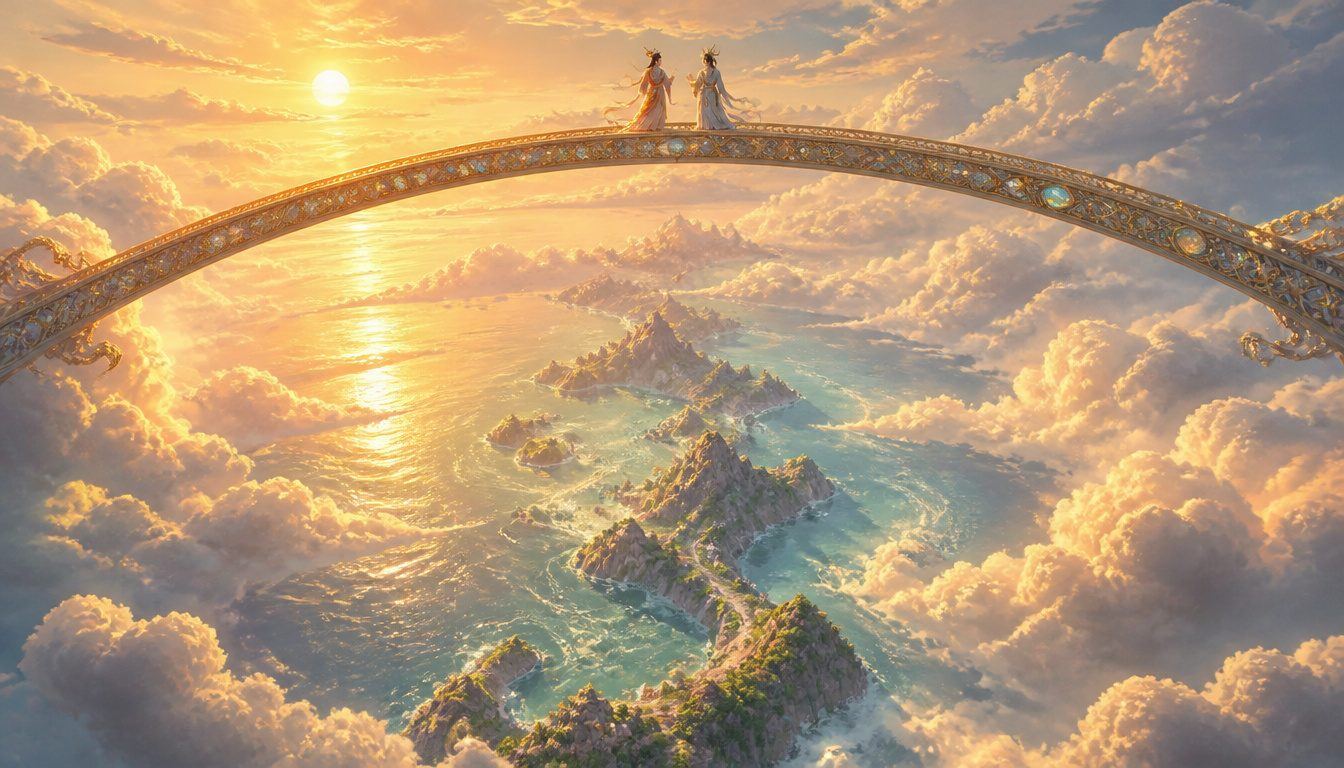
Izanagi proposed a marriage ritual. They would walk around the heavenly pillar in opposite directions—Izanami going round from the right, Izanagi from the left—and when they met, they would join together.
When they met, Izanami spoke first: "What a handsome young man!" Izanagi replied, "What a lovely maiden!"—though he remarked that it was not fitting for the woman to speak first. Their first child was Hiruko, the "leech child," a failure whom they placed in a boat of reeds and set adrift. Their next, the island of Awa, was also counted as no child of theirs.
Troubled, the couple went up to Heaven to ask the heavenly gods what had gone wrong. The gods divined the answer: it was because the woman had spoken first. So they went back down and circled the pillar again, this time with Izanagi speaking first. From this union the great islands of Japan were born, one after another: Awaji, Shikoku, Oki, Kyushu, Iki, Tsushima, Sado, and finally the largest, Honshu—the "Land of the Eight Great Islands." Six smaller islands followed.
Chapter Four
The Gods of Nature
Having created the land, Izanagi and Izanami went on to give birth to deities: gods of rock and soil, of the house and of the wind, a great god of the sea, gods of the river mouths, of trees and mountains and moors, of mountain passes and valleys, a god of the heavenly bird-boat and a goddess of food.
Each deity brought a new dimension to the growing world, filling it with the forces that would shape and sustain life. The couple's creative power seemed boundless, and the world blossomed with divine presence.
Chapter Five
The Fire God's Birth
But tragedy struck when Izanami gave birth to Kagutsuchi, the god of fire. The flames burned her as she bore him, and she fell sick and lay down. Even as she lay dying, more deities came from her: gods of metal from her vomit, gods of clay from her excrement, and from her urine a goddess of water and a god of growth. At last she died.
Izanagi crawled weeping around her pillow and her feet, lamenting that he had traded his beloved wife for a single child, and from his tears a weeping goddess was born. He buried Izanami on Mount Hiba, on the border of Izumo and Hōki. Then, in his grief and rage, he drew his long sword and cut off Kagutsuchi's head. From the blood on the blade eight gods came into being—among them gods who split rocks and roots, gods of fire and swiftness, the mighty Takemikazuchi, and the water gods Kuraokami and Kuramitsuha—and from the fire god's body came eight gods of the mountains. But none of this brought comfort to Izanagi, for his beloved wife was gone.
Chapter Six
The Descent to Yomi
Unable to accept his wife's death, Izanagi decided to follow her to Yomi, the land of the dead, to bring her back. When Izanami came out through the palace door to meet him, he called to her.
"My beloved wife," he said, "the lands we were making are not yet finished. Please come back with me."
Izanami answered that it was a great pity he had not come sooner, for she had already eaten food cooked at the hearth of Yomi. Yet because he had come so far for her, she wished to return, and she would talk it over with the gods of Yomi. "But do not look at me," she warned.
Chapter Seven
The Forbidden Sight
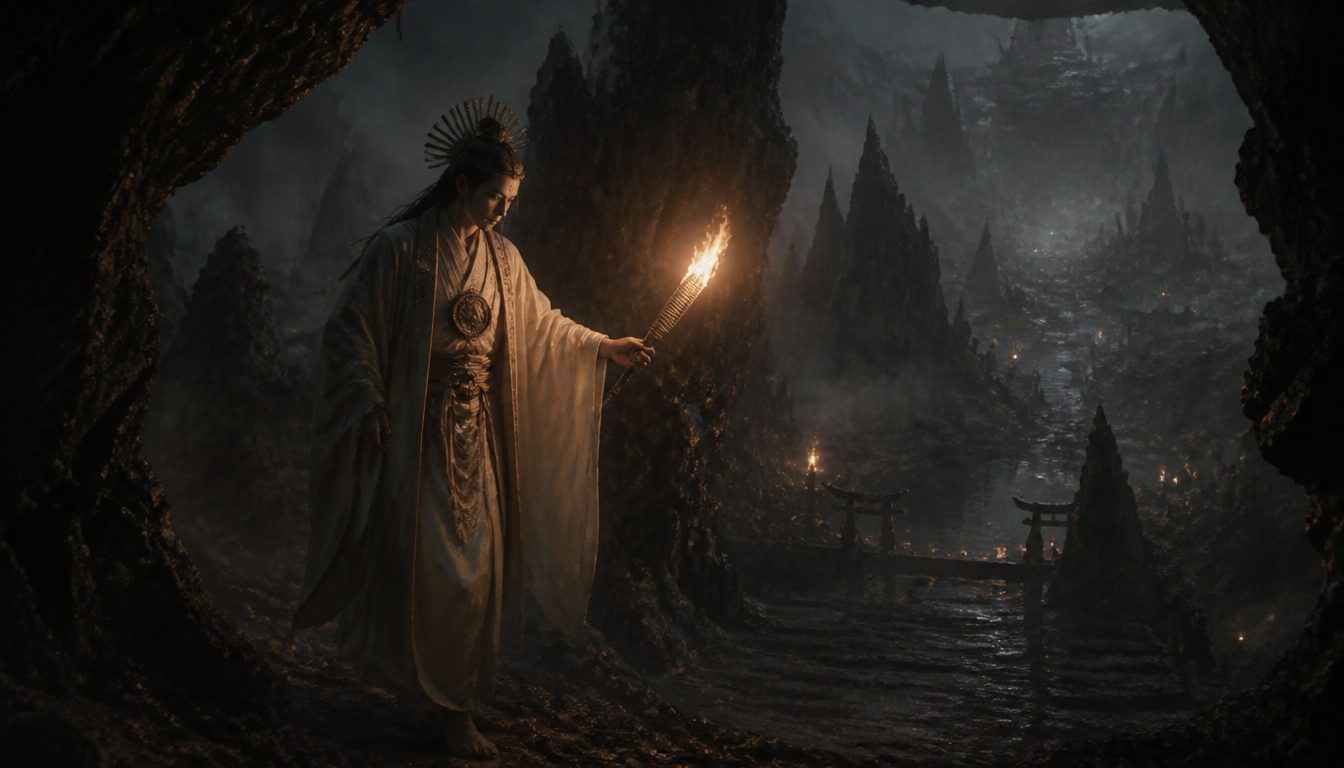
Izanami went back inside, and she stayed there so long that Izanagi could wait no longer. He broke off one of the end teeth of the comb in his hair, lit it as a torch, and went in to look, defying his wife's warning.
What he saw filled him with horror. Izanami's body was rotting and swarming with maggots, and eight thunder gods had been born and dwelt in it—in her head, her breast, her belly, her loins, her hands and her feet. She had become a thing of death and darkness.
Izanagi fled in terror. "You have put me to shame!" Izanami cried, and she sent the hag of Yomi, Yomotsu-shikome, to pursue him.
Chapter Eight
The Great Separation
Izanagi fled back toward the world of the living. He threw down his black headdress, which turned into grapes, and while the hag stopped to eat them he ran on. He broke the comb from the other side of his hair and threw it down; it turned into bamboo shoots, and again she stopped to eat. Then Izanami sent the eight thunder gods after him with fifteen hundred warriors of Yomi. Izanagi ran on, swinging his sword behind him, until he reached the foot of Yomotsu Hirasaka, the slope at the border of Yomi. There he took three peaches from a tree growing at its base and struck at his pursuers with them, and they all fled back. Izanagi thanked the peaches and charged them to help the people of the land whenever they fell into trouble.
Last of all, Izanami herself came after him. Izanagi pulled a huge boulder, one that would need a thousand men to drag, across the pass, sealing the land of the dead away from the land of the living. The Kojiki says this pass is the Ifuya Pass in Izumo.
From opposite sides of the boulder, the divine couple spoke their final words to each other. Izanami declared that if he did this, she would strangle a thousand of the people of his land every day.
Izanagi responded that, in that case, every day he would set up fifteen hundred birthing huts. So it is that each day a thousand people die and fifteen hundred are born—and from then on Izanami was called the Great Goddess of Yomi.
Chapter Nine
Purification
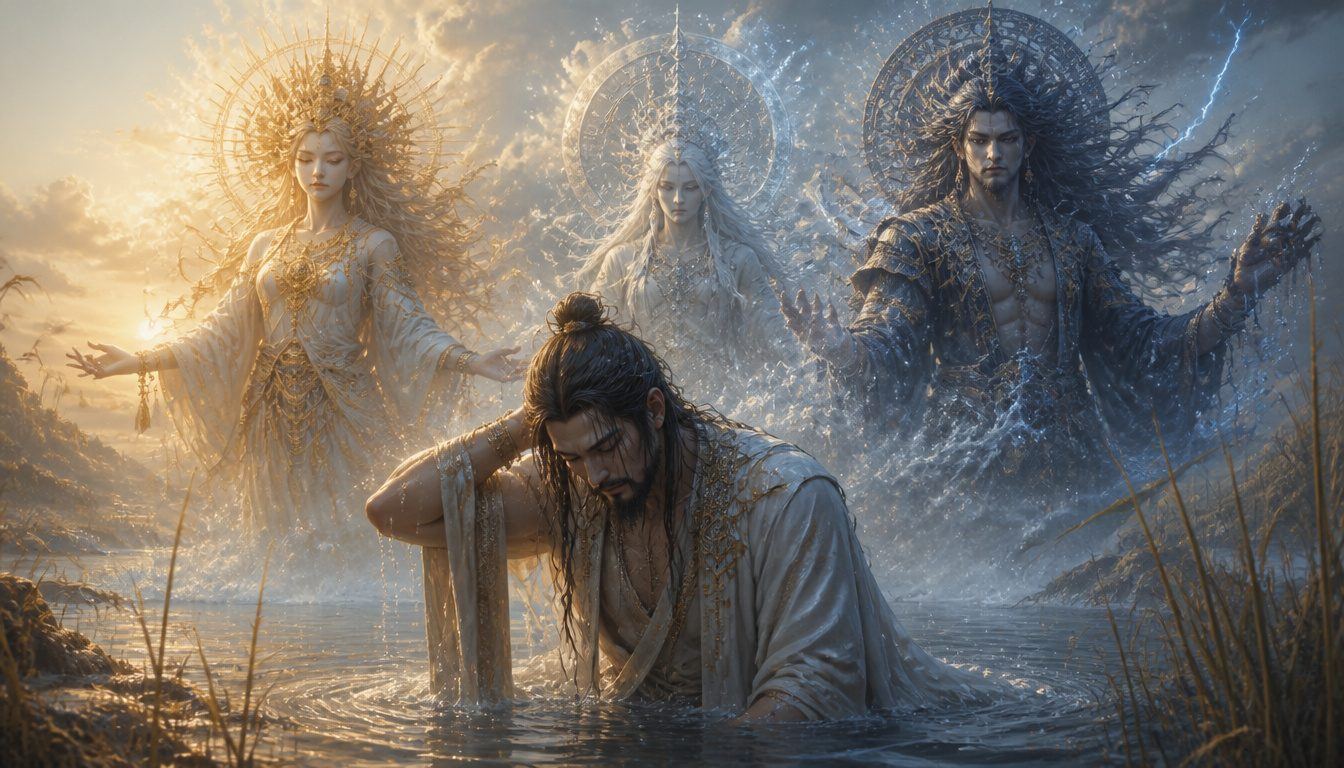
Defiled by his visit to that foul land, Izanagi went to purify himself at a small river mouth at Tachibana in Himuka, on the island of Tsukushi (Kyushu)—the place later called Tachibana no Odo. As he threw down his staff, his belt, his clothes, his hat and his bracelets, a god was born from each. As he washed in the middle of the stream, more deities were born: gods of misfortune from the pollution of Yomi, gods who set misfortune right, and gods of the sea's depths, middle and surface. But the most important births came when he washed his face:
From his left eye was born Amaterasu, the sun goddess, who would light the world. From his right eye was born Tsukuyomi, the moon god, who would govern the night. And from his nose was born Susanoo, the storm god, whose wild nature would challenge the heavens.
Epilogue
The Foundation
Overjoyed that at the end of all his begetting he had gained three noble children, Izanagi divided the world among them. He took off his necklace of jewels, shook it so that it jingled, and gave it to Amaterasu with the High Plain of Heaven to rule. To Tsukuyomi he gave the realm of the night. And to Susanoo, he gave the plain of the sea.
Having completed his tasks, Izanagi withdrew from the world: the Kojiki says that he dwells at Taga in Ōmi, while the Nihon Shoki says he built a hidden dwelling on the island of Awaji and stayed there in silence. But the islands he and Izanami created remained, the foundation of Japan. The gods they birthed continued to shape the world. And the cycle they established—of creation and destruction, life and death—continues to turn, eternal and unchanging.
This is how Japan came to be, born from the love and tragedy of two divine beings, shaped by their creative power, and forever marked by the separation of life from death, the living world from the realm of shadows.
Sources
Sources & Versions
This telling follows the Kojiki (712), Book One, in Basil Hall Chamberlain's 1882 translation: §I–II (the first deities and the seven generations), §III "The Island of Onogoro," §IV–V (the courtship, Hiruko, and the birth of the eight great islands), §VI (the birth of the nature deities), §VII–VIII (Izanami's death and the slaying of the fire god), §IX "The Land of Hades" (Yomi), §X "The Purification of the August Person," §XI (the three children receive their realms) and §XII (Izanagi's dwelling at Taga). The Nihon Shoki (720), Book I, in W.G. Aston's 1896 translation, differs in important ways. It opens with heaven and earth still mixed together in a chaotic mass "like an egg," from which the clear part rose to become heaven. In its main text, when the woman speaks first Izanagi objects at once and they circle the pillar again, so no failed child results; Hiruko is born later, after the sun and moon, and still cannot stand at three years old (a variant follows the Kojiki, with the heavenly gods divining the mistake). Above all, in the main text Izanagi and Izanami together give birth to the sun goddess, the moon god and Susanoo, and Izanami does not die; Kagutsuchi, the journey to Yomi and the purification appear only in its variant accounts ("in one writing it is said"), several of which tell them differently, for example cutting the fire god into three or five pieces. Kokugakuin University's Encyclopedia of Shinto notes that the Kojiki leaves Izanami out of the birth of the three noble children, and that one Nihon Shoki variant places her burial at Kumano rather than Mount Hiba.
- Kojiki (Chamberlain, 1882), §III — The Island of Onogoro
- Kojiki (Chamberlain, 1882), §V — Birth of the Eight Great Islands
- Kojiki (Chamberlain, 1882), §VII — Retirement of Her Augustness the Princess-Who-Invites
- Kojiki (Chamberlain, 1882), §IX — The Land of Hades
- Kojiki (Chamberlain, 1882), §X — The Purification of the August Person
- Kojiki (Chamberlain, 1882), §XI — Investiture of the Three Illustrious August Children
- Nihongi (Aston, 1896), Book I — The Age of the Gods, Part I
- Encyclopedia of Shinto (Kokugakuin University) — Izanagi
- Encyclopedia of Shinto (Kokugakuin University) — Izanami
- Encyclopedia of Shinto (Kokugakuin University) — Kagutsuchi
- Encyclopedia of Shinto (Kokugakuin University) — Hiruko