Kasa-obake
傘おばけ
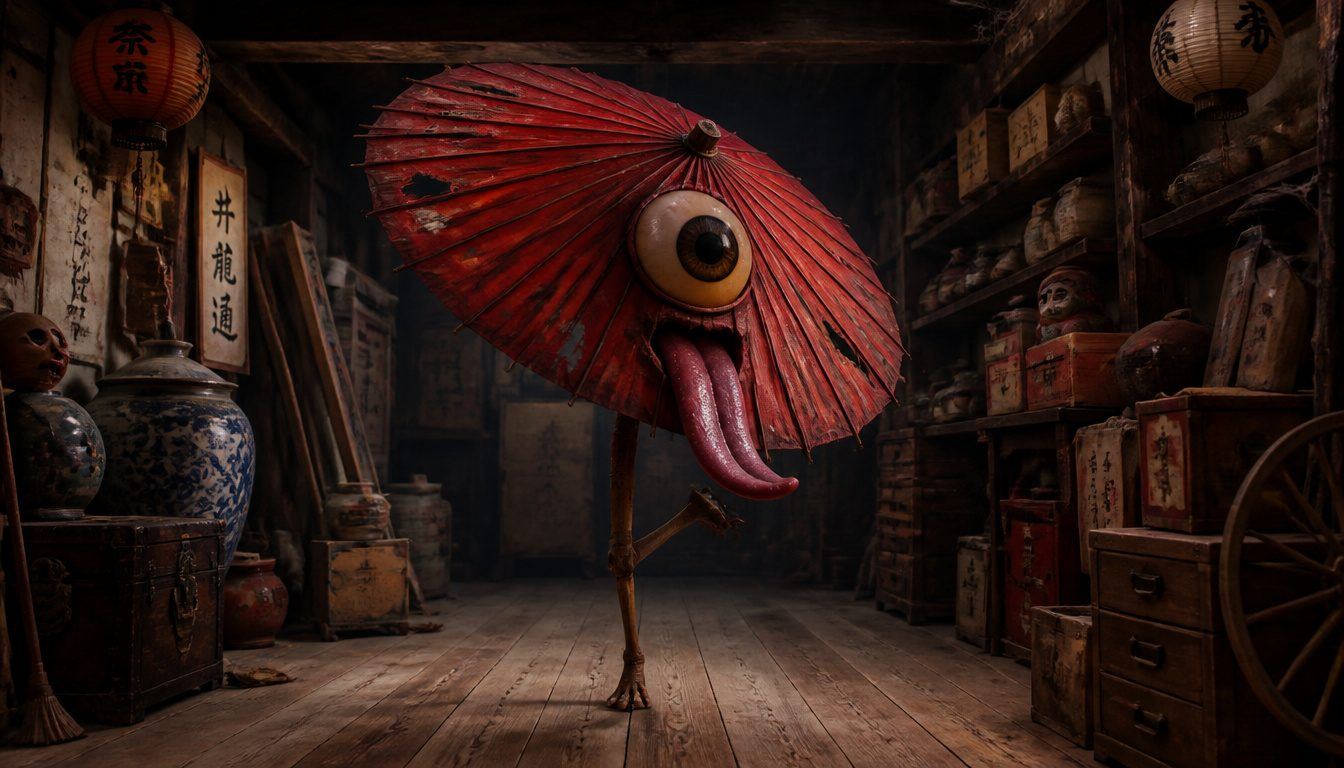
Illustration — Kasa-obake, the Japanese umbrella yokai: a tattered red paper umbrella with one huge eye and long tongue hops on one leg. About our pictures
Household yokaiAn old paper umbrella that has sprung to life, hopping about on a single leg, usually pictured today with one big eye and a long lolling tongue. It is more likely to startle and amuse than to harm.
At a glance
What is a kasa-obake?
The kasa-obake (傘おばけ), "umbrella ghost", also called karakasa-obake, is an old oiled-paper umbrella that has come to life. In its familiar form it hops about on a single leg, often wearing a wooden clog, with a face on its paper and a long tongue hanging out. Today it is usually drawn with one big eye. It does not haunt anyone, curse anyone or carry a moral. It simply bounces into view and makes people jump, or laugh.
The kasa-obake is one of the most recognisable yokai in Japan, and one of the least explained. Unlike the kappa, the fox or the Yamauba, it has almost no folklore of its own. There are no regional legends about where it lives, no rules for keeping it away and no famous encounters. It is above all a picture. What history it has is a history of drawings, prints, games and stage effects, and that is the story this page tells.
A picture with no story
The clearest way to see how thin the folklore is, is to search for it. The Kaii-Yōkai Densho database of the International Research Center for Japanese Studies (Nichibunken) indexes supernatural reports from local histories and folklore journals across Japan. Under the names kasa-obake and karakasa-obake, our searches returned nothing.
The nearest records are scattered and unrelated. A report from Yamagata Prefecture says that on a rainy night the ribs of an umbrella glowed in front of a bridge. In Fukushima Prefecture, a doctor had his fish stolen by a giant holding an umbrella. People said the giant was a weasel, since weasels took that shape on rainy days. In Ehime Prefecture, a woman's umbrella grew heavy at a place where someone had died, as though something were pressing on it. None of these is a hopping, one-eyed umbrella. In these stories the umbrella is a prop for some other spirit, not the yokai itself.
That fits a wider change described by the yokai scholar Kagawa Masanobu. Once illustrated catalogues of yokai appeared in the eighteenth century, he argues, a yokai came to be identified by its name and its look, like a character in a modern monster collection, rather than by the strange happening it explained.
Umbrellas in the night parade
Umbrella monsters do have a long pedigree in painting. The tradition of the Hyakki yagyō emaki, the "Night Parade of a Hundred Demons" picture scrolls, includes one. A copy of the scroll in the Nichibunken collection shows a monster with a torn umbrella on its head, the tear tied up with white cord and a large eye peering through the gap. It walks on tall clogs, leaning on a staff. The same figure appears in Nichibunken's copy of a night-parade picture attributed to the painter Tosa Mitsuoki. This umbrella-headed walker is not yet the modern kasa-obake. It has a body, two legs and a stick, but it shows that painters counted the umbrella among the household things that might turn monstrous.
Comic books carried the idea forward. Sokuseki onryōji, an illustrated booklet with a preface dated 1798, shows animals and household objects visiting a doctor. One of the patients is a personified umbrella leaning on a stick.
The one-legged umbrella of the toy prints
The kasa-obake as most people now picture it belongs to the cheap prints and games of the late Edo and Meiji periods. Its true home is the omocha-e, "toy prints" for children. One kind of these was the bakemono-zukushi, a single sheet crowded with dozens of monsters, each with its name. Kagawa notes that such sheets, along with yokai board games (sugoroku) and card games (karuta), worked as illustrated catalogues of monsters. They were a way to collect and name them, long before Pokémon.
The umbrella is a regular member of the cast. On Shinban bakemono-zukushi, a sheet of 48 monsters by the print artist Yoshimori, the "umbrella ghost" has eyes and a mouth, sticks out its tongue, has two arms, and stands on one leg in a wooden clog. In a sugoroku board game of object monsters, its arms and its single leg are covered in hair. A shadow-picture toy print of 1881 shows a one-legged umbrella dancing with its tongue out. A Meiji-period monster sheet by Toyosada shows it dancing in a loincloth. On a set of shrine-pilgrimage stickers (senjafuda) from 1906, it appears again as a happily dancing silhouette.
The umbrella ghost also had a life on the stage. A kabuki print of 1899, showing the swordsman Miyamoto Musashi facing the spirit Osakabe-hime, includes a one-legged umbrella monster dancing with a fan among the foxes, kappa and skeletons in the background.
Across all these pictures the details shift. In Kawanabe Kyōsai's Kyōsai hyakki gadan (1890), an umbrella monster stares out with two eyes, and many of the toy-print umbrellas have arms. The single hopping leg, the tongue and the clog are the features that recur.
Is the kasa-obake a tsukumogami?
It is usually counted as one. A tsukumogami is a household object that gains a spirit with age. The Muromachi-period Tsukumogami scroll says it happens after a hundred years. Nichibunken's own catalogue files the umbrella sugoroku under both bakemono (monsters) and tsukumogami, because every monster on the board is a transformed tool or utensil.
The connection is mainly a matter of family resemblance, though. No old source we found tells the kasa-obake's own story or explains why an umbrella in particular comes alive. It belongs with the dancing sandals and rice bowls of folk tales and the kettle stands and lutes of the picture scrolls. Like them, it is an everyday object that has started to move, and that is the whole joke.
From bakemono to mascot
Kagawa argues that by the late Edo period city people no longer feared such creatures much. In Edo, bakemono had become largely characters of fiction and play, made up for fun even by people who did not believe in them. He adds that the Edo public found its monsters comical but not yet "cute". That softer, friendlier image is modern.
The kasa-obake fits this history perfectly. It began as a figure in a parade of monsters, became a stock face on children's prints and games, and is now a friendly mascot of yokai culture. It may be the purest example of a yokai that exists because people enjoyed drawing it.
Frequently asked questions
What is a kasa-obake?
It is a yokai in the form of an old paper umbrella that has come alive. It is usually drawn hopping on one leg, sometimes in a wooden clog, with a long tongue and, today, often a single large eye. It is also called karakasa-obake.
Is the kasa-obake a tsukumogami?
It is generally grouped with the tsukumogami, household objects that come alive in old age. Nichibunken's image database files umbrella monsters alongside other object monsters under that heading. No traditional story explains how an umbrella in particular becomes one.
Is the kasa-obake dangerous?
Not in any source we found. Edo and Meiji pictures show it dancing, hopping and pulling faces. It is a comic figure meant to startle and amuse.
Are there any folk tales about the kasa-obake?
Almost none. A search of the Nichibunken folklore database turned up no reports of a one-legged umbrella monster. The few umbrella stories it holds involve weasels or other spirits using an umbrella. The kasa-obake is known almost entirely from scrolls, prints, games and the stage.
Why does the kasa-obake have one leg?
No early source we found explains it. The night-parade scrolls show an umbrella-headed figure on two legs. By the Meiji period the one-legged, hopping form is standard on toy prints, board games and theatre prints.
Sources & further reading
- Nichibunken Kaii-Yōkai Densho Database (search page)
- Nichibunken record 1150047: glowing umbrella ribs on a rainy night, Yamagata (1977)
- Nichibunken record 1420126: a weasel as a giant with an umbrella, Fukushima (1970)
- Nichibunken record 0200192: an umbrella grows heavy, Ehime (1985)
- Nichibunken Yōkai Image Database: torn-umbrella monster, *Hyakki yagyō emaki*
- Nichibunken Yōkai Image Database: torn-umbrella monster, *Tosa Mitsuoki hyakki yagyō no zu*
- Nichibunken Yōkai Image Database: umbrella in *Sokuseki onryōji* (1798)
- Nichibunken Yōkai Image Database: Yoshimori, *Shinban bakemono-zukushi*, "Karakasa no obake"
- Nichibunken Yōkai Image Database: *Ōshinban bakemono tobimawari sugoroku* (object monsters)
- Nichibunken Yōkai Image Database: one-legged umbrella, shadow-picture toy print (1881)
- Nichibunken Yōkai Image Database: Toyosada, *Ōshinban bakemono-zukushi* (Meiji period)
- Nichibunken Yōkai Image Database: umbrella silhouette on *senjafuda* (1906)
- Nichibunken Yōkai Image Database: two-eyed umbrella, Kawanabe Kyōsai, *Kyōsai hyakki gadan* (1890)
- Nichibunken Yōkai Image Database: dancing umbrella in a kabuki print (1899)
- Kagawa Masanobu, "Yōkai: kyokō o tanoshimu seishin ga unda Japanīzu monsutā", nippon.com
- Wikipedia: Kasa-obake (pointer to further reading)
- yokai.jp — karakasa-kozou