Umibozu
海坊主
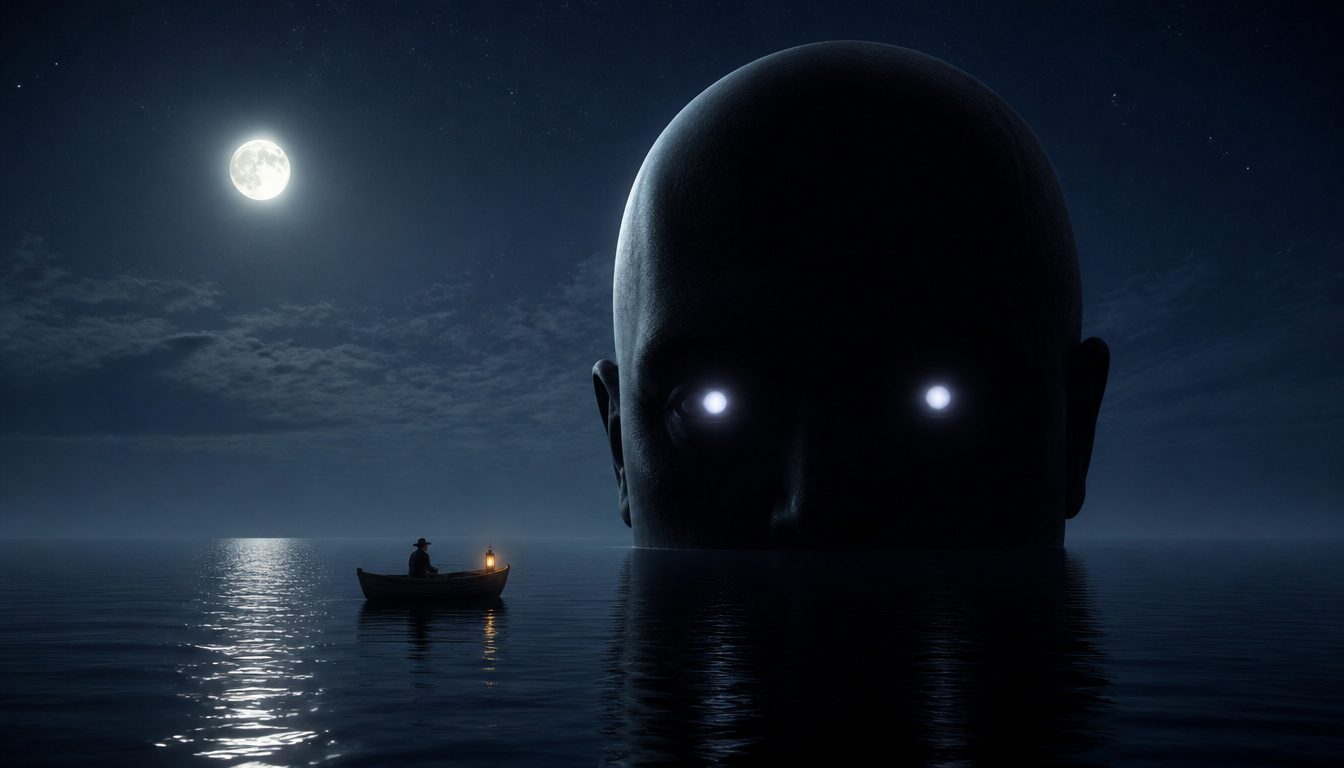
Illustration — Umibozu, the Japanese sea monk: a colossal dark bald head with glowing eyes rises from a moonlit sea beside a small boat. About our pictures
Nature spiritA vast, black, shaven-headed shape that rises out of a calm sea at night and towers over a boat. Sometimes it simply capsizes the vessel; sometimes it asks for a ladle and starts filling the boat with seawater. The trick, sailors said, is to hand over a ladle with the bottom knocked out.
At a glance
What is an umibōzu?
An umibōzu, or "sea monk", is a monster of the open sea. The name joins umi, sea, with bōzu, a Buddhist monk, and by extension anyone with a shaved, round head. Japanese dictionaries define it as a large, round-headed apparition that appears on the sea, known from the lore of sailors and fishermen. Other names include umi-nyūdō and umi-hōshi, which also mean "sea priest", and umi-kozō, "sea boy".
There is no single umibōzu. Reports from Japan's coasts describe a black shape rising beside a boat, a hairless head on a turtle's body, a giant that grows as you look up at it, a hairy wrestler, a ghost ship and a woman. What these versions share is the setting. The umibōzu meets people who are alone on the water, usually at night, and it is a danger to the boat itself.
Edo-period records
The umibōzu was already a subject for scholars' notebooks in the Edo period. Heibonsha's encyclopedia names the essay collections Saikai Zokudan and Kasshi Yawa among the works that record many examples. The Saikai Zokudan of 1758 describes a creature of the open ocean with the body of a soft-shelled turtle and a human head without hair, the largest five or six shaku long (roughly 1.5 to 1.8 metres). Fishermen who saw one caught nothing. If someone caught it and tried to kill it, it seemed to weep and beg for its life, and the writer adds that the Chinese called it the "monk fish".
Other writers saw something much larger. The Kii Zōdanshū, as summarised in the Nihon Daihyakka Zensho, tells of a black, shaven head bobbing in the waves a few metres from a boat, as big as five or six human heads together, with shining eyes, a long bird-like beak and a mouth about sixty centimetres wide. In the essay collection En'kyo Zatsuwa, the scholar Hio Keizan quotes an earlier account of something seen off the border of Awa and Tosa in Shikoku. It was about ten jō high, perhaps thirty metres, narrow at the top and wide at the base like a great Buddha statue, and it slowly faded away. The boatmen said this was an umibōzu, which appears on clear, calm days but is rarely seen.
Yanagihara Motomitsu recorded in his Kansō Jigo that near Kaizuka, on the coast of Izumi south of Osaka, an umibōzu sometimes came close to the shore. It was shaped like a person but huge, black as lacquer from head to foot, and showed half its body above the water. Families kept their children away from the rocks until it went back out to sea about three days later.
The bottomless ladle
The most famous umibōzu story is a request. A voice from the dark asks the crew to lend it a ladle, or a bailer. If they hand one over, the creature uses it to scoop seawater into the boat until the boat sinks. The answer, recorded again and again along the coasts, is to knock the bottom out of the ladle first.
Folklore surveys indexed in the Nichibunken database (the International Research Center for Japanese Studies) trace this rule from one end of the country to the other. A 1959 report from the Oki Islands says no one should go to sea on the sixteenth day of the Bon festival, because the umibōzu will ask for a ladle. A 1932 report from the Gotō Islands near Nagasaki gives the same warning about ghost ships and umibōzu. A 1956 entry in the Miyagi prefectural history, in the north-east, lists a bottomless ladle among the things a fishing boat should carry. Further reports come from Hamada in Shimane, Kumano in Mie, Ehime in Shikoku and Kunisaki in Ōita.
Heibonsha adds a second remedy: stroking the side of the boat with the stick used to smoke shipworms out of the hull. It also notes that umibōzu were said to appear most often on New Year's Eve and during Bon, the festival when the dead return. A 1991 report in the Shizuoka prefectural history makes that link explicit. Fishermen who met a ladle-begging umibōzu on the evening of the thirteenth day of Bon, the day the ancestors come home, took it as a sign of the ancestors' anger.
Many faces
Beyond the ladle, local stories go off in every direction. In Imabari, Ehime, the umibōzu was hairy and challenged people to sumo wrestling. A strong man who fought one saw it vanish at cockcrow, but he died three days later. Other Ehime reports say it can appear as a fireball or as a woman, and that a phantom umibōzu boat can be recognised because its mast has no pulley. Racing it is hopeless. In some places the umibōzu was even welcome: a report from the waters off Futagami island off Matsuyama describes a copper-coloured creature with round eyes and a short tail, and says that anyone who saw one would live long.
Several stories turn on a riddle. A 1913 report from Mihonoseki in Shimane tells of a boatman caught in a storm when an umibōzu climbed onto the bow and asked him what he feared most in the world. He answered that making a living was the most frightening thing of all. The creature vanished and the storm died away. The folklorist Miyamoto Tsuneichi recorded almost the same exchange on Suō-Ōshima in Yamaguchi in 1930, where the visitor was a one-eyed man who rose from the sea in the last month of the year.
On land, too, the umibōzu could appear. A 2005 report from Mihama in Aichi describes a man walking by the shore who told an acquaintance that a three-metre umibōzu haunted the area. "This big?" the acquaintance asked, and grew into one.
What was it?
Japanese scholars have offered several explanations, and they do not exclude one another. The folklorist Kitami Toshio, in Heibonsha's encyclopedia, suggests that some sightings were misperceptions of sea lions, dolphins, big waves or towering summer clouds, and that some were real glimpses of shipwreck victims, or stories about them. He argues that the deeper root is a fishermen's belief about muenbotoke, the dead who drowned at sea and have no one to mourn them. Many local reports agree. In Iwachi on the Izu Peninsula and in Takuma in Kagawa, the umibōzu is simply the spirit of the drowned. Inokuchi Shōji, in the Nihon Daihyakka Zensho, thinks the turtle-bodied version is a misidentified turtle, and he proposes that the umibōzu was once a sea god. In his view, as belief in it faded, only the fear remained.
A story recorded in Ehime in 1976 points the same way. When a fisherman's boat stopped dead in the water, his father told him to pour sacred sake into the sea as an offering to the sea god, and the boat moved again. The umibōzu, he was told, seizes boats when the sea god is angry.
The bottomless-ladle remedy is shared with the funayūrei, the ship ghosts of the drowned, and the two figures often blur in the records. The umibōzu is less a single creature than a name fishing communities gave to whatever loomed out of the dark water.
Frequently asked questions
What does umibōzu mean?
It means "sea monk". Bōzu is a Buddhist monk, and by extension anyone with a shaved, round head, which describes the creature's usual bald, black, dome-shaped head. Other names include umi-nyūdō and umi-hōshi.
What do you do if you meet an umibōzu?
The best-known rule is that if it asks for a ladle, you give it one with the bottom knocked out, so it cannot fill your boat with water. Other local remedies include throwing the most precious thing on board into the sea, scattering miso, or stroking the boat with a particular stick.
Is the umibōzu a ghost?
Sometimes. Many coastal communities said it was the spirit of people drowned at sea. Others treated it as a sea creature or a degraded sea god, and in a few places seeing one was even lucky.
Is the umibōzu real?
There is no evidence of a real creature. Japanese folklorists suggest that sightings may have come from sea lions, dolphins, turtles, waves or clouds seen in poor light, combined with fishermen's fears about the dead at sea.
What is the difference between umibōzu and funayūrei?
Funayūrei are ship ghosts, the dead who try to drag the living down with them. Umibōzu are usually described as a single giant figure. Both ask for ladles in many local stories, and the records often use the two names for the same experience.
Sources & further reading
- Umibōzu entries in the *Nihon Kokugo Daijiten*, Heibonsha *Sekai Daihyakka Jiten* (Kitami Toshio), *Nihon Daihyakka Zensho* (Inokuchi Shōji) and Britannica Japan (Kotobank)
- Nichibunken Kaii/Yōkai Densho Database: all *umibōzu* records
- Nichibunken record 3200030: *Saikai Zokudan*, the turtle-bodied umibōzu
- Nichibunken record 3360009: *En'kyo Zatsuwa*, the giant off Awa and Tosa
- Nichibunken record 3550019: *Kansō Jigo*, the black umibōzu of Kaizuka
- Nichibunken record 1320008: the ladle at Bon, Oki Islands (1959)
- Nichibunken record 1230178: ghost ships and ladles, Gotō Islands (1932)
- Nichibunken record C0410205-000: the bottomless ladle, Miyagi prefectural history (1956)
- Nichibunken record C0222232-000: the ancestors' anger at Bon, Shizuoka prefectural history (1991)
- Nichibunken record 0200167: the sumo-wrestling umibōzu, Imabari (1985)
- Nichibunken record 0200169: fireballs, women and the ladle, Ehime (1985)
- Nichibunken record 0200170: the umibōzu ship, Ainan, Ehime (1985)
- Nichibunken record 0080200: long life for those who see it, Matsuyama (1968)
- Nichibunken record 0640030: "what do you fear most?", Mihonoseki (1913)
- Nichibunken record 1230086: Miyamoto Tsuneichi, Suō-Ōshima (1930)
- Nichibunken record 2130269: "this big?", Mihama, Aichi (2005)
- Nichibunken record 1400057: the drowned, Iwachi, Izu (1961)
- Nichibunken record 2363180: the spirits of the drowned, Takuma, Kagawa (1973)
- Nichibunken record 2181027: throw the most precious thing overboard, Sumoto (1939)
- Nichibunken record 0780067: scattering miso, Niigata (1937)
- Nichibunken record 0200060: sake for the angry sea god, Ehime (1976)
- Wikipedia: Umibōzu (pointer to further reading)
- nichibun.ac.jp — YoukaiDB