Oni
鬼
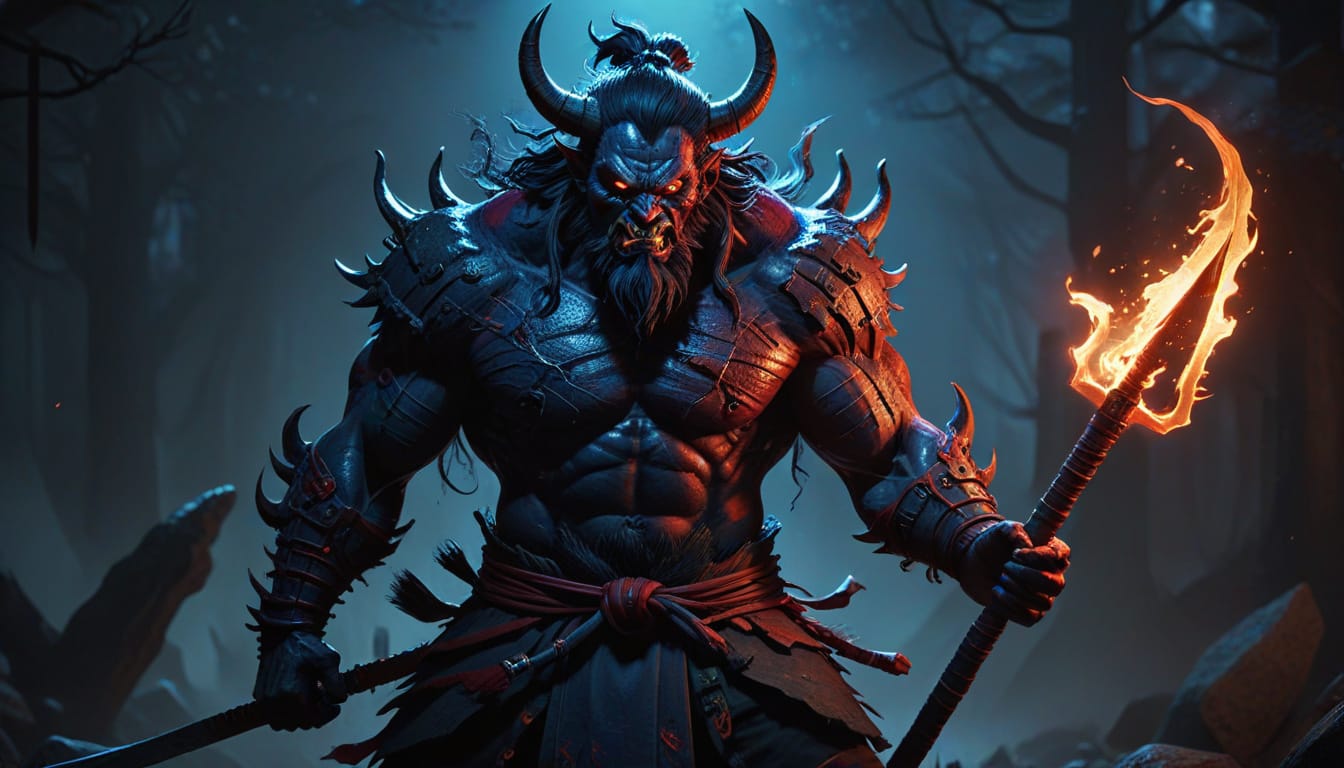
Illustration — Oni, the Japanese demon: a horned, muscular blue-skinned ogre with glowing red eyes grips a flaming spear in a dark forest. About our pictures
DemonFearsome demon-like beings with horns, sharp claws, and wild hair. They carry iron clubs and are known for their immense strength and cruel nature. Often depicted with red or blue skin.
At a glance
What is an oni?
The oni is the great monster of Japanese tradition, the figure English usually translates as "demon" or "ogre." In its most familiar form it is a huge, horned, wild-haired brute with fangs and claws, red or blue skin, a loincloth of tiger skin and an iron club. That picture is so fixed today that it appears on festival masks, roof tiles and children's picture books all over Japan.
But the oni was not always this creature, and it was never only a villain. The Kokugakuin University Encyclopedia of Shinto describes the oni as a misshapen supernatural visitor from the other world who can bring either disaster or blessing, and therefore one that was both feared and worshipped. Over more than a thousand years the word has covered invisible spirits of plague, vengeful ghosts, the jailers of the Buddhist hells, outsiders on the margins of society, and masked deities who visit villages at the New Year. Understanding the oni means following how these strands came together.
Appearance and powers
The classic oni is a giant with one or two horns, bulging eyes, a wide fanged mouth and a mane of hair. It is enormously strong and, in many stories, eats people. Heian-period tales repeatedly describe oni devouring a victim in a single mouthful, a motif known in Japanese as oni hitokuchi, "the oni's one bite." Oni can also fly, vanish, and take human form to deceive their prey; a disguised oni is a common turn in the legends below.
The details of its costume carry a curious explanation that is often repeated. The northeast was considered the unlucky "demon gate," kimon, through which evil entered, and in the old system of directions it lies between the Ox and the Tiger, ushitora. One hypothesis holds that the oni's ox-like horns and tiger-skin loincloth are a visual pun on that direction. Whether or not it began that way, the belief in the demon gate had real effects: the northeast corners of the walls of the Kyoto Imperial Palace are notched inward to ward off oni, and Enryaku-ji on Mount Hiei, which lies northeast of Kyoto, is often said to guard that gate, though some historians doubt that the temple was sited for this reason.
Origins and history
The character 鬼 comes from Chinese, where it is read gui and refers to the spirit of a dead person. The Japanese word oni has a separate history. The tenth-century dictionary Wamyō ruijushō explained it as coming from on, "hidden," because oni conceal themselves and do not wish to be seen. That fits the oldest layer of belief, in which oni were invisible bringers of disease, death and disaster, and only later took on visible, monstrous bodies.
Oni appear in Japan's earliest writings. The Izumo no kuni fudoki, a provincial gazetteer of the early eighth century, tells of a one-eyed oni that ate a man. The Nihon Shoki (720) records that in 661, on the night after Empress Saimei died at Asakura in Kyūshū, a demon wearing a great hat was seen on the top of Mount Asakura looking down on her funeral, to the wonder of all the people. The same chronicle mentions the use of peaches to ward off evil spirits, a Chinese belief that also echoes in later oni tales.
Buddhism reshaped the oni profoundly. Merged with Indian demons such as the rakshasa and yaksha, oni became the wardens of hell who torment the dead on the orders of King Enma, and the horse-headed and ox-headed hell guards, mezu and gozu, joined their ranks. Paintings of the hells gave the oni much of its now-standard look. The Noh theatre added another layer: its founder Zeami wrote that oni on the stage are either vengeful spirits that possess the living or demons of hell. The jealous woman transformed into a horned demon, represented by the hannya mask, comes from this tradition.
The Encyclopedia of Shinto also points to a social dimension. People on the edges of the Japanese world, such as foreign arrivals, rebels, bandits, mountain dwellers and wandering ritual specialists, were at times called oni. A thirteenth-century collection, the Kokon chomonjū, describes castaways who landed on an island off Izu as "demons" with wild hair and dark red bodies.
Famous legends
Shuten-dōji. The most famous oni is Shuten-dōji, the "sake-drinking boy," who lived with his band of demons on Mount Ōe northwest of Kyoto, raiding the capital and carrying off young women. The court sends the warrior Minamoto no Raikō (Yorimitsu) with a small band of companions. The gods of three great shrines give them a magic sake, a cord and a helmet. Welcomed into the demon's fortress, the heroes share the drugged sake, and when Shuten-dōji falls into a stupor they cut off his head, which flies at Raikō but is stopped by the helmet. The story was popular by the late fourteenth century, when the oldest surviving illustrated scroll was painted, and a rival version sets it on Mount Ibuki.
Ibaraki-dōji and the severed arm. One of Raikō's companions, Watanabe no Tsuna, is remembered for fighting the oni Ibaraki-dōji, at the Rashōmon gate of Kyoto in some versions and at the Modoribashi bridge in others. Tsuna cuts off the demon's arm and keeps it as a trophy. Later the oni returns disguised as Tsuna's aged aunt, asks to see the arm, and snatches it back before flying away. Ukiyo-e artists such as Kuniyoshi and Yoshitoshi made the encounter a favourite subject.
Momotarō. In the folk tale beloved of every Japanese child, a boy born from a giant peach sets out with a dog, a monkey and a pheasant to raid Onigashima, the island of the oni, and returns with their treasure. Here the oni has become a straightforward villain for a children's adventure.
Setsubun and the oni in folk practice
Every year at Setsubun, the day before the traditional start of spring in early February, households and temples across Japan throw roasted soybeans while shouting "Oni wa soto, fuku wa uchi!" ("Oni out, good fortune in!"). The custom grew out of tsuina, an exorcism rite of Chinese origin practised at the ancient court, in which a masked exorcist drove out the demons of pestilence. Over time tsuina was absorbed into Buddhist New Year ceremonies and became tied to Setsubun, and bean-throwing as the standard way of chasing out oni is said to have spread from aristocrats and samurai in the Muromachi period.
Not every oni of folk ritual is driven away. The Encyclopedia of Shinto describes a third type of oni as good kami, seen in New Year rites where costumed "oni" dancers stamp and drive out evil to bring blessings. Oni-faced roof tiles, onigawara, are set on temple and house roofs to keep misfortune away. In Akita Prefecture, the masked namahage who visit homes on New Year's Eve to scold lazy people and bless the household look much like oni, but tradition regards them as incarnations of the mountain deities. The custom was inscribed by UNESCO in 2018 as part of Raihō-shin, ritual visits of deities in masks and costumes.
In modern popular culture
Modern oni have grown less frightening. They appear as gruff guardians, comic villains and even heroes in manga, anime and games, from the spirit-world staff of YuYu Hakusho to the playable oni Arataki Itto in Genshin Impact. Setsubun shops sell paper oni masks for children, and the oni in modern picture books is often more lovable than terrifying, a long way from the hidden plague-bringer of the earliest texts.
Frequently asked questions
What is the difference between oni and yokai?
Yokai is the broad umbrella term for the strange and supernatural beings of Japanese folklore, and oni are one kind of yokai. Oni form an unusually old and distinctive group, rooted in ancient spirit belief and the Buddhist hells, and some traditions treat them as kami rather than mere monsters.
Are oni evil?
Most legends cast oni as violent man-eaters, but not all. Scholars of Shinto describe them as ambivalent beings able to bring disaster or blessing, and oni figures appear as protectors on roof tiles and as good spirits in some New Year rituals.
Why do people throw beans at oni?
At Setsubun, people scatter roasted soybeans and shout "Oni out, good fortune in!" to drive misfortune from the home before spring. The rite descends from the ancient court exorcism called tsuina.
Why do oni wear tiger-skin loincloths?
One often-repeated explanation links the oni to the northeast "demon gate," a direction named after the Ox and the Tiger. On this view the oni's horns and tiger skin are a picture of that unlucky direction, though it remains a hypothesis rather than an established origin.
Sources & further reading
- Oni, Encyclopedia of Shinto, Kokugakuin University
- Oni (Wikipedia, used as a pointer to primary texts)
- Nihongi, tr. W. G. Aston, vol. 2 (Internet Archive)
- Shuten dōji, JAANUS dictionary of Japanese art, Columbia University
- Yoshitoshi, Watanabe no Tsuna and the Demon of Rashōmon (Allen Memorial Art Museum, Oberlin)
- Watanabe no Tsuna (Wikipedia)
- Namahage Museum: What Are the Namahage? (Japan Tourism Agency)