Kodama
木霊
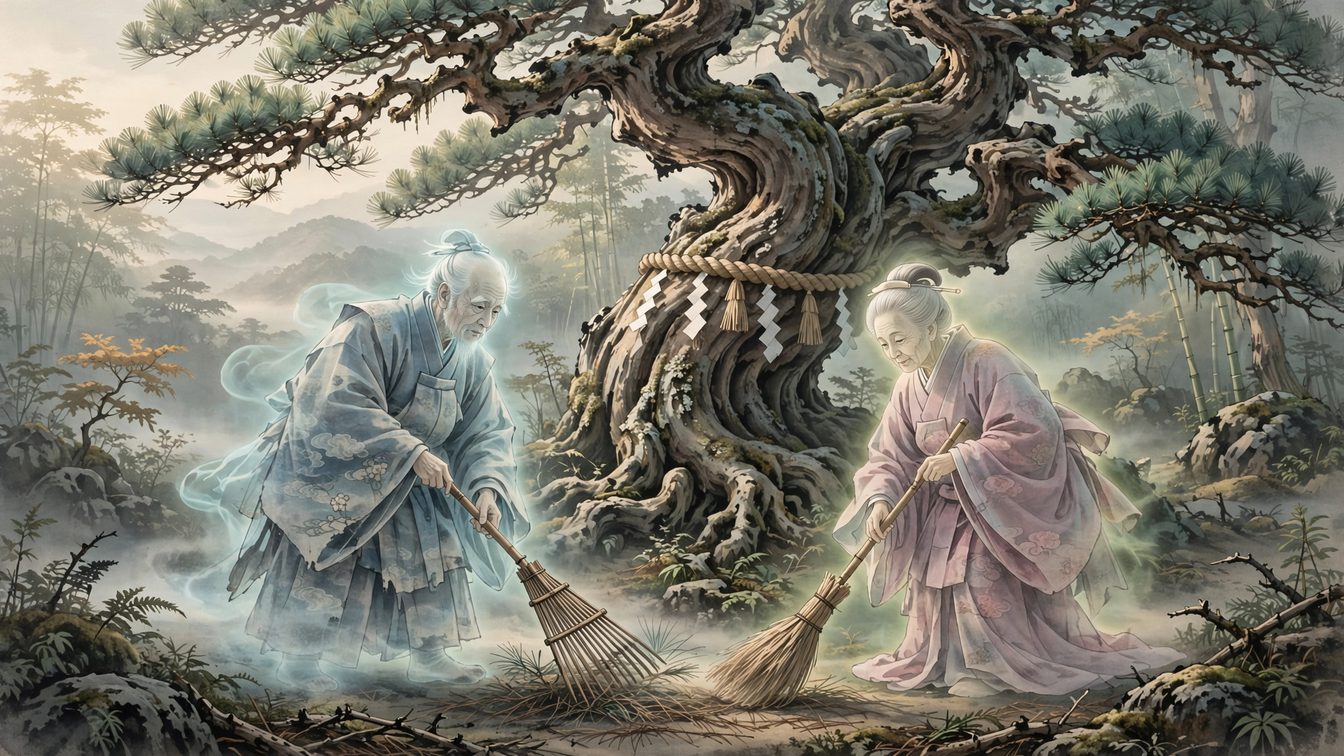
Illustration — Kodama, the Japanese tree spirits: a glowing elderly man with a rake and woman with a broom sweep beneath an ancient pine bound with a sacred rope. About our pictures
Nature spiritThe spirit that dwells in an old tree. Fell such a tree, and misfortune may follow - which is why ancient trees are often bound with sacred straw rope. The word kodama also means 'echo', the voice that seems to answer back from the forest.
At a glance
What is a kodama?
Kodama (木霊, also written 木魂 or 木魅) is the spirit that lives in a tree. The same word also means "echo," the voice that seems to answer from a mountain or a valley. Japanese dictionaries give both senses, and they are closely linked. People once believed that when a shout came back from a forested hillside, it was the spirit of the trees answering.
Kodama are among the oldest supernatural beings named in Japanese writing. They have no single shape and no fixed story. They are less a creature than an idea: that an old tree is a living presence, that cutting it down is dangerous, and that the forest can talk back.
Kodama in early Japan
The word appears very early. The tenth-century dictionary Wamyōshō glosses the characters 樹神, "tree god," with the native reading kotama. The Engishiki, a body of court regulations completed in 927, lists a ritual for the kodama and the mountain god to be held when trees were felled to build the ships that carried Japanese envoys to Tang China. Even in an official state project, cutting great trees meant asking permission of the spirits that lived in them.
By the Heian period the kodama had become something eerie. In the "Tenarai" chapter of The Tale of Genji, written in the early eleventh century, a mysterious stranger raises the suspicion that something like a fox or a kodama has taken a human form to deceive people. Centuries later, Yoshida Kenkō's Tsurezuregusa, from the fourteenth century, remarks in its 235th section that in a house where nobody lives, kodama and other strange shapes will appear. In these texts the kodama is not a friendly forest sprite. It is one of the vague, unsettling things that move into empty places.
The echo
The second meaning of kodama, "echo," is attested almost as early. A poem in the Kamo-jo shū, a private poetry collection from the late tenth century, already uses kotama for a sound that comes back. In 1603–04 the Jesuit Vocabulario da Lingoa de Iapam, a Japanese–Portuguese dictionary, defines cotama simply as yamabiko, the mountain echo.
The Sekai Daihyakka encyclopedia explains that echoes were originally thought to be made by the spirits living in mountain trees. The Nipponica encyclopedia adds that an echo was understood as a mountain spirit answering a human voice, and that mountain gods, tengu, wild "mountain men" and the trickster amanojaku were all said to mimic people. The Edo scholar Kitamura Intei went further and wrote in his essay collection Kiyū shōran that the kodama was simply a tengu. A 1929 article in the folklore journal Tabi to densetsu even suggested that Hitokotonushi, a god in the Kojiki who mirrors exactly what the emperor does, might be a deified echo, since the mountain opposite you does the same. Kabuki even turned the echo into stage music: two small drums played in alternation, called kodama, signal that a scene is set deep in the mountains.
Respect for old trees
The most practical side of kodama belief concerns tree-felling. Dictionaries and folklore records describe the same basic rule in many places: very old trees are inhabited, and cutting one carelessly invites a curse.
Regional customs show how people dealt with this. On Hachijō-jima and Aogashima, islands south of Tokyo, large leafy trees were said to hold kidama-sama or kodama-sama. Cutting such a tree was thought to bring a curse, so woodcutters left one standing. On Aogashima, the spirit was ceremonially shaken out of the timber at a house's roof-raising. In Ikeda, Tokushima Prefecture, a record collected for Nichibunken's yokai database describes a rite called kodama-nuki, "drawing out the kodama." Before cutting a tree over a hundred years old, people cut one of its small branches and laid it across to another tree, so the spirit could move out first.
In Okinawa the comparable tree spirit is the kijimun, said to live in old banyan trees. Nipponica describes it as child-like, and says it brings good fishing to anyone who makes friends with it.
The kodama mouse
Hunters in the mountains of northern Japan had a darker kodama of their own. Among the matagi, the traditional bear hunters of Akita and the surrounding region, the kodama-nezumi, or "kodama mouse," was a bad omen. Records in the Nichibunken database say that hearing its body burst with a bang like a gunshot meant poor hunting, an angry mountain god, or even an avalanche, and hunters would abandon the hunt and come down from the mountain. One legend explains that the mice were once a band of hunters of the "Kodama group." They turned away a woman who came to their hut on a snowy night. She was the mountain god in disguise, and she turned them into mice. A 1956 Miyagi prefectural history suggests that the real animal was the Japanese dormouse, yamane, which hibernates curled into a ball.
Sekien's kodama
The Edo artist Toriyama Sekien included the kodama, written 木魅, in his illustrated yokai catalogue Gazu Hyakki Yagyō of 1776. His picture shows no monster at all. An old man with a rake and an old woman with a broom stand among gnarled pines. The inscription says that a tree a hundred years old has a god in it, which shows itself in visible form. The elderly couple sweeping beneath pine trees recall Jō and Uba, the spirits of the paired pines in Zeami's Noh play Takasago. In Sekien's hands the kodama is a quiet, dignified presence, a sign of a tree's great age.
Kodama in modern culture
Most people outside Japan know the kodama from Studio Ghibli's Princess Mononoke, released in July 1997. Its kodama are small, pale, round-headed figures that fill the trees of an ancient forest and rattle their heads. That look belongs to the film, not to older art, but the idea behind it, that a healthy old forest is full of spirits and that cutting it down has a cost, is very close to the old belief.
Frequently asked questions
What does kodama mean in Japanese?
Kodama means both "tree spirit" and "echo." The two senses are linked by an old belief that echoes from forested mountains were the voices of the spirits living in the trees.
Are kodama good or evil?
Neither, exactly. In Heian literature the kodama is an eerie thing that might deceive people or haunt an empty house. In folk belief it is a spirit that must be respected, and it can bring misfortune to anyone who cuts down its tree carelessly.
What happens if you cut down a tree with a kodama?
Folklore says it brings a curse or bad luck. Some communities performed rites before felling old trees, such as passing a branch to a neighbouring tree so the spirit could move out first.
Are the kodama in Princess Mononoke from real folklore?
The name and the idea come from folklore. The rattling white figures are Studio Ghibli's design. Earlier pictures, such as Toriyama Sekien's of 1776, showed the kodama quite differently, as an elderly couple beneath pine trees.
How old is the kodama legend?
Very old. The Wamyōshō dictionary of the tenth century records the word, the Engishiki of 927 prescribes a ritual for kodama when trees were felled, and The Tale of Genji mentions them in the early eleventh century.
Sources & further reading
- Kodama entries (Kotobank: Nihon Kokugo Daijiten, Sekai Daihyakka, Nipponica, Britannica)
- Nichibunken yokai database: *kodama-nuki*, Ikeda, Tokushima
- Nichibunken: the kodama mouse and the matagi (Miyagi prefectural history)
- Nichibunken: the Kodama hunters turned into mice
- Nichibunken: the kodama mouse as an ill omen, Akita (1937)
- Nichibunken: Hitokotonushi as a deified echo (1929)
- Nichibunken: *Kiyū shōran* equates kodama with tengu
- Toriyama Sekien, *Gazu Hyakki Yagyō*, Library of Congress
- Toriyama Sekien's kodama (Wikimedia Commons image)
- National Diet Library Image Bank: Toriyama Sekien's yokai books
- Takasago Shrine and the pine spirits Jō and Uba (Japan Tourism Agency multilingual database)
- *Princess Mononoke*, Studio Ghibli (official, Japanese)
- Kodama (Wikipedia, used as a pointer)
- en.wikipedia.org — Kodama (spirit)
- yokai.jp — kodama
- yokai.jp — gazu-hyakki-yakou