Kappa
河童
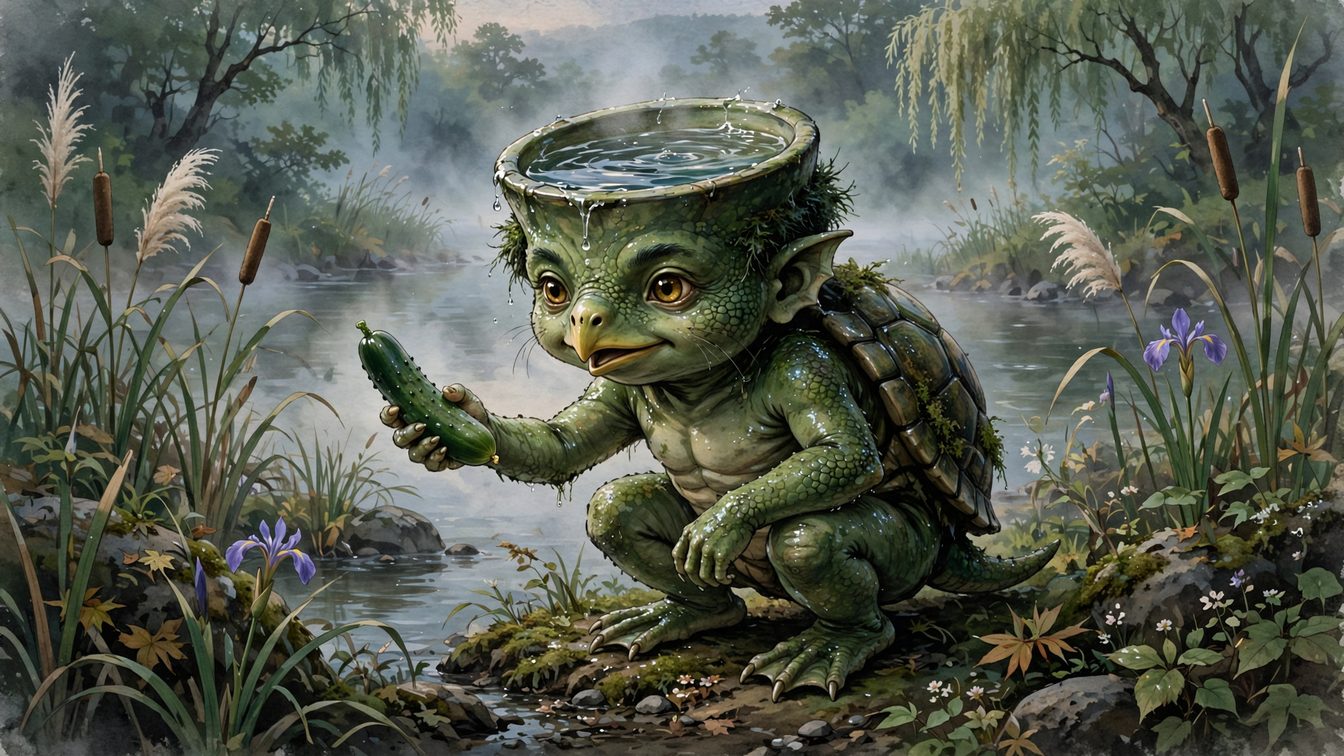
Illustration — Kappa, the Japanese river creature: a small green scaly kappa with a turtle shell and water-filled head dish offers a cucumber by a misty river. About our pictures
Nature spiritWater-dwelling creatures resembling humanoid turtles with a water-filled dish on their heads. Known for their love of cucumbers and their dangerous habit of challenging humans to wrestling matches or pulling victims underwater.
At a glance
What is a kappa?
The kappa is Japan's best-known water yokai: a child-sized creature said to live in rivers, ponds and lakes, which could drag people and animals into the water to drown them. The name is written 河童, usually glossed as "river child," but it was never the only one. Across Japan the same kind of being was called kawatarō ("river boy"), kawako, gatarō, enkō in parts of Shikoku and western Honshū, hyōsube in southern Kyūshū, and many other local names. Edo-period scholars writing in a learned, Chinese-influenced style often used suiko, "water tiger."
What unites these creatures is less a fixed body than a set of habits: they live in fresh water, they are dangerous to swimmers, horses and cattle, and they are oddly bound by rules of courtesy and promise-keeping. That mixture of menace and good manners is what makes the kappa so memorable.
Appearance and powers
The classic kappa of Edo-period descriptions is about the size of a young boy, greenish or yellowish, scaly or slimy, with webbed hands and feet, a snout or beak, a shell on its back like a turtle's, and a fringe of hair around the top of its head. In that bare crown sits its most famous feature, a shallow hollow called the sara, or "dish," which holds water. As long as the dish stays full, the kappa is strong, on land as well as in water. If the water spills or dries up, it weakens and, in some tellings, may even die.
Not every kappa looked like this. Older images were often hairy and ape-like, while later ones became more turtle- or frog-like, and different regions had their own versions. The variety is a reminder that the "standard" kappa is partly a product of Edo-period encyclopedias and pictures, which gathered scattered local beliefs into a single recognisable creature.
Kappa were credited with great strength for their size. They loved sumo and would challenge passers-by to wrestle, and they were said to pull horses and cattle into the water as well as people. The most gruesome belief concerned the shirikodama, an imaginary organ that the kappa was said to pull out of its victims through the anus, leaving them dead or senseless. Kappa were also said to dislike iron and other metals, as well as sesame and deer antler.
Origins and history
Where the kappa came from is not settled. The great folklorist Yanagita Kunio argued that it was a fallen water deity, a suijin once worshipped and later reduced to a goblin as belief in it faded, and Michael Dylan Foster's study of the kappa likewise describes it as a once malicious water deity. Other scholars have pointed to Chinese river-god traditions, especially in the kappa's habit of dragging horses into the water; Orikuchi Shinobu suggested that the head-dish might derive from the hat of a rice-field deity. Kappa beliefs also served a very practical purpose. Stories of a creature lurking in the water warned children away from deep pools and fast rivers, and that use continues in the warning signs still seen near water in some towns.
The written record of the kappa as we know it belongs largely to the Edo period (1603–1868). The illustrated encyclopedia Wakan sansai zue (1712) describes the kawatarō as a creature that steals crops and attacks cattle. Naturalists and scholars of the period collected kappa reports eagerly: Suiko kōryaku (1820) gathered kappa anecdotes with illustrations, and the illustrated sheet Suiko jūnihin no zu shows twelve kinds, some of them turtle-like. Edo collections of strange tales, comic paintings and the occasional ukiyo-e print all featured them.
Famous legends
The kappa and the bargain. The most widespread kappa tale is a story of capture and release. A kappa tries to drag a horse into a river and loses: it is caught, or its arm is cut off. To win back its freedom or its arm, the kappa makes a bargain. Often it swears never again to harm the people or animals of that village, sometimes in a written pledge; in many versions it teaches its captor a secret medicine for setting bones or healing wounds. Some old families and temples still say they hold such a pledge, a recipe, or the kappa's preserved hand. One early written example appears in the Seiban kaidan jikki of 1754, and Ushiku Pond in Ibaraki Prefecture is known for a version in which a kappa reunited with its severed hand gives a healer its recipe for a wonder salve.
The bowing kappa. Kappa are said to be extremely polite. The standard way to escape one is to bow deeply: the kappa must bow back, the water spills from its dish, and it is left helpless until someone refills it. The same trick is said to work before a sumo bout.
Kusenbō and the kappa of Kyūshū. The rivers of northern Kyūshū are especially rich in kappa lore. Legend makes Kusenbō a kappa chief said to command nine thousand followers, and around the Chikugo River the kappa are tied to the Suitengū water shrine in Kurume. In the same region a music-and-dance tradition known as kappa-gaku is said to appease the spirits of the Heike warriors defeated at the end of the twelfth century.
Regional traditions and offerings
The kappa's favourite food is the cucumber, and people gave it cucumbers to keep it friendly. In Edo-period Edo they floated cucumbers down the rivers to appease the kappa, and offerings of cucumbers are still made at some shrines. The cucumber sushi roll is called kappa-maki for the same reason.
In Tōno, Iwate Prefecture, the town made famous by Yanagita Kunio's Tōno monogatari (1910), kappa are part of local identity. The book records local accounts of kappa preying on women, and a stream behind Jōken-ji temple, known as Kappabuchi, is said to be the creatures' home. The Tōno tourism association notes a small shrine to the kappa beside the stream, where expectant mothers leave red cloth offerings as they pray to be able to nurse their babies.
In Aomori, the kappa is worshipped as a deity under the name Suiko-sama. These places preserve the older, sacred side of the kappa, closer to the water god Yanagita had in mind than to the cartoon.
In literature and popular culture
Over the twentieth century, the kappa went from a feared drowner to one of Japan's friendliest mascots, a process Michael Dylan Foster has traced in detail. Akutagawa Ryūnosuke's satirical novella Kappa (1927) follows a man who stumbles into a kappa country and uses it to mock human society. After the Second World War the cartoonist Shimizu Kon drew a charming, rounded kappa that spread a cute image of the creature, and a kappa family he created became the mascot of the Kizakura sake brewery from the mid-1950s. Tokyo's kitchenware district, Kappabashi, has a local legend that kappa helped build its bridge, though the name is usually traced to a merchant called Kappaya Kihachi.
Kappa remain favourites in manga and anime, from the yokai of Mizuki Shigeru, whose kappa bronze statues line Mizuki Shigeru Road in Sakaiminato, to Keiichi Hara's 2007 film Summer Days with Coo, about a boy who befriends a young kappa.
Frequently asked questions
What does a kappa's dish do?
The sara, a water-filled hollow on top of the kappa's head, is the source of its strength. While the dish holds water, the kappa is powerful even out of the river; if the water spills, it becomes weak or helpless until the dish is refilled.
Why do kappa like cucumbers?
Folklore simply makes the cucumber the kappa's favourite food, and people offered cucumbers to win its goodwill or keep it from harming swimmers. In Edo, cucumbers were floated down rivers for the kappa, and the cucumber sushi roll is called kappa-maki after it.
How do you defeat a kappa?
The classic method is to bow to it. Kappa are extremely polite and must return the bow, which spills the water from their dish and leaves them powerless. Kappa were also said to dislike iron and sesame.
Are kappa real?
Kappa are creatures of folklore, not a known animal. Some temples and families keep relics said to be kappa hands or mummies. These belong to the tradition rather than proving it: none has been confirmed as an unknown animal, and one is thought to be made from whale bone.