Daidarabotchi
ダイダラボッチ
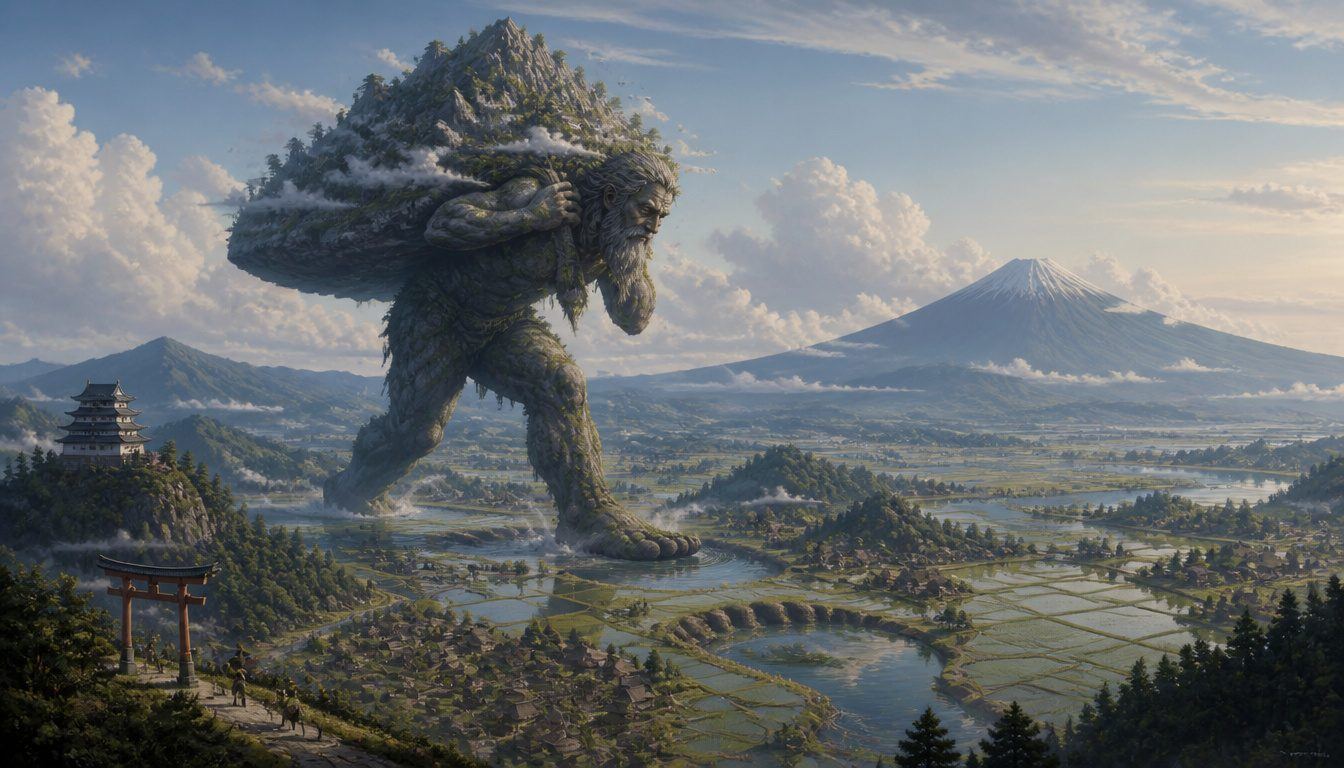
Illustration — Daidarabotchi, the Japanese giant: a bearded mossy colossus carries a mountain on his back across rice paddies, Mount Fuji behind. About our pictures
Nature spiritA giant so huge that its footprints became ponds and its handfuls of earth became mountains. In local legend it carried peaks on its back, scooped out lakes, and left hollows across the countryside where it once stepped.
At a glance
What is the Daidarabotchi?
The Daidarabotchi (ダイダラボッチ, also written 大太法師) is a giant of Japanese place-name legend. It is so large that its footprints became ponds and the earth it dropped became hills. It does not hunt people or haunt houses. Its stories exist to explain the shape of the land: why a hollow fills with water, why a round hill stands alone in a plain, why a valley has no wisteria.
The name comes in many forms. The Nihon Kokugo Daijiten lists daidabotchi, daidabō, daidahōshi and daidaibotchi. Heibonsha's Sekai Daihyakka adds Dadabō and Deirabō. The Nipponica encyclopedia gives Daitarabotchi, Daitarabō, Dirabotcha, Dirabō, Dendenbome and Tadabō. Heibonsha says the stories are spread mainly across the Kantō and Chūbu regions of eastern Japan. In southern Kyushu a similar giant is called Ōhito Yagorō.
A giant in the Hitachi Fudoki
Japan's oldest written giant of this kind is not called Daidarabotchi at all. He is simply "a person" in the Hitachi no Kuni Fudoki, the gazetteer of Hitachi Province (modern Ibaraki). The gazetteers were ordered by the court in 713. Britannica's Japanese encyclopedia says the Hitachi text was probably finished around 723. The Yamakawa dictionary of Japanese history argues that it was sent in soon after the 713 order.
In its entry for Naka District, the gazetteer describes a hill called Ōkushi. A page published by the Kantō Regional Agricultural Administration Office quotes the passage in a Japanese reading. Roughly translated:
"Twelve ri west of the Hiratsu post station there is a hill called Ōkushi. In ancient times there was a person whose body was extremely tall. While staying on top of the hill, his hand could reach the clams on the seashore. The shells of what he ate piled up and became a hill. People of that time took the sense of 'great decay' (ōkuchi), and it is now called the hill of Ōkushi."
The story fits a real place. The Ōgushi shell mound in Mito, a national historic site, is an Early Jōmon midden of clams, oysters and other shells. Nipponica and the Kōdansha guide to national historic sites both identify it with the gazetteer's hill. They call it the oldest record of a Jōmon shell mound in any written source. By the eighth century the coast lay far away, which may be why heaps of shells inland were explained as the leftovers of a giant's meal.
Mito City has made the giant the centrepiece of the Ōgushi Shell Mound Park. The city's page describes a statue called "Daidarabō" standing 15.25 metres tall. The modern name has been attached to the old gazetteer's nameless giant.
Other early texts have giants too. Heibonsha quotes the Harima no Kuni Fudoki, the gazetteer of Harima Province. It tells of a giant whose many footprints turned into marshes. Britannica's entry on giant tales notes another giant in the same text who had to walk bent over, because there was too little room between heaven and earth. The Nihon Kokugo Daijiten also names Dōjō Hōshi, a monk of great strength in the ninth-century Buddhist tale collection Nihon Ryōiki, as the ancestor of the later Daidabotchi. Heibonsha adds that a twelfth-century diary, the Taiki, records a well Dōjō Hōshi scratched out with his nails and his footprints at Ishiyama-dera. It sees this as an echo of Daidarabotchi stories.
Footprints, hills and broken ropes
Most Daidarabotchi tales follow a few patterns. Britannica describes giant footprints across Kantō, Chūbu and other regions. It also describes a common story in which the giant carries a mountain tied up with wisteria vines. The vine snaps and the dropped earth becomes a hill. The folklore records collected in the Kaii-Yōkai Densho Database of the International Research Center for Japanese Studies (Nichibunken) are full of local versions.
- In Murayama, in western Tokyo, a 1927 article in the journal Minzoku reported a round hill called Maruyama. It was said to be the giant's load, which fell when his wisteria carrying-rope broke as he got up from a rest. The same report mentions a well said to be his footprint.
- In Gotemba, Shizuoka, a 1975 survey recorded that the giant tied a mountain with wisteria vines, meaning to put it on top of Mount Fuji. The vine broke at Ashigara and the mountain became Yagura-dake. That is why no wisteria grows there.
- The Kanagawa Prefectural History (1977) tells of Daidarabotchi carrying Mount Fuji east into Sagami. He could not lift it again after a rest, the rope broke, and the footprint he left became the pond of Kanuma.
- In Ōta, Gunma, the giant is called Dettarabotchi. He sat on Mount Akagi and washed his feet in the Tone River. His footprints became two ponds, and a hill called Maruyama is the ash from his pipe.
The Nihon Kokugo Daijiten sums up the same set of motifs. The giant built Mount Fuji in a single night, sat on Mount Haruna to wash his feet in the Tone, and left footprints that became ponds. Nipponica adds one from Sagami, in today's Kanagawa. According to the essay collection Matsunoya hikki, the great marsh of Sagamino was the hollow left when Daidarabotchi braced himself to lift Fuji. There was no wisteria nearby because he had stripped it all for rope.
Mount Fuji and Lake Biwa
The best-known Daidarabotchi story is not a folk report but an Edo-period book. Heibonsha and Nipponica both cite the Kidan isshō. In it a giant called Daidahōshi dug up all the earth of Yoshitsumi District in Ōmi and loaded it into a carrying basket. He walked three and a half paces east and tipped the basket out. The hole became Lake Biwa and the pile of earth became Mount Fuji.
This is a legend, not geology. It is a good example of how the giant works in Japanese storytelling, though. Two of the country's most famous landmarks become a single afternoon's labour.
The word was also used as an insult and a joke. The Nihon Kokugo Daijiten's earliest example comes from the preface of a comic sharebon book of 1780, which pits Fuji against a "Daida-bōshi" in a contest of height. By 1841 the essayist of Yōshabako explained daidabotchi as a jibe at a big man, the opposite of Issun-bōshi, the one-inch boy of the fairy tale.
Daita, Tokyo, and Yanagita Kunio
The giant's best-known footprint may be in Tokyo. Heibonsha's Mypedia says that the place name Daita, in Setagaya Ward, is said to come from the legend. Nipponica gives more detail. Until fairly recently a long hollow of about two tan (some 2,000 square metres) lay near the Daita Yakushi temple. It was called the giant's footprint, and local people said he had built Daitabashi bridge. Britannica says there were two footprint sites in Daita, left as the giant strode across.
The folklorist Yanagita Kunio made the Daidarabotchi a serious subject. His essay Daidarabō no ashiato ("The Footprints of Daidarabō") appeared in the April 1927 issue of the magazine Chūō Kōron, pages 141 to 158, according to the National Diet Library's contents listing. It was later reprinted in volume 5 of his collected works. Nipponica says that Yanagita argued tara in the name was a term of respect for a person of high rank. Heibonsha records a rival idea, that the name comes from tatara, the foot bellows of a smelting furnace. It concludes that neither explanation has been settled.
Fallen gods or tall tales?
Both major encyclopedias read the giant in the same way. Heibonsha's Hanabe Hideo suggests that the giant was once a creator figure, believed to have shaped the land. As that belief faded, it shrank into a strong man, a big lout or an oni. Nipponica's entry on giant legends makes the same argument. In early Japan gods were imagined as huge, which is why they could make heaven and earth. It points to the creation of the islands by Izanagi and Izanami and the land-pulling myth of Izumo as giant stories of the same kind. As reverence weakened, the giant turned comic.
The comedy is real. Nipponica describes the Japanese giant as a figure with a touch of the ridiculous, and many stories turn on a failure: a broken rope, a dropped load, a mountain he cannot lift again. In the related tale of hitomokko-yama, a tengu or giant works through the night, the cock crows before the job is done, and the unfinished pile becomes a hill. Heibonsha adds that the giant's deeds were also pinned on other strongmen, including yamabushi mountain ascetics and the warrior monk Benkei.
Frequently asked questions
What does Daidarabotchi mean?
No one is sure. Bōshi or botchi comes from hōshi, "monk" or "fellow", as in the tiny hero Issun-bōshi. Yanagita Kunio read tara as a term of respect for a high-ranking person. Others link the name to tatara, the smelting bellows. Heibonsha says the question is still open.
Is the Daidarabotchi in the Hitachi Fudoki?
A giant is, but not by that name. The eighth-century gazetteer describes an unnamed, extremely tall person who ate clams from the shore while sitting on a hill. His piled shells became the hill of Ōkushi, identified today with the Ōgushi shell mound in Mito. The name Daidarabotchi was attached to this giant later.
Did the Daidarabotchi make Mount Fuji?
In legend, yes. The Edo-period book Kidan isshō says a giant dug out the earth of Ōmi to make Lake Biwa and dumped it to make Mount Fuji. Other local tales say he built Fuji in one night or carried it on his back.
Is the Daidarabotchi dangerous?
Not in the traditional stories. It reshapes the landscape but rarely harms people. Encyclopedias describe it as a fallen creator figure that later became a slightly comic strongman.
Where can I see traces of the Daidarabotchi?
Hollows, ponds and small hills across eastern Japan are named as its footprints or its spilled loads. The best known are in Daita in Tokyo's Setagaya Ward and at the Ōgushi Shell Mound Park in Mito, which has a 15.25-metre statue of the giant.
Sources & further reading
- Daidabōshi / Daidarabotchi (Kotobank: Nihon Kokugo Daijiten, Britannica, Digital Daijisen, Nihon Jinmei Daijiten)
- Daidarabotchi (Kotobank: Heibonsha Sekai Daihyakka, Mypedia)
- Giant legends (Kotobank: Nipponica, including the Kidan isshō, Matsunoya hikki and Daita accounts)
- Giants (Kotobank: Heibonsha Sekai Daihyakka, Mypedia)
- Giant tales (Kotobank: Britannica)
- Hitachi no Kuni Fudoki: date and compilation (Kotobank: Britannica, Yamakawa, Nipponica)
- The Ōkushi passage of the Hitachi Fudoki and the Ōgushi shell mound (Kantō Regional Agricultural Administration Office)
- Ōgushi shell mound (Kotobank: Nipponica, national historic sites guide, Nihon Rekishi Chimei Taikei)
- Ōgushi Shell Mound Park and the Daidarabō statue (Mito City)
- Dōjō Hōshi (Kotobank: Nihon Kokugo Daijiten, Heibonsha)
- Ōhito Yagorō (Kotobank: Heibonsha, Nipponica)
- Contents of *Chūō Kōron*, April 1927, listing Yanagita Kunio's "Daidarabō no ashiato" (National Diet Library Search)
- Nichibunken yokai database: all Daidarabotchi records
- Nichibunken: the dropped hill at Murayama, Tokyo (*Minzoku*, 1927)
- Nichibunken: Yagura-dake and the broken wisteria vine, Gotemba (1975)
- Nichibunken: carrying Mount Fuji and the pond of Kanuma, Kanagawa (1977)
- Nichibunken: Dettarabotchi at Akagi and the Tone River, Gunma (1982)
- Daidarabotchi (Wikipedia, used as a pointer)