Tsuchigumo
土蜘蛛
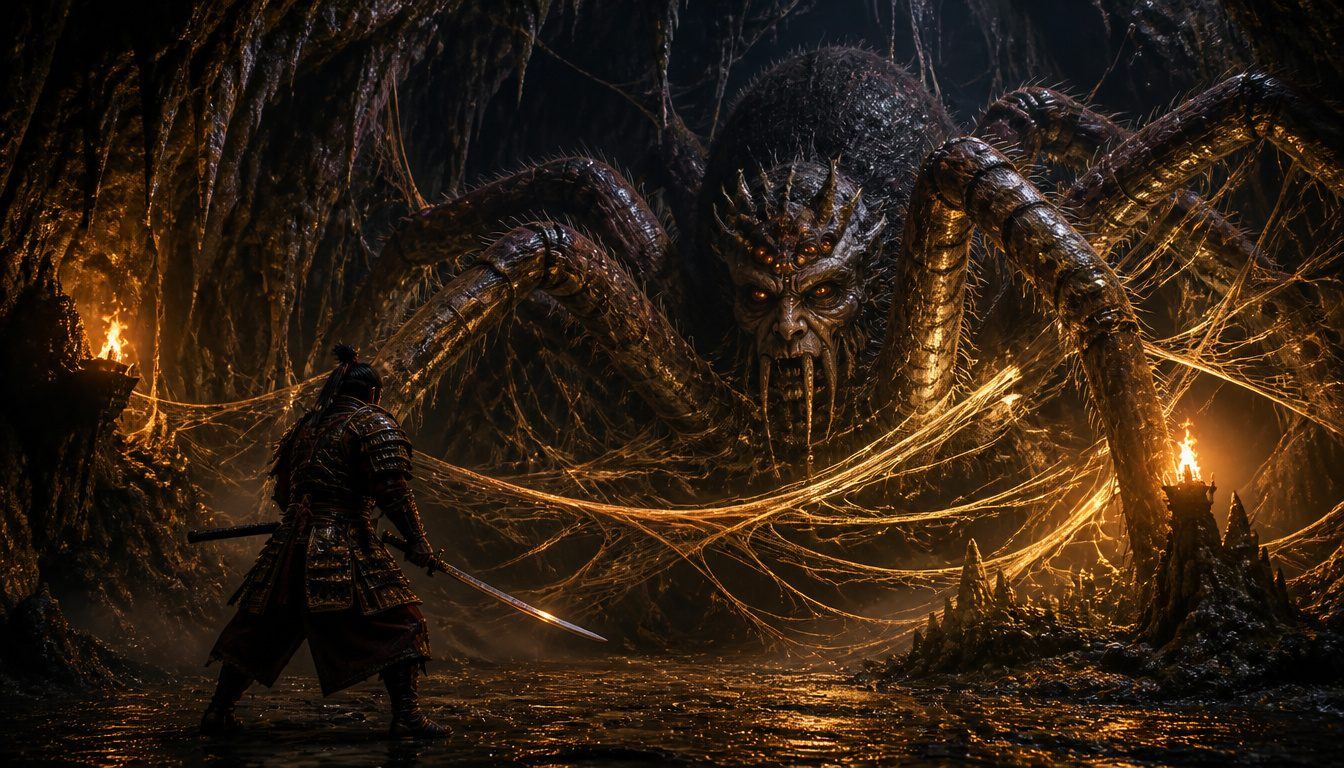
Illustration — Tsuchigumo, the Japanese giant earth spider: a samurai with drawn katana faces a monstrous demon-faced spider in a torchlit, web-filled cave. About our pictures
DemonA gigantic earth spider that lurks in caves and ruined mansions, spinning illusions and webs of sickness. In the most famous tale it creeps to the bedside of the ailing warrior Minamoto no Raikō, who wounds it with his sword before it is tracked to its lair and slain.
At a glance
What is a tsuchigumo?
Tsuchigumo (土蜘蛛), "earth spider", is a name with two separate histories. In Japan's oldest chronicles it is not a monster at all. It is an insult that the historians of the Yamato court used for local chiefs and their followers who refused to submit, people said to live in pits and caves. Many centuries later the same word came to mean a gigantic spider, a shape-shifting demon that creeps into the sickroom of the warrior Minamoto no Raikō and is hunted down by him and his men.
Dictionaries keep the senses apart. The Nihon Kokugo Daijiten gives the word first as another name for a real ground-dwelling spider, and second as a contemptuous name for native peoples who would not bow to the central government. The monster grew slowly out of that second sense.
Earth spiders in the ancient chronicles
The earliest appearance is in the Kojiki of 712. In the story of the first emperor, Jinmu, the conqueror reaches the great cave of Osaka, a place in Yamato and not the modern city. There "earth-spiders with tails", eighty fierce warriors, lie in wait for him. He offers them a banquet and gives each guest a server with a hidden sword. When he sings a song, his men cut them all down. Basil Hall Chamberlain, who translated the Kojiki in 1882, noted that this passage writes the name partly by sound, as 土雲 ("earth cloud"), not with the character for spider.
The Nihon Shoki of 720 mentions tsuchigumo several more times. In the Jinmu chapter, three groups of them in Yamato trust to their own strength and refuse to come to court, and they are put to death. Another band, at Takaowari, has short bodies and long arms and legs. The emperor's troops catch them in nets woven from vines, and the chronicle uses this to explain the place-name Katsuragi. In the chapter on Emperor Keikō, the emperor's progress through Kyushu becomes a string of clashes with cave-dwelling tsuchigumo who will not obey him. Among them are two who live in a great cavern called the Rat's Cave. His soldiers destroy them with mallets made of camellia wood.
These passages describe a political category, not a kind of creature. William George Aston, who translated the Nihon Shoki in 1896, pointed out that its tsuchigumo have ordinary Japanese names and live in long-settled parts of the country such as Yamato and Kyushu. He took their strange bodies to be "nothing more than a product of the popular imagination" working on the name.
The Fudoki and the "earth-hiders" debate
The provincial gazetteers called Fudoki, compiled in the eighth century, add local detail. The Hitachi Fudoki says that in the local speech the kuzu people of that region were called tsuchigumo or yatsukahagi, a name the Nipponica encyclopedia explains as "long-legged ones". They dug pits everywhere, lived in them, and hid inside whenever anyone came. The Heibonsha encyclopedia adds that tsuchigumo also appear in the Fudoki of Bungo and Hizen, and in surviving fragments of those for Settsu, Echigo, Higo and Hyūga. Their stories range from Mutsu in the north-east to Hyūga in southern Kyushu, and in every one they are the enemy in a story of conquest.
Who these people were is still debated. Heibonsha lists three theories: they were farmers who lived in pit dwellings, they were Emishi (the peoples of the north-east), or they were local earth gods. The Nipponica entry suggests that the name was a slur for groups who lived more by hunting than by rice farming. Heibonsha goes further and wonders whether the cave-dwelling habits were invented to fit the name, rather than the name being given because of the habits.
The word's origin is just as uncertain. The eighteenth-century scholar Motoori Norinaga thought these people were likened to spiders because of how they lived. Chamberlain preferred to read the word as a corruption of tsuchi-gomori, "earth-hiders". Aston thought the choice hardly mattered, since in his view the Japanese words for spider and for hiding came from the same root.
From rebels to monster: the Tsuchigumo-zōshi
By the Middle Ages the word had come loose from history. The Kodansha biographical dictionary sums up the change in one line: in the medieval period the tsuchigumo became a symbol of monsters and shape-shifters, and passed into Noh and kabuki.
The key work is a picture scroll, the Tsuchigumo-zōshi (土蜘蛛草紙). It is held by the Tokyo National Museum and designated an Important Cultural Property. The Nipponica encyclopedia thinks the story was composed in the Kamakura period, and it dates the surviving scroll to the fourteenth century. Japan's Agency for Cultural Affairs also lists it as a fourteenth-century work. An old attribution to the painter Tosa Nagataka is, says Nipponica, unproven and does not fit the date. The scroll is just under ten metres long.
In the story, Raikō and his retainer Watanabe no Tsuna enter a ruined house at Kaguraoka, in northern Kyoto, and one apparition after another tries to drive them out. The Agency for Cultural Affairs remarks that the monsters are full of personality and rather comical. A sword-stroke draws blood, and the two men follow the trail to a cave deep in the western hills. There they find an enormous earth spider and kill it. The closing scenes show the spider being beheaded and the house being burned. Each man appears twice in the same scene, a standard picture-scroll device for showing time passing.
Raikō is the same hero who beheads the oni Shuten-dōji, and his monster-slaying is largely the work of later storytellers. JAANUS, Columbia University's dictionary of Japanese art, notes that most Edo-period paintings of the spider fight drew not on the scroll but on other sources, such as the Tale of the Heike and the Noh play.
The Noh play Tsuchigumo
The Noh play Tsuchigumo is a fifth-category demon play performed by all five schools; the Konparu and Hōshō schools write its title 土蜘. Its author is unknown. According to the-noh.com and Nipponica, its source is the "Book of Swords" (Tsurugi no maki), a chapter about the heirloom swords of the Minamoto found in some texts of the Tale of the Heike.
Raikō lies ill with a strange sickness. His attendant Kochō brings medicine, but he grows worse. Late at night an unknown monk appears at his bedside reciting an old poem about a spider, then throws threads to bind him. Raikō seizes his sword Hizamaru and cuts the creature, which vanishes. He renames the blade Kumokiri, "Spider-cutter". In the second half a warrior, Hitorimusha, and his men follow the blood to an old mound, which Nipponica places on Mount Katsuragi. That is the same district as the vine-net story in the chronicle. The spider spirit bursts out and fights back with its webs, but it is finally beheaded.
The play's great visual effect is the thread. Nipponica explains that it is thin ganpi paper wrapped tightly round a lead core and cut into fine strips. Thrown from the actor's hand, it streams across the stage like a white rainbow. Kawatake Mokuami turned the play into the kabuki dance Tsuchigumo, first performed at Tokyo's Shintomi-za in 1881 by Onoe Kikugorō V. Kikugorō made it the first of his family's collection of signature plays, the Shinko engeki jisshu.
Mounds, masks and local legends
Many places still claim an earth spider. Reports gathered in the Nichibunken yokai database record a tsuchigumo-zuka (spider mound) at Hitokotonushi Shrine in Gose, Nara Prefecture. It is said to mark where Emperor Jinmu caught tsuchigumo in a net of vines, cut them into head, body and legs, and buried them under stones. In Taketa, Ōita Prefecture, seven mounds are said to be the graves of tsuchigumo destroyed by Emperor Keikō.
Such stories blend the two tsuchigumo: the rebels of the chronicles are remembered as spiders, buried in pieces like dangerous monsters. The spider also became a popular character. A 1935 report on Kyoto toys lists papier-mâché tsuchigumo masks sold at the April kyōgen performances of Mibu-dera temple.
Frequently asked questions
What does tsuchigumo mean?
It means "earth spider". In the eighth-century chronicles it was an insulting name for local groups who resisted the Yamato court and were said to live in pits and caves. From the Middle Ages on, it came to mean a giant spider monster.
Were the tsuchigumo real people?
The chronicles present them as real chiefs with Japanese personal names, living in places such as Yamato and Kyushu. Scholars read the name as a slur for groups that resisted the court, not the name of a separate race. They still disagree about who these groups were: cave-dwelling farmers, the Emishi, or local gods recast as enemies.
Who killed the tsuchigumo?
In the fourteenth-century Tsuchigumo-zōshi, Minamoto no Raikō and Watanabe no Tsuna kill the giant spider in a cave in the western hills of Kyoto. In the Noh play, Raikō wounds it with his sword, which he renames Kumokiri, and the warrior Hitorimusha's men finish it off at its mound. In the ancient chronicles, Emperor Jinmu, Emperor Keikō and their troops put down the human tsuchigumo.
What is the difference between a tsuchigumo and a jorogumo?
They are separate yokai. The tsuchigumo begins as a name for human enemies of the early state and becomes the giant spider of the Raikō legend. The jorogumo is a spider that takes the form of a woman, known mainly from Edo-period tales and local waterfall legends.
Where can I see the Tsuchigumo-zōshi scroll?
The fourteenth-century scroll belongs to the Tokyo National Museum, which also holds a Meiji-period copy. Picture scrolls are not always on display, so check the museum's exhibition schedule before visiting.
Sources & further reading
- 土蜘蛛: *Nihon Kokugo Daijiten*, *Daijisen*, Nipponica, Heibonsha *Sekai Daihyakka Jiten*, Kodansha *Nihon Jinmei Daijiten* (Kotobank)
- 土蜘蛛草紙: Nipponica entry with image caption (Kotobank)
- *Tsuchigumo-zōshi*, Cultural Heritage Online, Agency for Cultural Affairs
- *Tsuchigumo-zōshi* Meiji-period copy, Cultural Heritage Online
- Chamberlain, *Kojiki* (1882), Section 48: the earth-spiders of the cave of Osaka (Wikisource)
- Aston, *Nihongi* (1896), Book III: Emperor Jinmu and Aston's note on the Tsuchi-gumo (Wikisource)
- Aston, *Nihongi*, Book VII: Emperor Keikō in Kyushu (Wikisource)
- Tsuchigumo, JAANUS dictionary of Japanese art, Columbia University
- *Tsuchigumo* (Ground Spider): synopsis, the-noh.com
- *Tsuchigumo*: play details and source, the-noh.com
- Nichibunken record C2910094-000: the spider mound at Hitokotonushi Shrine, Gose (1988)
- Nichibunken record 0640142: seven mounds of Taketa, Ōita (1915)
- Nichibunken record 1232898: tsuchigumo masks at Mibu-dera, Kyoto (1935)
- Wikipedia: Tsuchigumo (pointer to further reading)
- en.wikipedia.org — Tsuchigumo Sōshi