Yuki-onna
雪女
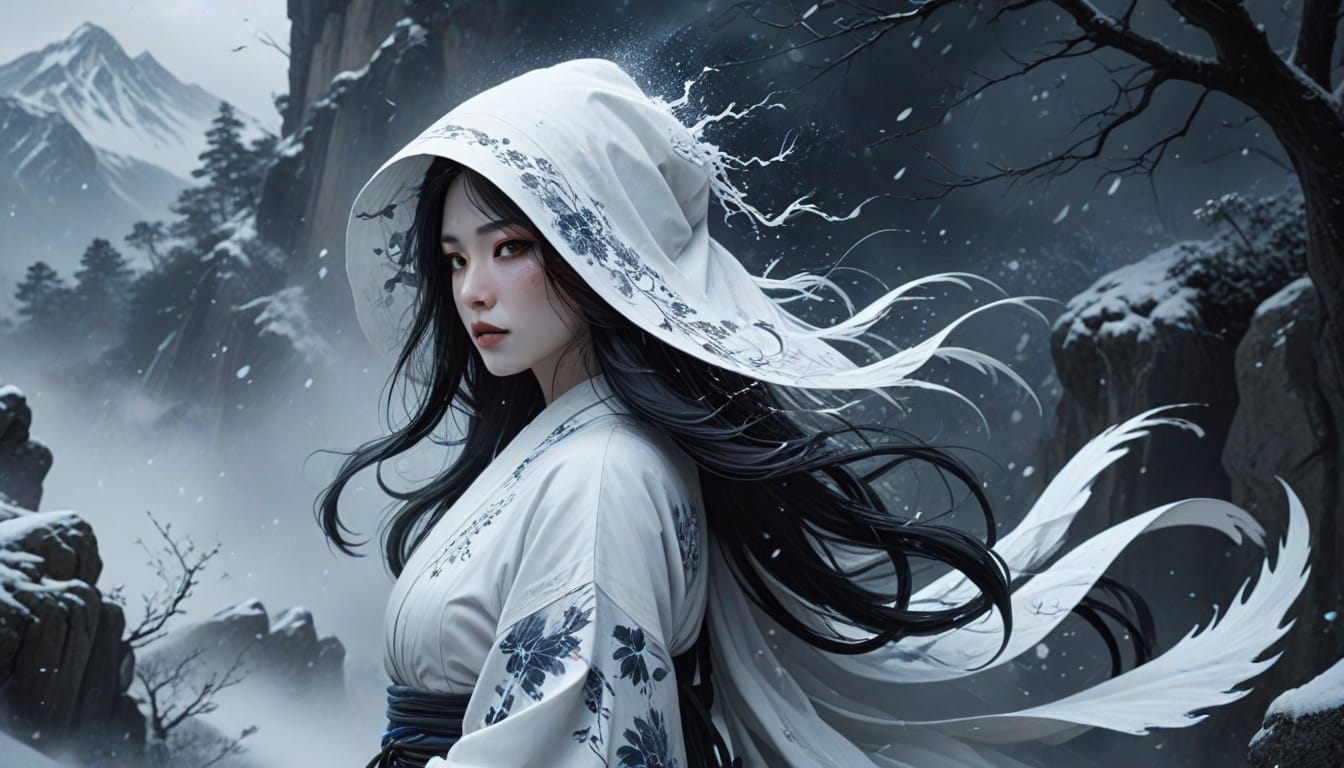
Illustration — Yuki-onna, the Japanese snow woman: a pale black-haired woman in a white hooded robe stands in a snowstorm on a mountain. About our pictures
Nature spiritA beautiful woman appearing during snowstorms, with pale skin and long black hair. She can freeze victims with her breath or touch and is associated with death by exposure in snowy mountains.
At a glance
What is a yuki-onna?
The yuki-onna (雪女), "snow woman", is the spirit of winter storms in Japanese folklore: a pale, silent woman who appears out of falling snow, most often at night and most often to people caught far from home. She is one of the most widely known yokai in Japan and one of the few whose story is famous abroad, largely thanks to a single retelling by Lafcadio Hearn in 1904.
She has many local names. Depending on the region she may be yuki-musume ("snow girl"), yuki-jorō ("snow lady"), yukinba or yuki-onba ("snow hag"), or tsurara-onna ("icicle woman"), and stories about her have been recorded from Aomori and Akita in the far north down to Ehime in Shikoku and Ōita in Kyushu. The International Research Center for Japanese Studies (Nichibunken), whose folklore database gathers reports from local histories and folklore journals, holds accounts of her from Niigata, Fukushima, Gunma, Miyagi, Iwate, Nagano, Kyoto and Tottori, among others.
Appearance and powers
Almost every account agrees on whiteness. Recorders in Gunma heard that on snowy nights the yuki-onna "comes wearing a white kimono"; in Tottori, that in heavy snow "a woman in white comes riding on the snow". She is usually beautiful, and her beauty is part of the danger. Some details are startlingly local: in one Niigata tradition, a single round hollow in the snow is the footprint of the one-legged yuki-onna, and in another the tracks she leaves are dotted with blood, and anyone who meets her is sure to be killed.
What she does varies just as much. In Hearn's version she kills with her breath, which streams out "like a bright white smoke" and leaves her victim frozen. Elsewhere she is said to drain the life from those she meets (in Iwate and Miyagi), to drink blood (in Ōita), or to take children's livers (in Niigata). A hunter's account recorded in Miyagi offers practical advice: if a yuki-onna appears, do not step aside, run back or speak to her, or she will devour you; instead run straight at her.
Water and heat are a recurring theme. In Okayama, giving her water makes her swell, while hot water makes her vanish; in Tottori she is driven off with hot water, and a Gifu tradition advises offering her hot tea rather than cold water. The tsurara-onna tale from Ojiya in Niigata takes this to its logical end: a mysterious bride who refuses to bathe is finally made to, and nothing is left in the tub but an icicle.
Origins and history
The snow woman is older than the printed page can quite show. The earliest literary appearance usually cited is in the Sōgi Shokoku Monogatari, a collection of tales bearing the name of the medieval renga poet Sōgi, in which the narrator reports seeing a yuki-onna while staying in Echigo Province, today's Niigata. By the Edo period she was a familiar figure: haikai poets wrote verses about her, some of which were quoted in the essay collection Kiyū Shōran, and Toriyama Sekien included her in his illustrated catalogue of yokai, Gazu Hyakki Yagyō, first published in 1776.
It is natural to connect her with the real hazards of the snow country, where a sudden blizzard could kill a traveller or a woodcutter within sight of home, and many of her stories are, at heart, about deaths of exactly that kind. She also served as a warning to children. A mother in Gunma would settle a child who would not sleep by telling it that on snowy nights someone comes to take away a crying child; in Tōno, in Iwate, the yuki-onna was said to come out on the Little New Year or on full-moon nights to gather children to play.
Famous legends
Hearn's "Yuki-Onna". In Kwaidan (1904), Lafcadio Hearn tells of two woodcutters from a village in Musashi Province, old Mosaku and his eighteen-year-old apprentice Minokichi, who are caught by a snowstorm and shelter in a ferryman's hut. In the night a woman in white enters, breathes on Mosaku and kills him, then bends over Minokichi, but spares him because he is young, warning him that if he ever tells anyone what he saw, she will know and kill him. A year later Minokichi meets a lovely girl named O-Yuki on the road; they marry, and she bears him ten children while never seeming to age. One night he tells her about the strange woman he once saw, who looked just like her. O-Yuki reveals that it was she, spares him only for the children's sake, and melts into white mist that drifts out through the smoke-hole.
Hearn wrote in his preface that the tale was told to him by a farmer of Chōfu, in Nishitama District of Musashi, as a legend of his native village, and that he did not know whether it had ever been written down in Japanese. The village of Chōfu he meant lies in today's city of Ōme in western Tokyo, which has since marked its connection to the story with a monument; it is not the modern city of Chōfu. No version of the marriage-and-broken-promise plot written before Hearn is known, and Japanese scholars still debate how much of it came from his informant and how much from Hearn himself.
The snow woman with a baby. A much older-looking pattern overlaps with the ubume, the ghost of a woman who died in childbirth. In the Aizu district of Fukushima, a 1928 report noted, the yuki-onna takes the form of an ubume. In a tale collected in Kurihara in Miyagi, a young samurai meets a snow woman carrying a baby, who asks him to hold it; when she vanishes, the infant is cold as ice and will not let go of his arms. In some northern versions a man who endures the weight of the child is rewarded with great strength.
A visitor at New Year. In Miyama, in the mountains north of Kyoto, an old woman preparing the New Year rice cakes sensed someone under the eaves. She opened the paper screen to find a beautiful, pale woman standing there; the old woman shouted at her and the woman disappeared, leaving only footprints in the snow. The villagers said it was the yuki-onna.
Regional traditions and variants
Later collectors found stories close to Hearn's in several places. A version told in Tōno has a son who watches his father die from the snow woman's breath, is sworn to silence, marries a beautiful wife and, when he finally speaks, sees her turn into the yuki-onna and leave the children in his care. Another, set on Mount Shirouma in Nagano, names its heroine Koyuki. Both were recorded in the late twentieth century, long after Kwaidan had become well known in Japan, so their relationship to Hearn's story is an open question. Some traditions give the snow woman a more benevolent role, linking her to the New Year deities and to visitors who leave gold behind.
In art, film and pop culture
Sekien's print established a visual type, and Hearn's story fixed the plot that most people now know. That plot was filmed as "The Woman of the Snow", one of four Hearn stories in Kobayashi Masaki's anthology film Kwaidan of the mid-1960s, with Kishi Keiko as Yuki, and again as The Snow Woman (1968). Kurosawa Akira's Dreams (1990) includes a snow-woman episode in its "Blizzard" segment. Since then she has become a familiar character in modern manga, anime and games, though the village tales collected over the past century show a figure far stranger and more varied than any single modern version.
Frequently asked questions
Is yuki-onna good or evil?
She is both, depending on the story. Many local accounts make her a killer who freezes, drains or devours those she meets, while others present her as a mysterious visitor or even a bringer of fortune. Hearn's famous version makes her a loving wife and mother who is still capable of deadly anger.
Where does the story of yuki-onna come from?
She is an old folk figure of the snow country, first appearing in literature in a tale of a sighting in Echigo (Niigata) and pictured by Toriyama Sekien in 1776. The best-known plot, the snow woman who marries the man she spared, comes from Lafcadio Hearn's Kwaidan (1904), which he said he heard from a farmer in what is now Ōme, Tokyo.
How do you escape a yuki-onna?
Folklore gives different answers. Some traditions say she can be driven away with hot water or should be offered hot tea, and a hunter's account from Miyagi advises running straight at her rather than turning away or speaking to her.
Is yuki-onna a ghost?
Not usually. She is generally treated as a spirit or yokai of snow and winter rather than the ghost of a dead person, though some regional tales blend her with the ubume, the ghost of a woman who died in childbirth.
Sources & further reading
- Lafcadio Hearn, *Kwaidan: Stories and Studies of Strange Things* (1904) — Project Gutenberg
- 怪異・妖怪伝承データベース: 雪女 (30 records) — Nichibunken
- 雪女 — Japanese Wikipedia (regional names and traits, Sōgi Shokoku Monogatari, Ōme monument, origin debate)
- Toriyama Sekien, *Gazu Hyakki Yagyō* — Library of Congress
- Yuki-onna — Wikipedia (pointer; film adaptations)
- Kwaidan (Kobayashi Masaki) — The Criterion Collection