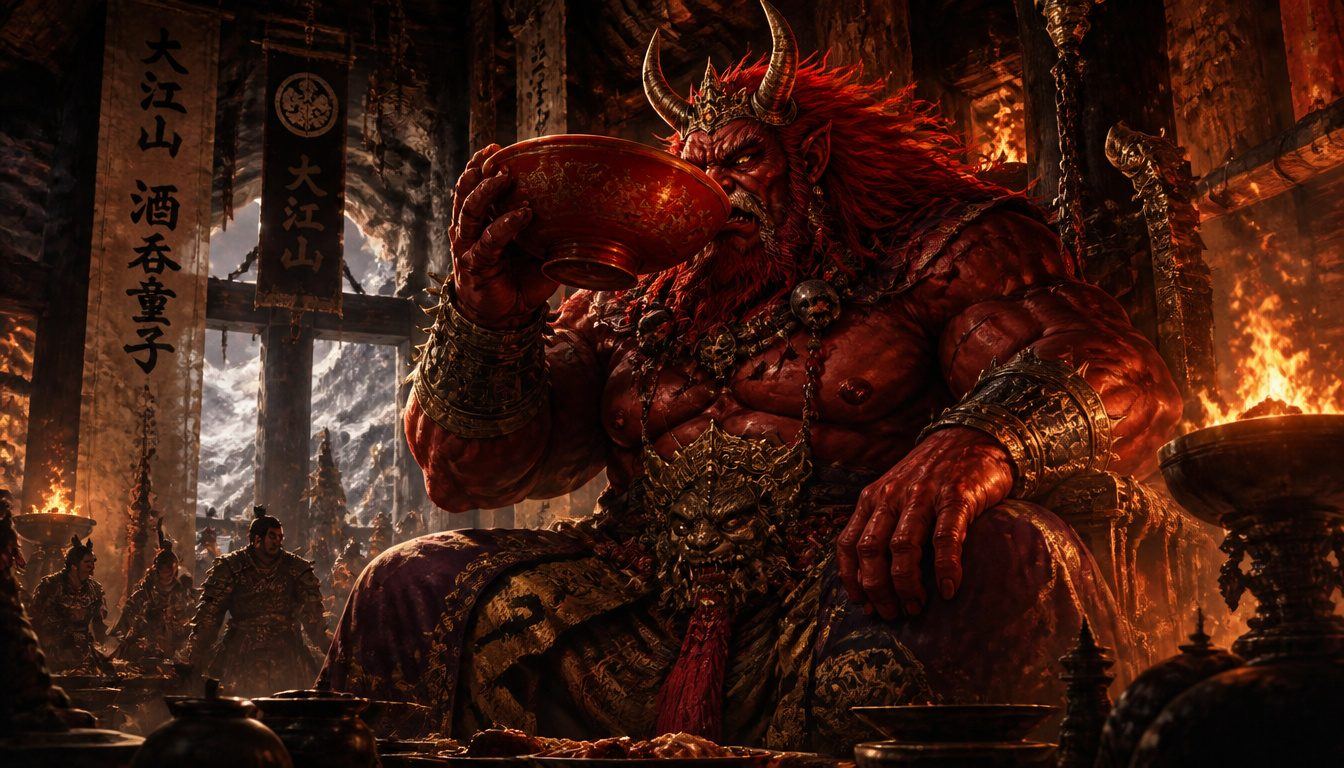
Shuten-doji
酒呑童子
Illustration — Shuten-doji, the oni king of Mount Ōe: a huge red-skinned horned demon drinks from a sake bowl on his throne amid flames. About our pictures
DemonThe king of the oni, a giant red demon with a taste for sake and for the young women he carried off from Kyoto to his mountain fortress. The warrior Minamoto no Raikō and his companions reached him disguised as mountain priests, drugged him with magic wine and struck off his head.
At a glance
Who is Shuten-dōji?
Shuten-dōji is the most famous oni in Japanese legend: the chief of a band of demons who lived in a mountain fortress, raided the capital of Kyoto and carried off its young women and its treasure. His name is usually read as "the sake-drinking boy". The first character means sake, the second means to drink, and dōji is a word for a child or page boy. In the oldest version the name is explained simply by his love of drink. The story ends when the warrior Minamoto no Raikō and his companions, disguised as mountain ascetics, get him drunk on a god-given sake and cut off his head.
The tale was being told by the fourteenth century and has been retold ever since, in picture scrolls, short prose tales, Noh, puppet theatre and kabuki.
The oldest version: the Ōeyama ekotoba
The earliest surviving telling is a picture scroll called Ōeyama ekotoba ("Illustrated Tale of Mount Ōe"), now in the Itsuō Art Museum in Ikeda, Osaka Prefecture, and designated an Important Cultural Property. Heibonsha's encyclopedia dates it to the second half of the fourteenth century. Until 1887 it belonged to the family of the chief priests of Katori Shrine in present-day Chiba Prefecture, and so it is also known as the Katori-bon. A 2022 public lecture series in Chiba presented the historian Suzuki Tetsuo's theory that the Chiba warrior clan may have commissioned it. That is a proposal, not settled fact.
Scholars therefore think the basic story already existed before the scroll was made. The literary scholar Tokue Gensei, comparing it with the later otogi-zōshi text, notes that the later version still keeps some archaic touches, such as the protection of three shrine gods, the demon's cannibal feast and a courtyard strewn with bones. Overall, though, the uncanny atmosphere of the scroll has faded considerably.
The otogi-zōshi story
The version most Japanese readers know comes from the otogi-zōshi, the short illustrated tales of the Muromachi period. Shuten-dōji was one of the twenty-three tales that the publisher Shibukawa printed in the Edo period as the Otogi Bunko. Encyclopedia summaries of that text give the plot in this order.
A demon of Mount Ōe in Tanba has taken the only daughter of the courtier Ikeda Chūnagon, and the grieving father appeals to the emperor. Raikō receives the imperial command. With five companions, the courtier-warrior Fujiwara no Hōshō and the four retainers Watanabe no Tsuna, Sakata no Kintoki, Usui Sadamitsu and Urabe no Suetake, he prays at the shrines of Hachiman, Sumiyoshi and Kumano and sets out disguised as yamabushi, wandering mountain priests. In a hut in the mountains, three old men, the three gods in disguise, give them a magic sake that is medicine to humans and poison to demons, together with a star-studded helmet, and guide them on. A captive young woman washing clothes in a stream shows them the way to the demon's stronghold.
Shuten-dōji receives them as fellow travellers and, over a night of drinking, tells them his history. He came from Echigo, settled on Mount Hiei until the monk Saichō (Dengyō Daishi) drove him out, and was later threatened again by the monk Kūkai (Kōbō Daishi). The only man he still fears, he says, is Raikō. Raikō keeps up the disguise through a grisly banquet and offers his own sake in return. The demons drink until they collapse. Raikō strikes, with the three gods helping, and the severed head flies up to attack him but cannot get through the helmet. The heroes then free the captive women and return to the capital.
Raikō and the Four Guardians
Minamoto no Raikō is a historical figure. Under the more formal reading of his name, Minamoto no Yorimitsu (948–1021), he was a Heian-period warrior-noble, eldest son of Minamoto no Mitsunaka. He served as governor of several provinces and grew rich in the service of the Fujiwara regents. He was known for his archery, and the names of the retainers linked with him already appear in the Konjaku Monogatarishū and other tale collections, but the Nihon Daihyakka Zensho encyclopedia remarks that his actual military record is unremarkable. The demon-slaying hero is largely the creation of later storytellers.
His four retainers became known as the Raikō shitennō, Raikō's "Four Heavenly Kings", a name taken from the four Buddhist guardian kings. Each has a legend of his own. Sakata no Kintoki is the grown-up Kintarō of the children's tale, and Watanabe no Tsuna is remembered for cutting off the arm of an oni at the Rashōmon gate of Kyoto.
Mount Ōe or Mount Ibuki?
Two families of the story survive. In one the demon lives on Mount Ōe, and in the other on Mount Ibuki in Ōmi, present-day Shiga Prefecture. According to the Nihon Kokugo Daijiten, the Ibuki tradition gives Shuten-dōji an earlier life on Ibuki and draws on the local legend of Ibuki Yasaburō recorded in the Sangoku Denki. A related tale, Ibuki-dōji, tells his childhood. The finest early example of the Ibuki tradition is the Shuten-dōji emaki in the Suntory Museum of Art, an Important Cultural Property painted by Kanō Motonobu in the Muromachi period. The museum describes it as the oldest surviving scroll of the Ibuki line and displayed it in 2025 after a full restoration. Columbia University's JAANUS art dictionary adds that the Kanō school favoured the Ibuki version in later paintings.
Even "Mount Ōe" is uncertain. Today the name belongs to an 833-metre mountain on the border of the old provinces of Tanba and Tango, north-west of Kyoto, where places such as Oni-ga-chaya ("the demons' teahouse") keep the legend alive. Several Japanese encyclopedias note, however, that the original Ōeyama may have been the pass now called Oinosaka, on the western edge of Kyoto. That pass was a boundary between the capital and the outside world, and it was notorious for bandits. Local tradition recorded in Fukuchiyama says the demon's head was buried there.
Other regions claim his childhood. Folklore records from Tsubame in Niigata say Shuten-dōji was a boy at the temple Kokujō-ji, so handsome that women were bewitched, until he turned into a demon and fled, eventually reaching Mount Ōe. One version gives his childhood name as Gedōmaru.
The Noh play Ōeyama
The Noh play Ōeyama is a fifth-category "demon play" still performed by all five schools. Its author is unknown. It is sometimes attributed to Miyamasu, and occasionally to Zeami. Raikō (the waki) and his men climb the mountain disguised as mountain priests. Shuten-dōji (the shite), who does not harm people who have taken holy orders, welcomes them in the form of a boy. He tells them frankly how he was driven from Mount Hiei, then drinks and dances with them and retires to sleep. When the warriors burst into his chamber he has taken on his demon form. He rages at the betrayal of his hospitality before he is finally beheaded.
The Nihon Daihyakka Zensho singles out the play's gentle, almost childlike portrait of the demon in its first half. In the comic interlude a woman carried off from the capital appears, along with a servant of the disguised party. The play influenced later kabuki and puppet-theatre versions.
The sword Dōjigiri
The sword credited with taking the demon's head is a tachi signed by the smith Yasutsuna. It has long been called Dōjigiri, "the dōji-cutter". Japan's Agency for Cultural Affairs dates it to the Heian period and records a blade length of 80.0 centimetres. It is held by the Tokyo National Museum, and it was designated an Important Cultural Property in 1933 and a National Treasure in 1951. The Kyōhō Meibutsuchō, an eighteenth-century register of famous swords, is said to record it as a possession of Toyotomi Hideyoshi that later passed from Tokugawa Hidetada to the Matsudaira lords of Echizen. It is counted among the Tenka Goken, the "five finest swords under heaven". Its link to Raikō is legend. The sword itself is real.
Frequently asked questions
What does Shuten-dōji mean?
The name is usually read as "sake-drinking boy". The oldest scroll explains it by the demon's love of sake, and in the Noh play he says his followers named him for his constant drinking. Dōji means a child or page boy, and in the Noh play and the otogi-zōshi he first appears in a youthful form.
How was Shuten-dōji killed?
Minamoto no Raikō and five companions, disguised as mountain priests, joined him at a feast and gave him sake that the gods had made poisonous to demons. When he fell into a drunken sleep they cut off his head. In the otogi-zōshi the head flies up at Raikō, but a helmet the gods had given him protects him.
Where did Shuten-dōji live?
Most versions place him on Mount Ōe, north-west of Kyoto. One tradition, preserved in the Suntory Museum of Art's scroll, sets the story on Mount Ibuki in Shiga Prefecture. Some scholars think the original "Ōeyama" was Oinosaka, a pass on the western edge of Kyoto.
Is the Dōjigiri sword real?
Yes. The tachi by Yasutsuna known as Dōjigiri is a National Treasure held by the Tokyo National Museum. Its use against Shuten-dōji is legend, not history.
Who are Raikō's Four Heavenly Kings?
They are Watanabe no Tsuna, Sakata no Kintoki, Usui Sadamitsu and Urabe no Suetake, the retainers of Minamoto no Raikō. In the Shuten-dōji story they are joined by Fujiwara no Hōshō.
Sources & further reading
- Shuten-dōji entries in the *Nihon Kokugo Daijiten*, Heibonsha *Sekai Daihyakka Jiten* and *Nihon Daihyakka Zensho* (Kotobank)
- Ōeyama entries, including the Noh play and the mountain (Kotobank)
- Minamoto no Yorimitsu entries (Kotobank)
- Shuten dōji, JAANUS dictionary of Japanese art, Columbia University
- Chiba City public lecture on the Itsuō *Ōeyama ekotoba* and the Chiba clan (2022)
- Suntory Museum of Art exhibition *Shuten-dōji Begins* (2025), via Tokyo Art Beat
- Tachi signed Yasutsuna (*Dōjigiri Yasutsuna*), Cultural Heritage Online, Agency for Cultural Affairs
- Dōjigiri Yasutsuna (Kotobank)
- Nichibunken Kaii/Yōkai Densho Database: all *shuten-dōji* records
- Nichibunken record 1350268: Gedōmaru and Kokujō-ji, Tsubame, Niigata
- Nichibunken record 0700148: the head buried at Oinosaka, Fukuchiyama (1969)
- Nichibunken record 2380005: Oni-ga-chaya and legend sites, Ōe, Kyoto (1973)
- Nichibunken record 2450276: Watanabe and the Rashōmon oni's arm (2000)
- Wikipedia: Shuten-dōji (pointer to further reading)
- britishmuseum.org — A 1881-1210-0-271
- en.wikipedia.org — Dōjigiri