Susanoo
須佐之男命
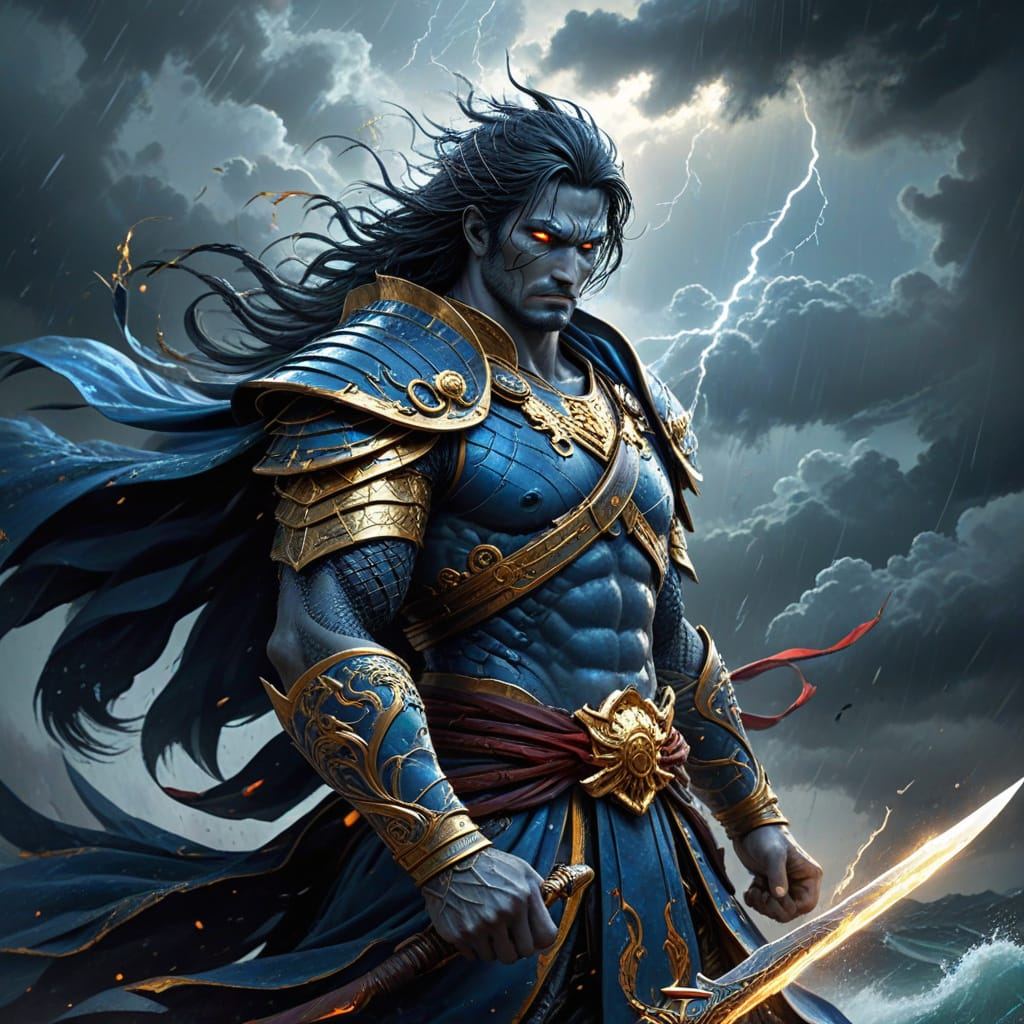
Illustration — Susanoo, the Japanese storm god: a long-haired warrior in blue and gold armour holds a glowing sword beneath lightning over the sea. About our pictures
Deity (kami)The tempestuous younger brother of the sun goddess Amaterasu. Known for his wild behaviour, he was banished from heaven, then in Izumo slew the eight-headed serpent Yamata no Orochi and found the sacred sword Kusanagi.
At a glance
Who is Susanoo?
Susanoo no Mikoto (須佐之男命, also written 素戔嗚尊) is the unruly brother of the sun goddess Amaterasu. He causes chaos in heaven and is driven out. Then, on earth, he kills the eight-headed serpent of Izumo and founds a line of gods. The Kojiki often gives his full name as Take-haya-susanoo. Heibonsha's encyclopedia reads susa as "raging" and take and haya as words for his force and speed. Nipponica offers another reading: that the name is tied to the place-name Susa in Izumo.
He is often called a storm god, but the sources are careful about this. The Kokugakuin University Encyclopedia of Shinto says only that he "has been associated with wind and rain", and that much about his character remains unclear. The Yamakawa Dictionary of Japanese History notes that he has been explained both as a storm god and as a farming god. Heibonsha's encyclopedia calls him the most problematic figure in Japanese myth, and Nipponica stresses his two opposite faces: a wrecker in heaven and a founder on earth.
Birth and banishment
The two court chronicles tell his birth differently. In the Kojiki (712), the god Izanagi washes himself after his journey to the land of the dead (see Izanagi and Izanami). Amaterasu is born from his left eye, Tsukuyomi from his right eye, and Susanoo from his nose. In the main text of the Nihon Shoki (720), Izanagi and Izanami bear him together, after the sun goddess, the moon god and the deformed "leech child".
His first crime is weeping. In the Kojiki, Izanagi gives him the sea to rule, but he cries until his long beard reaches the pit of his stomach. Chamberlain's 1882 translation says his weeping withered "the green mountains into withered mountains" and dried up the rivers and seas. He says he wants to go to his dead mother's land, and Izanagi drives him out. The Nihon Shoki main text adds that his weeping "brought many of the people of the land to an untimely end". There both parents banish him to the "Nether Land".
Before he goes, he climbs to heaven to take leave of his sister. She fears he has come to take her realm and meets him armed. They hold a contest of pledges, ukei, and Susanoo declares himself the winner. Then he runs riot. He breaks down the ridges of her rice fields, fouls the hall of her harvest feast, and throws a flayed horse through the roof of her weaving hall. The chronicles differ on the result. In the Kojiki a weaving maiden strikes herself with her shuttle and dies. In the Nihon Shoki main text Amaterasu herself is wounded by the shuttle. She hides in the Heavenly Rock Cave and the world goes dark. That story is told on our page Amaterasu and the Heavenly Rock Cave. The gods punish Susanoo with a heavy fine, cut off his beard, pull out his nails and expel him.
The serpent, the sword and the first poem
Driven from heaven, Susanoo comes down to the upper Hi River in Izumo. There he meets an old couple weeping over their last daughter, Kushinada-hime. An eight-headed serpent has eaten her seven sisters. He changes the girl into a comb for his hair, makes the serpent drunk on strong sake and cuts it to pieces. In its tail he finds a sword. Our page Yamata no Orochi tells the full story.
Details vary between the accounts. The Kojiki says he gave the sword to Amaterasu. The Nihon Shoki main text has him call it "a divine sword", which he dare not keep for himself, and give it "to the Gods of Heaven" (Aston's 1896 translation). One Nihon Shoki variant sets the fight at the River Ye in Aki, not in Izumo. Another says he first went down with his son Isotakeru to the Korean kingdom of Silla, refused to stay there, and crossed to Izumo in a boat made of clay. Yet another has him pluck out his beard and body hair to make Japan's trees: cedar, cypress, podocarpus and camphor.
The sword is Kusanagi, one of the three imperial regalia. The Kokugakuin encyclopedia gives the tradition. Prince Yamato Takeru later carried it east, then left it with his bride Miyasu-hime in Owari. It has been enshrined ever since at Atsuta Shrine in Nagoya, where Susanoo is one of the five gods worshipped. Nipponica doubts the story. It notes that the sword was stolen in 668 and returned to Atsuta in 686, after diviners blamed it for the emperor's illness. In its view, a curse like that suggests the sword was Atsuta's own treasure before it became a regalia sword.
After the fight, Susanoo looks for a place to live with his bride. He reaches Suga, says his heart feels refreshed, and builds a palace there. As clouds rise around it he sings Yakumo tatsu, "Eight clouds rise". The kana preface of the Kokinshū poetry anthology says that in the age of men, 31-syllable poetry began with Susanoo. The Nihon Kokugo Daijiten finds the same idea in the Heike monogatari (thirteenth century).
Lord of the Root Land
The Kojiki gives Susanoo a second career that the Nihon Shoki leaves out. After his expulsion from heaven he asks the food goddess Ōgetsuhime for food. She pulls dishes from her nose, mouth and rear, so he kills her, thinking she is serving him filth. Silkworms, rice, millet, beans and barley grow from her body. (A Nihon Shoki variant gives this killing to the moon god Tsukuyomi instead.)
Later, Susanoo rules Ne no kuni, the Root Land beneath the earth, which Chamberlain translates as "the Nether-Distant-Land". The young god Ōnamuchi flees there, and Susanoo sets him deadly tests: a night in a house of snakes, another in a house of centipedes and wasps, and a moor set on fire around him. When Ōnamuchi escapes with Susanoo's daughter Suseri-hime and his sword, bow and lute, Susanoo calls after him from the pass. He tells him to drive out his brothers and become "the Deity Master-of-the-Great-Land", Ōkuninushi. Our page Ōkuninushi follows that story. Heibonsha's encyclopedia sums up the three roles: a rebel in heaven, a hero on earth, and an ancestor who tests the young king in the underworld. The Kokugakuin encyclopedia notes that his words in Izumo are even written as imperial proclamations.
Worship in Izumo
Izumo's own record, the Izumo no kuni fudoki (733), does not tell the serpent story. The Kokugakuin encyclopedia says it treats Susanoo as just one of many local gods. But it does name places for him. Nipponica says that in the Fudoki he settles his own spirit at Susa, and Susa Jinja in Izumo City is still his shrine. It is listed in both the Fudoki and the tenth-century Engishiki. The Daijisen Plus dictionary notes a tradition that Susa is where his life ended. Kumano Taisha in Matsue, the ichinomiya or first shrine of Izumo province, worships a god called Kushimikenu, whom the Daijisen identifies with Susanoo. Heibonsha's historical gazetteer suggests Kushimikenu was first a grain god of the clan that ruled the Ou district.
Gozu Tennō and the Gion festival
Susanoo's largest cult grew up far from Izumo, and in a strange form. In the Heian period, Kyoto feared epidemics and the angry spirits thought to cause them. A plague god called Gozu Tennō, the "Ox-Head Heavenly King", was worshipped at the Gion shrine on the eastern edge of the city. The Kokugakuin encyclopedia traces this god to a Buddhist guardian of the Jetavana monastery in India, mixed with Chinese and Japanese yin-yang lore. In Japan he became identified with Susanoo.
A key text is a surviving fragment of the Bingo no kuni fudoki. In it a travelling god, named in Nipponica's summary as Susanoo, asks for a night's lodging. The rich brother Kotan Shōrai turns him away, but the poor brother Somin Shōrai feeds him on millet. The god tells Somin to have his family wear a ring of reed grass, chi no wa, at the waist. Nipponica's summary says that when the plague came, Somin's daughter, who did as she was told, was the one who lived. This is the origin story of the summer chi no wa grass rings that people still walk through at shrines. It also explains the charms marked "descendants of Somin Shōrai" that Yasaka Shrine and others hand out.
The Gion shrine's founding is told in more than one way. Yasaka Shrine gives two traditions: that an envoy from Korea brought Susanoo there in 656, or that the monk Ennyo built a hall there in 876. The Kokugakuin encyclopedia dates it to 876 or the early tenth century. The same uncertainty applies to the festival. Yasaka Shrine traces the Gion Festival to 869, when 66 halberds were set up against an epidemic. It cites a shrine record written no earlier than 1670 for this. The Kokugakuin encyclopedia says the Gion goryō-e is believed to date to the later tenth century. In 1868 the Meiji government separated Buddhas from kami, and the Gion shrine was renamed Yasaka Jinja. Many Gion shrines elsewhere took the name Yasaka too. Today Yasaka Shrine names Susanoo, Kushinada-hime and their eight children as its main gods.
Frequently asked questions
Is Susanoo a storm god?
He is often called one, and the Nihon Shoki links his descent from heaven with heavy wind and rain. But the Kokugakuin Encyclopedia of Shinto says only that he has been associated with wind and rain, and that much of his character is unclear. Some scholars see him first as a farming god.
Why was Susanoo banished from heaven?
He was banished twice. Izanagi first expelled him for weeping instead of ruling his realm. Then, after his rampage in heaven drove Amaterasu into the Rock Cave, the gods fined him, cut his beard, pulled out his nails and threw him out.
What did Susanoo find in the serpent's tail?
A sword, later called Kusanagi, the "grass-mower". It became one of the three imperial regalia and is said to be enshrined at Atsuta Shrine in Nagoya.
Who is Gozu Tennō?
A plague god worshipped at the Gion shrine in Kyoto, built from Buddhist and yin-yang sources, who became identified with Susanoo. The shrine was renamed Yasaka Jinja in 1868, and Susanoo is now its main god.
Is Susanoo good or evil?
Neither, simply. In heaven he breaks every rule. On earth he saves Kushinada-hime, kills the serpent and founds the line that leads to Ōkuninushi. Japanese scholars have called him the most complicated figure in the myths.
Sources & further reading
- Susanoo, Kokugakuin University *Encyclopedia of Shinto*
- Yamatanoorochi, Kokugakuin University *Encyclopedia of Shinto*
- Atsuta Shinkō, Kokugakuin University *Encyclopedia of Shinto*
- Gion/Tsushima Shinkō, Kokugakuin University *Encyclopedia of Shinto*
- Gozu Tennō, Kokugakuin University *Encyclopedia of Shinto*
- Gion matsuri, Kokugakuin University *Encyclopedia of Shinto*
- 素戔嗚尊: Heibonsha, *Mypedia*, Nipponica, Yamakawa and *Nihon Kokugo Daijiten* entries (Kotobank)
- 草薙剣: Nipponica, *Daijisen* and Britannica Japan entries (Kotobank)
- 須佐神社: Nipponica, *Daijisen Plus* and Heibonsha gazetteer entries (Kotobank)
- 熊野大社: *Daijisen* and Heibonsha gazetteer entries (Kotobank)
- 蘇民将来: Nipponica, Heibonsha and *Nihon Kokugo Daijiten* entries (Kotobank)
- *Kojiki*, tr. B. H. Chamberlain (1882), Section XII: The Crying and Weeping (Wikisource)
- *Kojiki*, tr. B. H. Chamberlain (1882), Section XVII: The August Expulsion (Wikisource)
- *Kojiki*, tr. B. H. Chamberlain (1882), Section XIX: The Palace of Suga (Wikisource)
- *Nihongi*, tr. W. G. Aston (1896), Book I (Wikisource)
- *Kokinshū*, kana preface (Japanese Wikisource)
- History of Yasaka Shrine, Yasaka Jinja (official site, Japanese)
- Enshrined deities, Yasaka Jinja (official site, Japanese)
- *Kojiki*, tr. B. H. Chamberlain (1882), Section XXIII: The Nether-Distant-Land (Wikisource)
- Fudoki, Kokugakuin University *Encyclopedia of Shinto*
- 古事記: *Daijisen* and *Nihon Kokugo Daijiten* entries (Kotobank)
- 日本書紀: *Daijisen* and *Nihon Kokugo Daijiten* entries (Kotobank)
- Wikipedia: Susanoo-no-Mikoto (pointer to further reading)