Chapter One
The Banished God
Susanoo, the unruly god often called the storm god, had been cast out of the Plain of High Heaven. His rampage there had driven his sister, Amaterasu, the sun goddess, to hide herself away in the Heavenly Rock Cave, and when she came out the eight hundred myriad gods punished him: they fined him a thousand tables of offerings, cut off his beard, had his fingernails and toenails pulled out, and drove him from Heaven. He came down to earth at a place called Torikami, at the headwaters of the Hi River in the land of Izumo.
There he noticed something strange—chopsticks floating downstream. Where there were chopsticks, there must be people. Following the river upward, he came upon the sound of weeping.
Chapter Two
The Grieving Family
Before him were an old man and an old woman with a young girl between them, all three in tears. The old man said that he was an earthly deity, a son of the great mountain god Ōyamatsumi. His name was Ashinazuchi, his wife's was Tenazuchi, and their daughter was Kushinada-hime.
Susanoo's heart, though wild, was not without compassion. He asked what this serpent looked like.

Chapter Three
The Beast Revealed
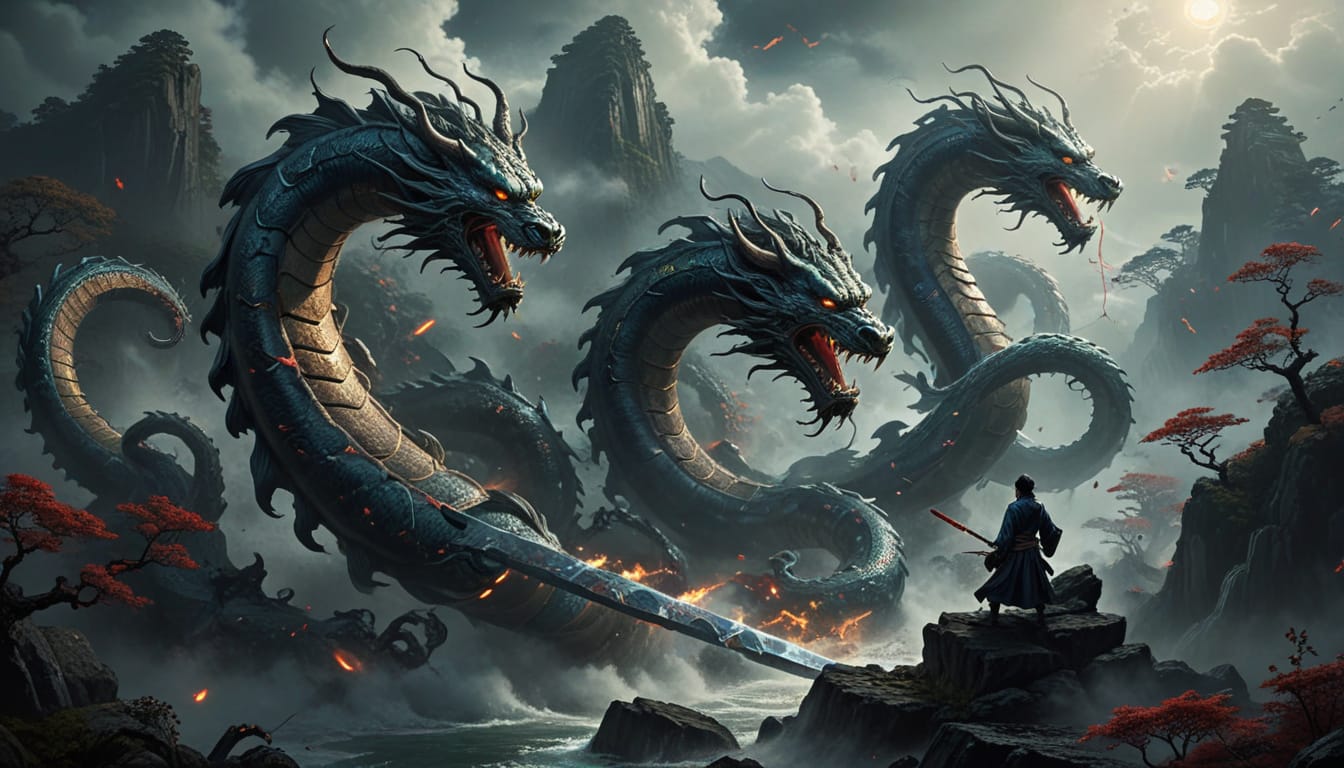
"Its eyes are red like winter cherries," Ashinazuchi answered. "It has one body with eight heads and eight tails. Moss grows on it, and cypress and cedar trees too. It is so long that it stretches over eight valleys and eight hills, and its belly is always bloody and inflamed." The creature had no other name: yamata no orochi simply means "the eight-forked serpent."
Even for a god, this would be a formidable opponent. But Susanoo had a plan—and a condition.
"If this is your daughter," he said, "will you give her to me?"
The old man answered that he would, with reverence—but he did not know the stranger's name. When Susanoo revealed that he was Amaterasu's brother, newly come down from Heaven, the old couple agreed at once.
Chapter Four
The Trap
Susanoo turned Kushinada-hime into a many-toothed comb and tucked it into his hair. Then he told the old couple to brew sake refined eight times over, to build a fence with eight gates, to set up a platform at each gate, and to place on each platform a vat filled with the strong sake.
Then they waited. And the serpent came, exactly as the old man had described it—Yamata no Orochi, its eight heads swaying above one vast body that sprawled across the hills.
Chapter Five
The Battle
The serpent found the sake. Each of its eight heads dipped into a vat and drank deeply of the powerful brew. Soon the creature was thoroughly drunk, and all its heads sank down and slept.
This was the moment Susanoo had waited for. He drew the great sword at his side—a "ten-grasp" sword, ten hand-breadths long—and cut the sleeping serpent to pieces. So much blood poured out that the Hi River flowed on as a river of blood.
Chapter Six
The Divine Sword
Puzzled, Susanoo used the point of his sword to split the tail open. Inside lay a great, sharp sword. Thinking it a wondrous thing, he took it and presented it to his sister Amaterasu. The Kojiki gives no reason for the gift; the Nihon Shoki has him say that this is a divine sword, and that he would not dare keep it for himself.
This is the sword known as Kusanagi-no-Tsurugi, the "Grass-Mowing Sword." One account in the Nihon Shoki says that its first name was Ame-no-Murakumo, "Gathering Clouds of Heaven," perhaps because clouds always hung over the serpent, and that it was renamed in the days of the hero Yamato Takeru. Generations later Amaterasu sent it down to earth with her grandson Ninigi, and it is counted among the three Imperial Regalia of Japan.
Epilogue
A New Beginning
With the monster dead, Susanoo searched Izumo for a place to build a palace. When he reached Suga he declared that his heart felt refreshed—suga means "pure, fresh," and this is said to be how the place got its name. There he built a palace for himself and Kushinada-hime, and as it rose, clouds climbed up from the land. Susanoo made a song:
Izumo's eightfold fence,
a fence to shelter my bride—
oh, that eightfold fence!"
The song, which opens with the words Yakumo tatsu ("eight clouds rise"), was later honoured as the root of Japanese waka poetry, and it is often called Japan's first poem. Susanoo made old Ashinazuchi the headman of his palace, and the land of Izumo was safe. The tale of the eight-headed serpent would echo through the ages—a reminder that even the fiercest monsters can fall, and that a god who brought only chaos to Heaven could bring order to the land below.
Sources
Sources & Versions
This telling follows the Kojiki (712), Book One, in Basil Hall Chamberlain's 1882 translation: §XVII (Susanoo's punishment and expulsion from Heaven), §XVIII "The Eight-Forked Serpent" and §XIX "The Palace of Suga"; the sword's later journey to earth with Ninigi is in §XXXIII. Between his expulsion and his arrival in Izumo, the Kojiki also places a short episode in which Susanoo kills the food goddess Ōgetsu-hime, from whose body the first seeds grow; it is left out here. The Nihon Shoki (720), Book I, tells the story in its main text and several variant accounts, in W.G. Aston's 1896 translation. Its main text has no floating chopsticks: Susanoo simply hears weeping at the headwaters of the Hi. The sake is set out in eight "cupboards" rather than behind eight gates, the serpent's eyes are again "like the winter-cherry," and firs and cypresses grow on its back. Susanoo's sword is only "slightly notched," he gives the sword he finds to the gods of Heaven, and a note gives its original name as Ame-no-Murakumo, changed to Kusanagi in Yamato Takeru's time. In the Nihon Shoki the poem appears only as "one version," which is one reason some scholars doubt its age. Other variants move the story to the Ye River in Aki, or have the old couple ask Susanoo to slay the serpent before he may marry their daughter. The "winter-cherry" (akakagachi) is the plant now called hōzuki, the Chinese lantern plant. Kokugakuin University's Encyclopedia of Shinto notes readings of the myth as the taming of the Hi River for rice-growing.
- Kojiki (Chamberlain, 1882), §XVII — The August Expulsion
- Kojiki (Chamberlain, 1882), §XVIII — The Eight-Forked Serpent
- Kojiki (Chamberlain, 1882), §XIX — The Palace of Suga
- Kojiki (Chamberlain, 1882), §XXXIII — The descent of the August Grandchild
- Nihongi (Aston, 1896), Book I — The Age of the Gods, Part I
- Encyclopedia of Shinto (Kokugakuin University) — Yamata no orochi
- Encyclopedia of Shinto (Kokugakuin University) — Kushinadahime
- Encyclopedia of Shinto (Kokugakuin University) — Susanoo