Yatagarasu
八咫烏
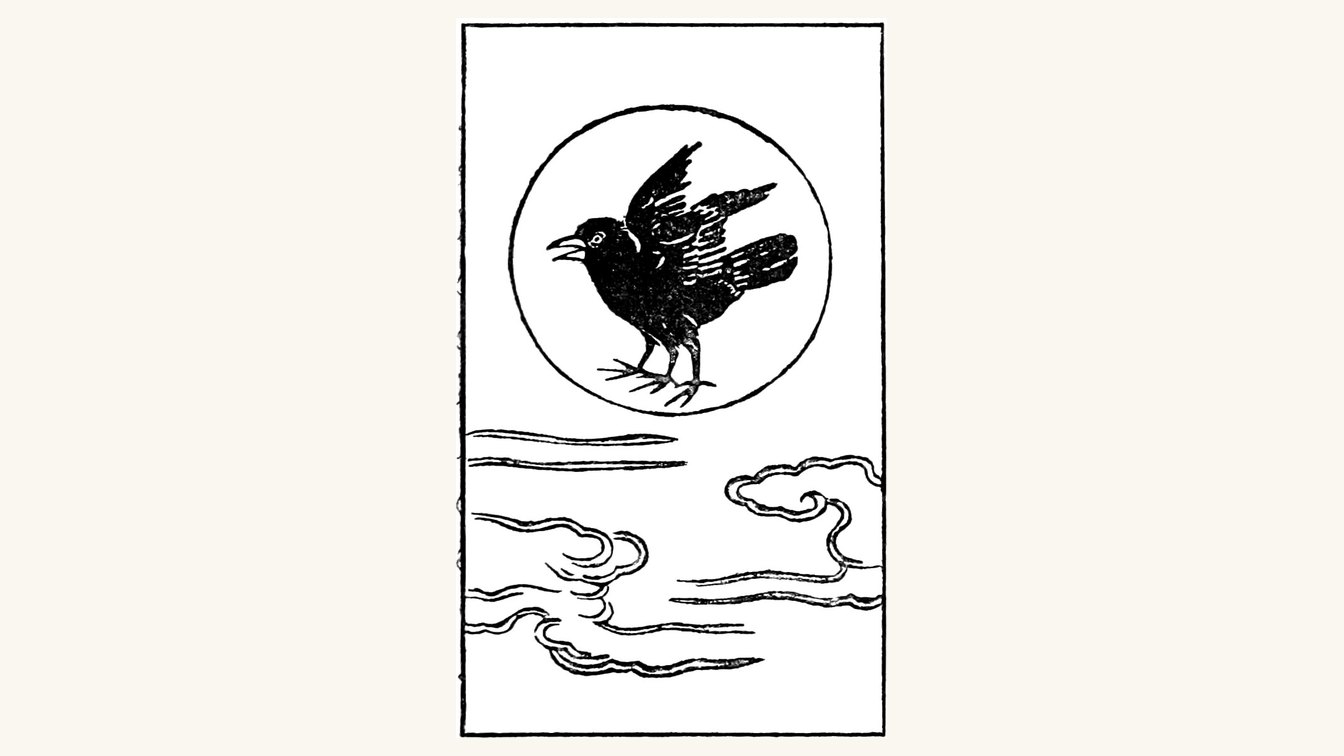
The three-legged sun crow, identified with Yatagarasu: a black crow on three legs inside the sun's disc above stylised clouds. W. G. Aston, Nihongi (1896), public domain, via Wikimedia Commons. Source
Deity (kami)The great crow sent from heaven to guide Emperor Jimmu's army through the mountains from Kumano into Yamato, later pictured with three legs. A divine messenger and symbol of guidance, now used as the symbol of the Japan Football Association.
At a glance
Who is Yatagarasu?
Yatagarasu (八咫烏) is the great crow sent from heaven to guide the legendary first emperor, Jimmu, through the mountains of Kumano into Yamato. Today it is pictured almost everywhere with three legs: on the amulets of the Kumano shrines, on shrine flags, and on the badge of Japan's national football teams.
The three legs are a later addition. Japan's oldest chronicles, the Kojiki (712) and the Nihon Shoki (720), say nothing about the crow's legs. The Japan Football Association, which uses the three-legged bird as its emblem, says so on its own website. This article follows the crow from the chronicles to the shrine amulet and the football shirt, and traces where the third leg came from.
The crow in the Kojiki
In the Kojiki, the future emperor, Kamu-yamato-iware-biko, is leading his army east to conquer Yamato. At Kumano, on the Kii Peninsula, a magic sword sent down from heaven saves the army from the spell of the local gods. Then the heavenly deity Takagi no kami, also called Takamimusubi, gives a warning. Chamberlain's translation of 1882 reads: "make no progress hence into the interior. The savage Deities are very numerous. I will now send from Heaven a crow eight feet [long]. So that crow eight feet [long] shall guide thee." The army follows the crow over the mountains and through Yoshino until it comes out at Uda in Yamato.
The crow then works as a messenger. It is sent ahead to two brothers at Uda, the Ukashi, to ask whether they will serve the newcomer. The elder brother answers by shooting at it with a whistling arrow.
The crow in the Nihon Shoki
The Nihon Shoki tells the story differently. In W. G. Aston's translation of 1896, the army is lost among precipitous mountains "not knowing whither to direct their march". The sun goddess Amaterasu appears to Jimmu in a dream: "I will now send thee the Yata-garasu, make it thy guide through the land." The crow appears, flying down from the sky, and Jimmu takes it as a sign that his ancestor Amaterasu is helping him. The army follows it to Uda.
So the two chronicles disagree about who sent the crow: Takamimusubi in the Kojiki, Amaterasu in the Nihon Shoki. The Kokugakuin University Encyclopedia of Shinto records both.
The Nihon Shoki gives the crow a bigger part. Sent to summon two local chiefs, the brothers Shiki, it cries "The child of the Heavenly Deity sends for thee. Haste! haste!" The elder brother, furious that "a bird of the crow tribe" should make such a noise, shoots at it. The younger brother is afraid and serves it food on eight leaf-platters. After the conquest, the chronicle says, the Yatagarasu "was also included in the ranks of those who received rewards". Its descendants were said to be the chiefs of Katsurano and the palace attendants called Tonomori.
A crow of what size?
The name is written 八咫烏. Karasu means "crow". The characters of yata mean "eight spans", but Britannica Japan and Kumano Hongū Taisha both explain yata as simply meaning "large". Kokugakuin University professor Hirafuji Kikuko writes that the name means "large crow", and that this is the only feature of the bird that can be learned from the myths.
Translators have read it in different ways. Chamberlain chose "a crow eight feet long". He noted that the great scholar Motoori Norinaga took the name to mean "an eight-headed crow". Aston observed that the characters in the Nihon Shoki literally mean "the crow with a head eight feet long". He argued that the Chinese characters should be ignored in favour of the Japanese word.
Later tradition also turned the crow into a god of a particular family. The Nipponica and Kokugakuin encyclopedias note that the Shinsen shōjiroku, a register of noble clans, says that Kamo no Taketsunomi, ancestor of the Kamo chiefs of Yamashiro, changed himself into a huge crow to guide Jimmu. The Kogo shūi also calls the crow a distant ancestor of the Kamo chiefs. Nipponica notes that the Kamo connection is the standard view, but that some scholars link the story to the Ōtomo clan instead. The Kokugakuin encyclopedia adds that the Shoku Nihongi records a Yatanokarasu Shrine founded in Uda in 705.
Where the third leg came from
In Chinese myth, a three-legged crow lives in the sun. The Nihon Kokugo Daijiten gives this as a second meaning of yatagarasu: the three-legged crow imagined to live in the sun, and by extension the sun itself. It cites the tenth-century dictionary Wamyōshō (c. 934). Aston's note on the Nihon Shoki explains the link. The Wamyōshō, quoting older commentaries on the Nihon Shoki, says that the Chinese "sun crow" is called yatagarasu in Japanese. Aston himself suggested that yata, "eight hands", might be a loose description of the sun crow's three claws. That was his theory, not the general view.
The Japan Football Association gives a short history of the merger. It explains that the story of the Chinese three-legged crow spread early to Goguryeo in northern Korea and then around East Asia. When it reached Japan it gradually became confused with the Yatagarasu, and the Yatagarasu came to be drawn with three legs. Hirafuji makes the same point. The myths give no third leg, but the Chinese sun crow seems to have shaped the image of a bird sent by the sun goddess.
So the sources point to the tenth century as the earliest written link between the name yatagarasu and the three-legged sun crow. None of the sources consulted here dates the first Japanese picture of the Yatagarasu with three legs. Some modern explanations of the three legs belong to the shrines. Kumano Hongū Taisha says they are "said to" stand for heaven (the gods), earth (the natural world) and people. That is a shrine teaching, not something found in the chronicles.
The crow of Kumano
At the three great shrines of Kumano, the crow became a sacred messenger. Kumano Hongū Taisha calls it the servant of its main deity, Ketsumimiko, whom it identifies with Susanoo. The shrine also honours it as a god of guidance. At Kumano Nachi Taisha, a Japan Tourism Agency text explains, legend says the crow returned after guiding Jimmu. A stone inside the shrine fence, the Yatagarasu-ishi, is said to be the crow at rest. A small shrine to it, the Miagatahiko-sha, stands in a building of 1867.
The crow's best-known form at Kumano is the Kumano goō, a paper talisman. Kumano Hongū Taisha describes its own as a design of 88 crows forming the characters of a charm, printed by hand from woodblocks. Each of the three shrines uses a different number of crows. The shrine says that from the Kamakura period the paper was also used for written oaths, and in the Edo period in place of formal pledge documents. It was believed that breaking an oath sworn on it would kill one of Kumano's crows and send the oath-breaker to hell. Every 7 January the shrine holds the Yatagarasu shinji. The Kokugakuin encyclopedia describes it as a rite in which a stamp cut from the New Year pine is purified with fire and pressed onto the new talismans.
The football crow
The Japan Football Association gives the history of its emblem in its official FAQ. Its board decided to adopt an emblem in June 1931. The following year, a national meeting of delegates chose a design by the sculptor Hinako Jitsuzō as the association's flag. The association's Hall of Fame entry for Uchino Tairei, a founder of the association, says the three-legged crow emblem came from an idea by Uchino and others, which Hinako then shaped. JFA states that Hinako took the Yatagarasu of the Jimmu story as his motif. It adds that, because the chronicles do not give the crow three legs, the association treats the emblem as both the Yatagarasu and a Chinese symbol, citing texts such as the Huainanzi.
Wakayama Prefecture links the emblem to Nakamura Kakunosuke (1878–1906), a native of Nachi on the Kumano coast. As a student at Tokyo Higher Normal School he compiled a Japanese book on association football and founded a football club there, said to be the first such team in Japan. The prefecture notes that the bird on the JFA flag is the same sacred crow worshipped at Kumano, and that Uchino was Nakamura's junior at the school. A Japan Tourism Agency text at Nachi goes further and says the crow was chosen to honour him. JFA's own account does not mention Nakamura, so this is best treated as a local tradition. Kumano Hongū Taisha says that JFA officials and national team players visit to pray for victory.
Frequently asked questions
Does Yatagarasu have three legs in the Kojiki or Nihon Shoki?
No. Neither chronicle mentions its legs. The Japan Football Association and Kokugakuin University both point this out. The three legs came from the Chinese sun crow. The tenth-century dictionary Wamyōshō already gives yatagarasu as the Japanese name for that bird.
Who sent Yatagarasu to Emperor Jimmu?
The Kojiki says it was the heavenly deity Takagi no kami (Takamimusubi). The Nihon Shoki says Amaterasu sent it, promising it to Jimmu in a dream.
What does "yata" mean?
The characters mean "eight spans", but the word is generally taken to mean simply "large". Chamberlain translated the name as "a crow eight feet long". Motoori Norinaga thought it meant "eight-headed".
Why is Yatagarasu the symbol of Japanese football?
The Japan Football Association adopted a three-legged crow emblem in 1931, designed by the sculptor Hinako Jitsuzō from an idea by Uchino Tairei and others. JFA describes it as the Yatagarasu of the Jimmu story combined with the Chinese sun crow. A local tradition in Wakayama also links it to the Kumano-born football pioneer Nakamura Kakunosuke.
Where is Yatagarasu worshipped?
Above all at the three Kumano shrines in Wakayama Prefecture, where it is the gods' messenger and appears on the Kumano goō talismans. The Shoku Nihongi also records a Yatanokarasu Shrine in Uda, Nara, in 705.
Sources & further reading
- *Kojiki*, tr. B. H. Chamberlain (1882), Section 46: "The Gigantic Crow and Gods with Tails" (Wikisource)
- *Kojiki*, tr. B. H. Chamberlain (1882), Section 47 (Wikisource)
- *Nihongi*, tr. W. G. Aston (1896), Book III: Emperor Jimmu (Wikisource)
- 八咫烏: *Daijisen*, *Nihon Kokugo Daijiten*, Nipponica, Heibonsha and Britannica Japan entries (Kotobank)
- Yatakarasu, Kokugakuin University *Encyclopedia of Shinto*
- Yatagarasu shinji, Kokugakuin University *Encyclopedia of Shinto*
- Hirafuji Kikuko, "The Yatagarasu: The Three-legged Crow That Guided Emperor Jimmu on his Journey", Kokugakuin University
- 八咫烏について, Kumano Hongū Taisha
- 熊野牛王神符, Kumano Hongū Taisha
- Yatagarasu, the Three-Legged Crow (Kumano Nachi Taisha), Japan Tourism Agency multilingual commentary database
- Japan Football Association FAQ: the meaning of the JFA emblem
- Japan Football Hall of Fame: Uchino Tairei, Japan Football Association
- スポーツ偉人伝: 中村覚之助, Wakayama Prefecture
- Wikipedia: Yatagarasu (pointer to further reading)