Chapter One
The Youngest Brother
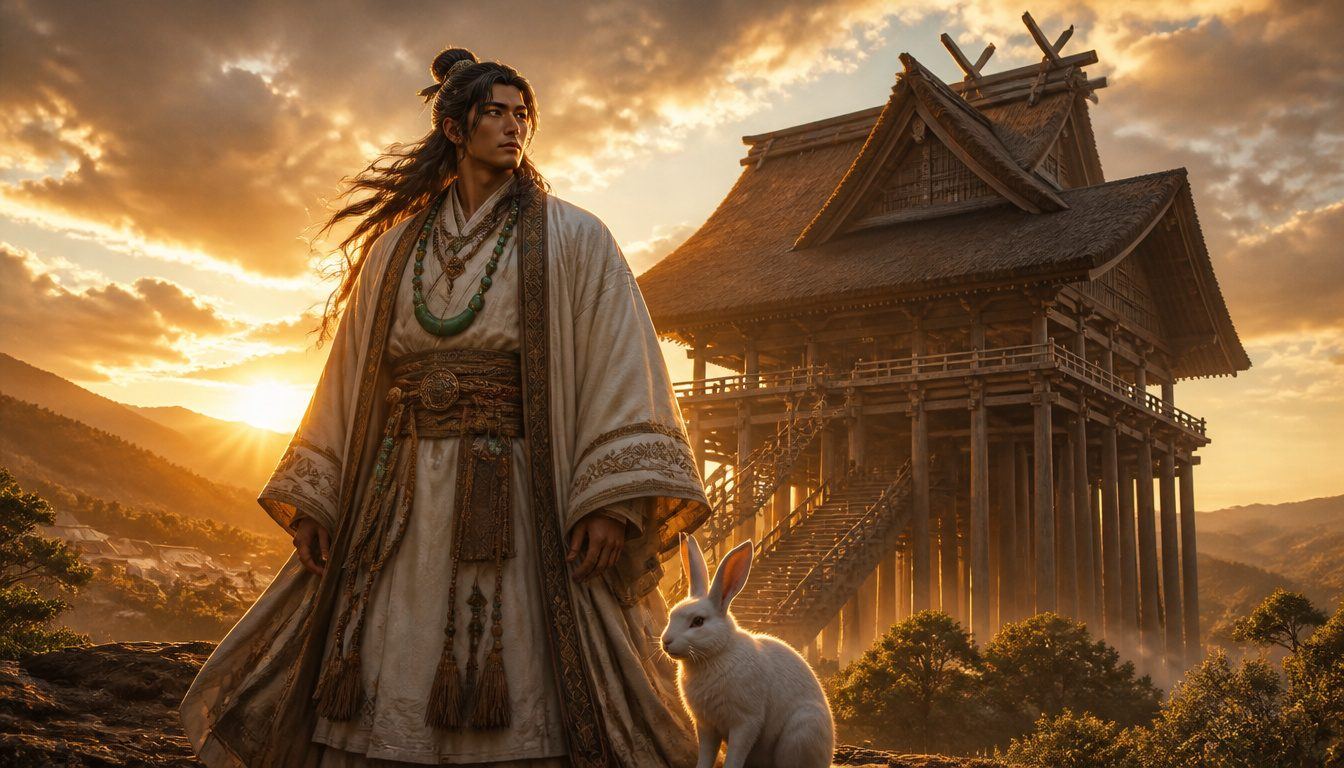
He began as the least of eighty brothers, carrying everyone's luggage. He was killed twice, tested in the underworld by the storm god Susanoo, and rose to become Ōkuninushi, "Great Lord of the Land", who shaped and healed the country — and then gave it away. His story, told almost entirely in Izumo, is the heart of the Kojiki's earthly myths.
Six generations after Susanoo settled in Izumo, there lived a god called Ōnamuji (大穴牟遅神), who would later be known as Ōkuninushi (大国主神). He had eighty brothers, the yasogami, "eighty gods", and all of them wished to marry the princess Yagami-hime of Inaba, in the east.
They set off together to court her. Ōnamuji went too — not as a rival, but as their porter, with their bag slung over his back, trailing behind them all.
Chapter Two
The White Hare of Inaba
At Cape Keta, on the Inaba shore, the brothers found a hare lying on the sand, stripped of all its fur. They told it, laughing, to bathe in the sea and then lie on a high hillside in the wind. The hare did as it was told; as the salt water dried, its skin cracked open in the wind, and it lay there weeping in pain.
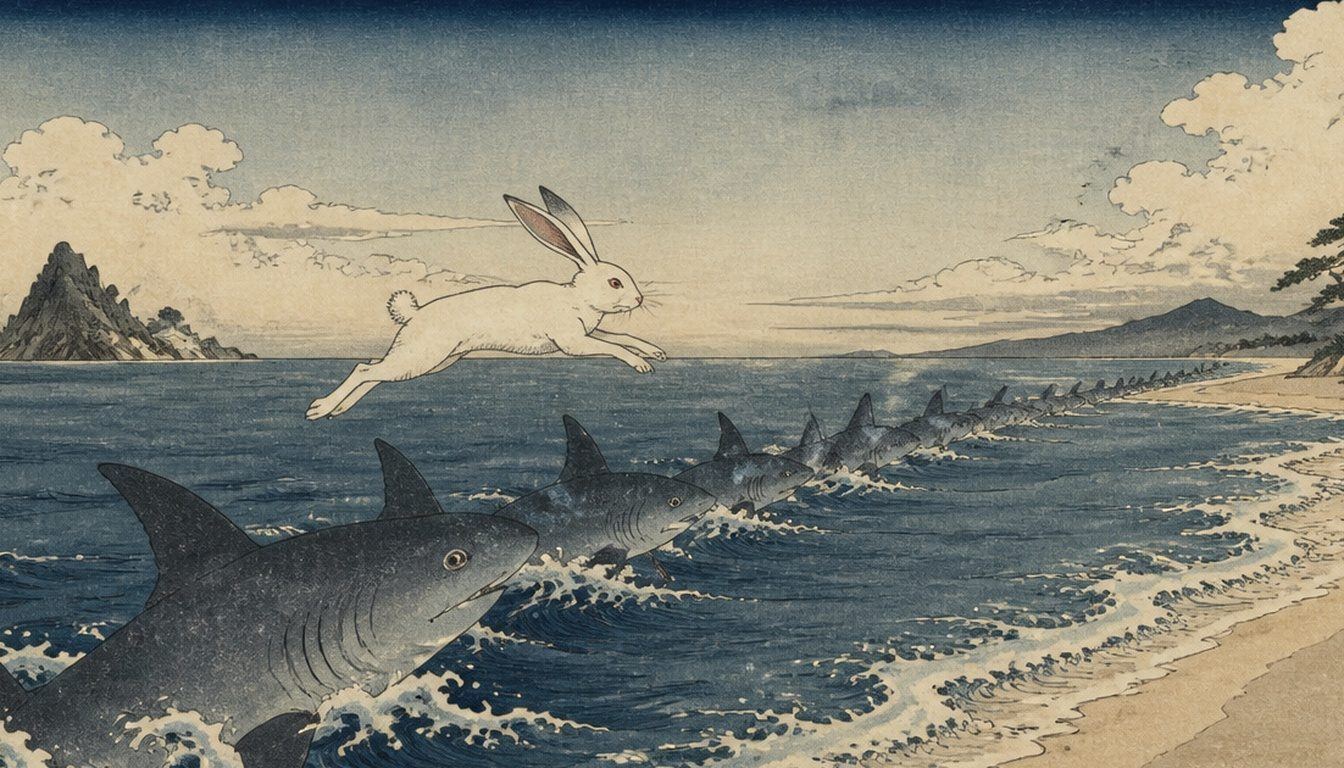
Ōnamuji, coming last, found it and asked why it wept. The hare told him its story. It had been living on the island of Oki and wanted to cross to the mainland, but had no way over. So it tricked the wani of the sea — sea creatures, usually understood today as sharks — by proposing a contest: let them line up from the island to the cape, and it would count them as it hopped across, to see whose tribe was bigger. The wani lay down in a line, and the hare ran across their backs, counting. But just before it reached the shore it could not resist crowing that they had been fooled — and the last wani seized it and stripped off its coat. Then the eighty gods had come by, and their advice had made it worse.
Ōnamuji told it to go at once to the river mouth, wash in fresh water, then spread out the pollen of the cattails that grew there and roll in it. The hare did so, and its body was made whole again. Grateful, it made a prophecy: the eighty gods would never win the princess. Though he carried their bag, Ōnamuji would be the one she chose.
The hare is honoured as a god, the Hare Deity of Inaba, at Hakuto Shrine in Tottori to this day, and it has become one of the best-loved stories in Japan.
Chapter Three
Killed by His Brothers
The hare was right. Yagami-hime told the eighty gods she would marry none of them — she would marry Ōnamuji. Enraged, the brothers resolved to kill him.
At the foot of Mount Tema in Hōki, they told him that a red boar lived on the mountain: they would drive it down, and he must catch it at the bottom or they would kill him. Then they heated a great boulder shaped like a boar until it glowed with fire and rolled it down the slope. Ōnamuji caught it, was burned against the stone, and died.
His mother wept and went up to heaven to plead with the creator deity Kamimusubi, who sent two shellfish goddesses, Kisagai-hime and Umugi-hime — the Princesses of the Ark Shell and the Clam. One ground and scorched her shell; the other carried water and spread the mixture over him like mother's milk. Ōnamuji rose again as a handsome young man.
The brothers tried again. They led him into the mountains, split a great tree, wedged it open, made him stand in the gap — and pulled out the wedge, crushing him to death. Again his mother searched for him, found him, broke open the tree and brought him back to life. If he stayed, she told him, they would destroy him in the end. She sent him away to the god Ōyabiko in the land of Ki. When the brothers tracked him there and raised their bows, he slipped away through the fork of a tree.
Chapter Four
The Ordeals of Susanoo
There was only one god great enough to advise him: Susanoo, the old storm god, who now dwelt in the Ne-no-Katasu-kuni (根之堅州国), the deep "root land" beneath the world. Ōnamuji went down to him. At Susanoo's palace he met the god's daughter, Suseri-hime (須勢理毘売), and the two fell in love at first sight and were married. She went in and told her father a very beautiful god had come.
Susanoo looked at the young man, called him "the ugly fellow of the Reed-Plains", and welcomed him — into a room full of snakes. That night Suseri-hime gave her husband a scarf: wave it three times, she said, and the snakes would grow still. He slept untroubled. The next night Susanoo put him in a room of centipedes and wasps, and again she gave him a scarf, and again he came out unharmed.
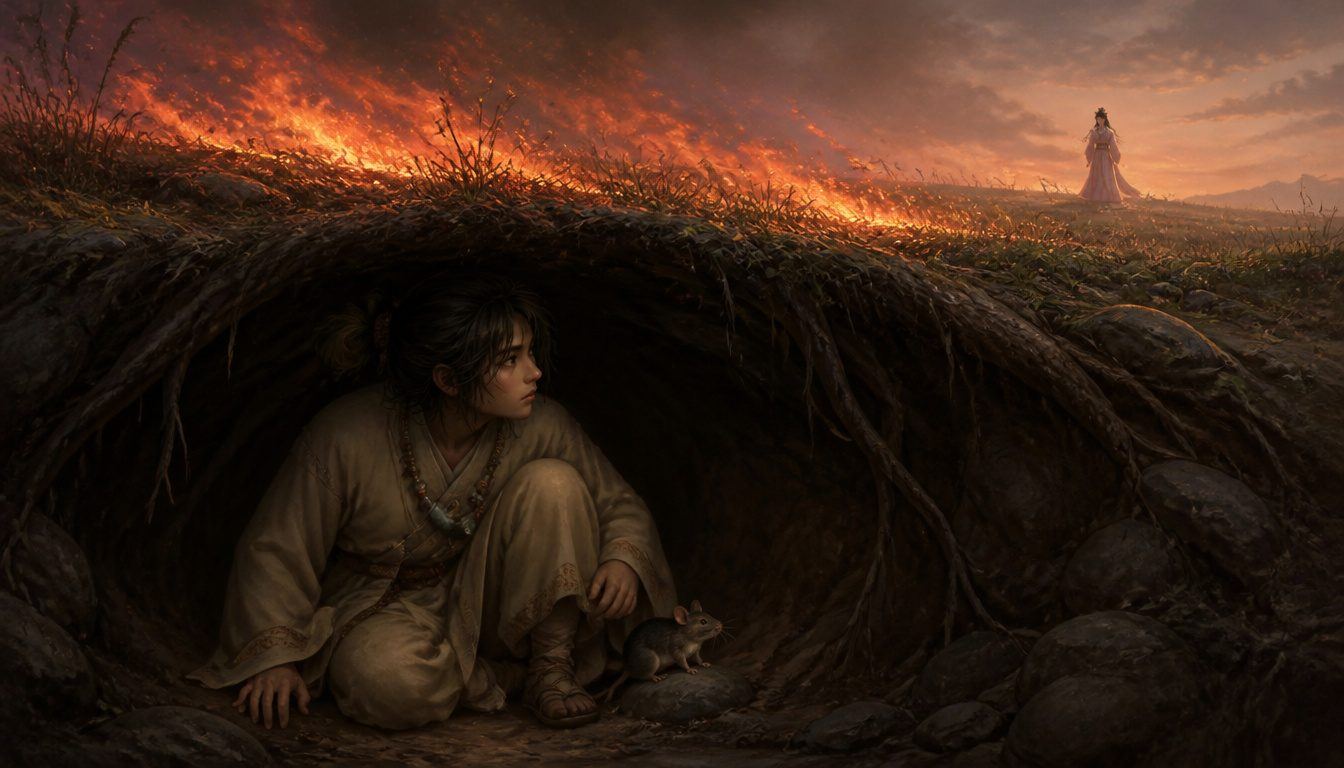
Then Susanoo shot a whistling arrow into a wide moor and sent Ōnamuji to fetch it — and set the grass alight all around him. Trapped in the fire, he heard a mouse speak: inside it is hollow, hollow; outside it is narrow, narrow. He stamped on the ground, fell into a hollow beneath it, and hid while the fire passed over. The mouse brought him the arrow, its feathers nibbled away by the mouse's children.
Suseri-hime, believing him dead, came weeping with funeral offerings, and Susanoo stood on the moor thinking the matter finished — until Ōnamuji walked out of the ashes and handed him the arrow.
Chapter Five
The Escape from the Root Land
Susanoo took him into his great hall and told him to pick the lice from his hair. The "lice" were centipedes. Suseri-hime slipped her husband berries of the muku tree and red clay; he chewed the berries and spat them out with the clay, and Susanoo, thinking he was crunching up the centipedes, felt fond of him and fell asleep.
Ōnamuji tied the sleeping god's hair to the rafters, blocked the door with a boulder, lifted Suseri-hime onto his back, and took Susanoo's great sword of life, his bow and arrows of life, and his heavenly koto. As they ran, the koto brushed a tree and the earth rang with its sound. Susanoo woke and pulled the house down — but by the time he had untangled his hair from the rafters, the pair were far away.
Susanoo chased them to the slope that divides the underworld from the land of the living, and there, gazing after them, he shouted his blessing as a curse. Take the sword and the bow, he roared, and drive your brothers down the hillsides and into the rivers. Become Ōkuninushi, Great Lord of the Land. Make my daughter your chief wife. Build your palace at the foot of Mount Uka with pillars sunk to the bedrock and roof-beams rising to the heavens — and live there, you rascal!
Ōkuninushi did as he was told. With Susanoo's sword and bow he scattered the eighty gods, and he began to make the land.
Chapter Six
The Tiny God from Across the Sea
Ōkuninushi was a great lover as well as a great lord: the Kojiki records his courtship songs to princesses as far away as Koshi, and the jealousy of Suseri-hime, and the cup they shared when they made their peace. But his true labour was the land itself.
One day, at Cape Miho in Izumo, a tiny god came riding in over the crests of the waves in a boat made from the seed pod of a kagami vine, dressed in the skin of a small creature — geese in the older translations, a moth in many modern readings. No one knew his name. A toad said that Kuebiko would know — Kuebiko, the scarecrow of the fields, who cannot walk but knows everything under heaven. Kuebiko named him: Sukunabikona (少名毘古那神), a child of Kamimusubi. Kamimusubi confirmed it — this was the child who had slipped through the gaps between his fingers — and told the two gods to be brothers and build the land together.
So they did. The Nihon Shoki adds that the two gods together devised ways to heal sickness in people and animals, and to ward off harm from birds, beasts and insects. When the work was not yet done, Sukunabikona crossed the sea to Tokoyo, the Eternal Land. Ōkuninushi lamented: how could he finish the land alone? Then a light came across the sea — a god who promised to help if Ōkuninushi would worship him on the eastern mountain of Yamato. That god dwells on Mount Miwa to this day.
Chapter Seven
The Land Is Given Away
From the High Plain of Heaven, Amaterasu looked down on the Central Land of Reed-Plains and declared that it should be ruled by her own descendants. But the land below seemed restless and full of unruly earthly gods, and the heavenly gods held council on how to bring it under heaven.
Their first envoy, Ame-no-Hohi, came down and was won over by Ōkuninushi, and for three years sent no word. The second, Ame-no-Wakahiko, married Ōkuninushi's daughter Shitateru-hime and schemed to take the land for himself; for eight years he sent no word. When heaven sent a pheasant to ask why, he shot it — and the arrow flew up to heaven, was thrown back down, and killed him where he slept.
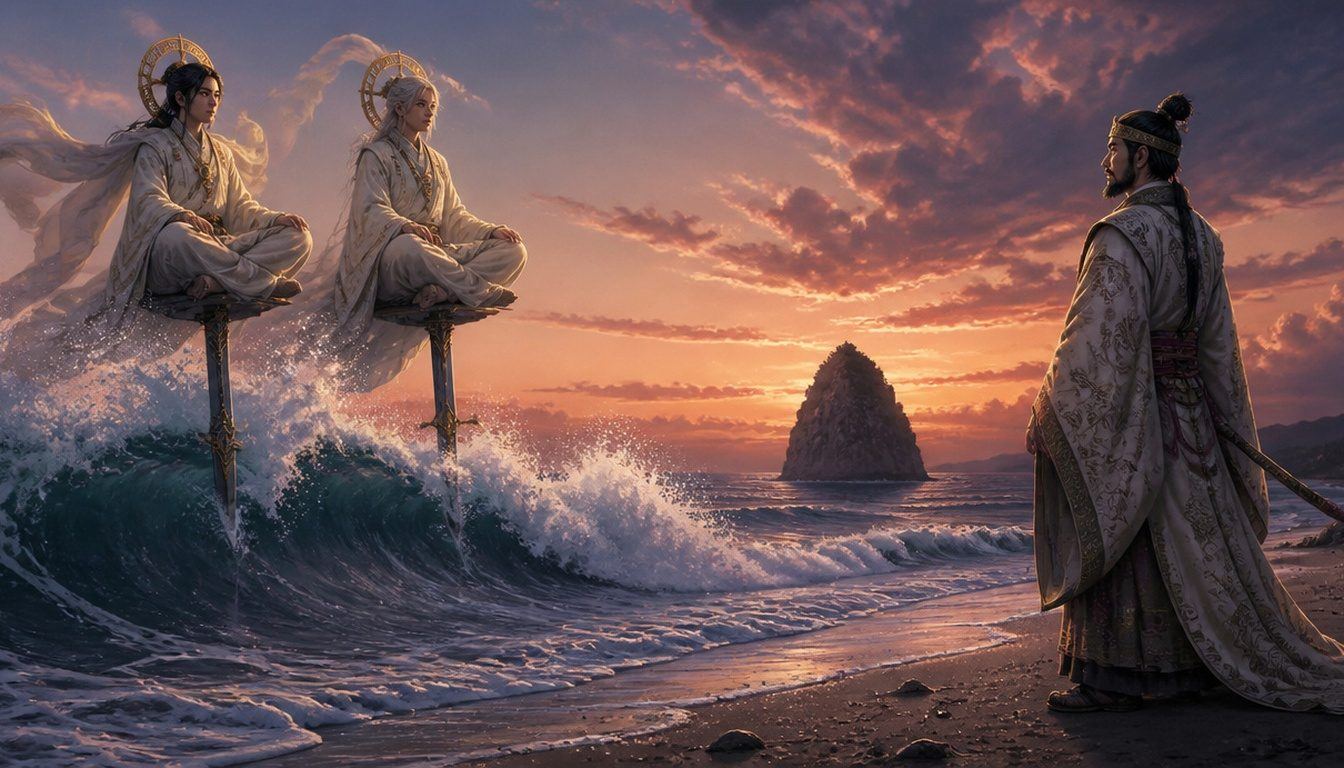
At last heaven sent the thunder-sword god Takemikazuchi with Ame-no-Torifune. They came down to the little beach of Inasa in Izumo, drove their swords point-up into the crest of a wave, sat cross-legged on the points, and asked Ōkuninushi what was in his heart. He said his son Kotoshironushi should answer. Kotoshironushi, fetched from fishing at Cape Miho, agreed that the land should be given up — then tipped over his boat and vanished. Another son, Takeminakata, came carrying a boulder on his fingertips and challenged the envoy to a contest of strength; but Takemikazuchi's hand turned to ice and then to a sword blade, and when he took Takeminakata's hand in turn he crushed it like a reed. Takeminakata fled as far as the lake of Suwa in Shinano, and there he too submitted.
Then Ōkuninushi gave his answer. As his sons had said, so would he: he would yield the land. He asked only one thing — that a dwelling be built for him with pillars sunk to the bedrock and cross-beams raised to the High Plain of Heaven, as grand as the palace of heaven's own heir. There he would withdraw and remain out of sight. With that, the land passed to the heavenly line, and Amaterasu's grandson Ninigi would later descend to rule it.
Chapter Eight
The Shrine That Touched the Sky
The Kojiki says a heavenly dwelling was built for him on the shore of Tagishi in Izumo. That promise is remembered in Izumo Taisha — Izumo Ōyashiro — the Grand Shrine of Izumo, where Ōkuninushi is enshrined, and where the shrine itself traces its origin to the kuni-yuzuri, the "yielding of the land". A Nihon Shoki variant makes the bargain explicit: the heavenly grandchild would govern the visible affairs of the world, and Ōkuninushi would govern the hidden ones, the matters of the gods.
Tradition holds that the ancient shrine stood far taller than today's, and a tenth-century text called it the largest building in the land. Today Ōkuninushi is worshipped above all as the god of en-musubi, the tying of bonds between people — and every autumn, in the lunar tenth month, the gods of all Japan are said to come ashore at the same Inasa beach where the land was once given up, and gather with him in Izumo.
The god who began at the back of the line, carrying his brothers' bag, ended as the lord of everything unseen.
Sources
Sources & Versions
- Kojiki (712), Book One — Chamberlain §XX (descent from Susanoo; the god's five names), §XXI "The White Hare of Inaba", §XXII "Mount Tema", §XXIII "The Nether-Distant-Land", §XXIV–XXV (the wooing songs; the cup pledge with Suseri-hime), §XXVII "The Little-Prince-the-Renowned-Deity" (Sukunabikona), §XXVIII (the god of Mount Miwa/Mimoro), §XXX–XXXII (the deliberation, Ame-no-Wakahiko, the abdication), §XXXIII (Ninigi's descent).
- Nihon Shoki (720), Book I, sixth variant on the Izumo section: Ōnamuchi and Sukunabikona build the land and establish healing; Sukunabikona leaves from Cape Kumano, or is flung to Tokoyo from a millet stalk on Awashima; he arrives in a boat of kagami dressed in wren feathers and slipped through Takamimusubi's fingers (the Kojiki says Kamimusubi). The god of Miwa is identified as Ōnamuchi's own spirit.
- Nihon Shoki, Book II, main text and variants on the land transfer: the envoys are Futsunushi and Takemikazuchi (the Kojiki has Takemikazuchi and Ame-no-Torifune); the beach is called Itasa; Takeminakata does not appear; heaven's command comes from Takamimusubi; in the second variant Ōnamuchi agrees to "direct secret matters" while the heavenly grandchild directs public affairs.
- The White Hare, the brothers' killings and the underworld ordeals appear only in the Kojiki, not in the Nihon Shoki.
- Lineage: the Kojiki makes Ōkuninushi a sixth-generation descendant of Susanoo; the Nihon Shoki main text makes Ōnamuchi Susanoo's son.
- Izumo no Kuni Fudoki (733) offers further Izumo traditions not covered here (see the site's Regional Legends page).
- Izumo Ōyashiro (official): kuni-yuzuri origin, en-musubi, the tall ancient honden, Kamiari festival and Inasa beach.
Source URLs:
- Chamberlain, Kojiki §XXI: https://en.wikisource.org/wiki/Kojiki_%28Chamberlain,_1882%29/Section_21
- §XXII: https://en.wikisource.org/wiki/Kojiki_%28Chamberlain,_1882%29/Section_22
- §XXIII: https://en.wikisource.org/wiki/Kojiki_%28Chamberlain,_1882%29/Section_23
- §XXVII: https://en.wikisource.org/wiki/Kojiki_%28Chamberlain,_1882%29/Section_27
- §XXVIII: https://en.wikisource.org/wiki/Kojiki_%28Chamberlain,_1882%29/Section_28
- §XXX: https://en.wikisource.org/wiki/Kojiki_%28Chamberlain,_1882%29/Section_30
- §XXXI: https://en.wikisource.org/wiki/Kojiki_%28Chamberlain,_1882%29/Section_31
- §XXXII: https://en.wikisource.org/wiki/Kojiki_%28Chamberlain,_1882%29/Section_32
- (Also at sacred-texts.com: https://sacred-texts.com/shi/kj/index.htm)
- Aston, Nihongi Book I: https://en.wikisource.org/wiki/Nihongi/Book_I
- Aston, Nihongi Book II: https://en.wikisource.org/wiki/Nihongi/Book_II
- Izumo Ōyashiro, English overview: https://izumooyashiro.or.jp/en/
- Japan Tourism Agency multilingual commentary, "Kamiari Festival" (Izumo Ōyashiro text): https://www.mlit.go.jp/tagengo-db/R3-00191.html