Seven Lucky Gods
七福神
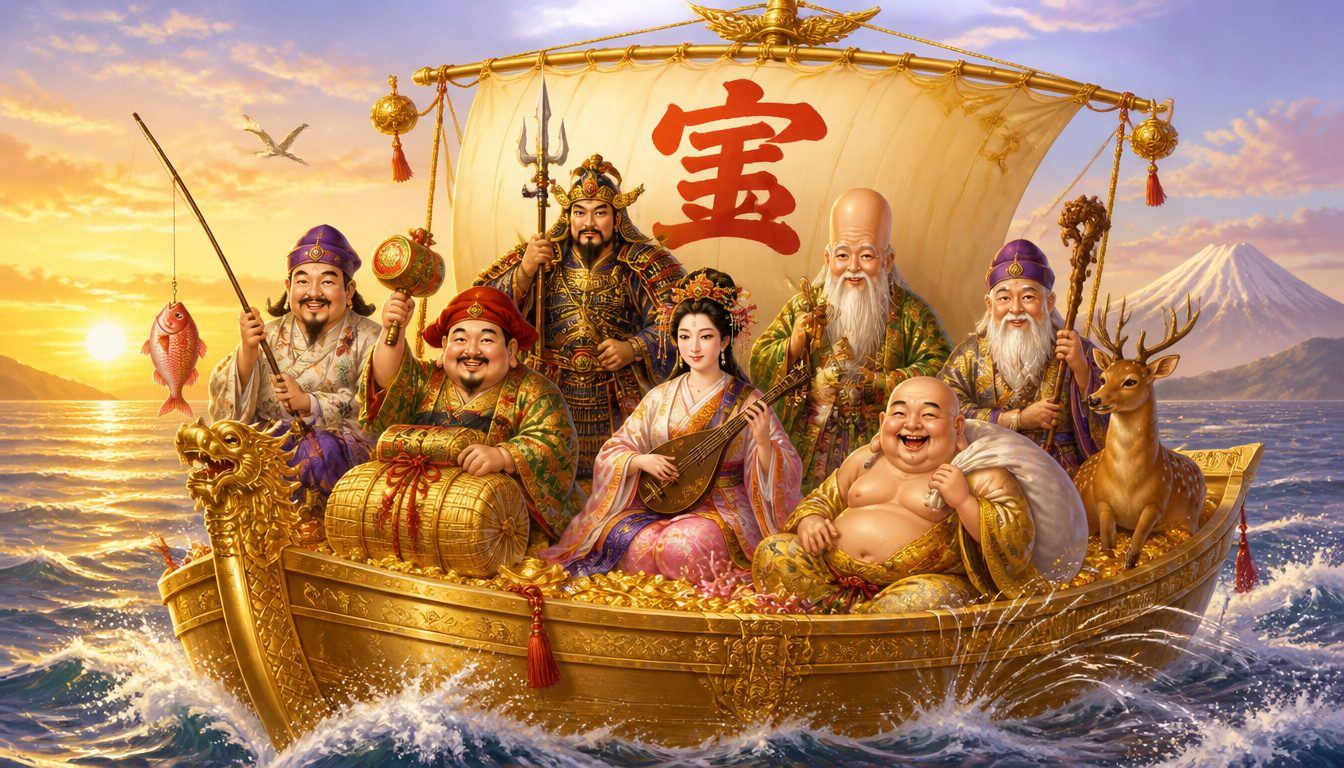
Illustration — The Seven Lucky Gods (Shichifukujin) on their treasure ship: smiling deities with fish, mallet, lute and deer sail past Mount Fuji. About our pictures
Deity (kami)A cheerful crew of seven deities of good fortune - Ebisu, Daikokuten, Bishamonten, Benzaiten, Fukurokuju, Jurōjin and Hotei - often shown sailing together on a treasure ship. Each has a speciality, from fishing and trade to music, wealth, longevity and contentment.
At a glance
Who are the Seven Lucky Gods?
The Shichifukujin (七福神), the "seven gods of good fortune," are a group of deities believed to bring luck, wealth and long life. The usual seven are Ebisu, Daikokuten, Bishamonten, Benzaiten, Fukurokuju, Jurōjin and Hotei. They are best known crowded together aboard a treasure ship heaped with riches.
They are gods, not yokai, but they show better than almost anything else how Japanese popular religion combines traditions. Only one of the seven is a native Japanese god. Three came from India by way of Buddhism, and three from China.
The seven, one by one
Ebisu: the native god
Ebisu is the only one of the seven with Japanese roots. He is shown as a smiling, stout man in old court hunting clothes and a soft pointed cap, holding a fishing rod and a large sea bream. Dictionaries note that his name is related to the word ebisu, "outsider" or "foreigner." The Nipponica encyclopedia traces him to coastal folk belief in "drifting gods," things that wash ashore from the sea. In the language of fishing communities, ebisu could mean a whale, a shark, a stone picked up at the start of the season, or even a drowned body carried in by the tide, all treated as gifts of the sea.
The Kokugakuin University Encyclopedia of Shinto notes that Ebisu was first a feared visitor from outside. He became a guardian of fishers, and through the cult of Nishinomiya Shrine near Kobe, a patron of commerce. He was identified with the kami Kotoshironushi, and in other traditions with Hiruko, the "leech child" of the creation myth. Merchant households held an Ebisu-kō celebration for him in the tenth lunar month.
Daikokuten: the god of the kitchen and the harvest
Daikokuten began as Mahākāla, a fierce Indian deity whom Buddhism adopted as a guardian of the kitchen. In Japan his name, written 大黒, "great black," is pronounced daikoku. That is also the Sino-Japanese reading of 大国, "great land," the characters in the name of Ōkuninushi, the great kami of the land. The Encyclopedia of Shinto explains that this coincidence of sound linked the two, and Daikoku became a gentle, round-faced god of farming and plenty. He wears a soft cloth cap and stands on two bales of rice, with a large sack and a mallet of good fortune.
Bishamonten: the warrior
Bishamonten is the Indian Vaiśravaṇa, chief of the four heavenly kings who guard the Buddhist world. He is the only armoured figure in the group, holding a spear in one hand and a small pagoda in the other.
Benzaiten: the goddess of music
Benzaiten, often called Benten, was originally Sarasvatī, an Indian river goddess. In Japan she became the patron of music, eloquence and wisdom, and she is shown in court dress playing a biwa lute. She is the only woman among the usual seven, and the Japan Art and Architecture Net Users System (JAANUS) notes that she joined the group somewhat later than the others.
Fukurokuju and Jurōjin: the old men of long life
These two Chinese figures are closely alike. The Encyclopedia of Shinto explains that both personify the Southern Pole Star, which in Daoist belief governed the length of a person's life. Fukurokuju is recognised by his extremely tall, domed head and is often shown with a crane. Jurōjin carries a staff with a scroll and is often accompanied by a deer. Because they overlapped, they were sometimes counted as a single god. When that happened, another deity was brought in to keep the number at seven, usually Kichijōten, the Buddhist goddess of beauty and fortune, or the shōjō, a monkey-like creature of Chinese legend that could speak and loved sake.
Hotei: the laughing monk
Hotei is based on a real person, a Chan (Zen) monk named Qici who lived in China during the Later Liang dynasty (907–923). Art shows him as a stout, pot-bellied figure carrying a huge cloth bag. The Encyclopedia of Shinto says that he joined the gods of fortune because of his round, cheerful appearance.
How the group came together
Nobody knows exactly why these seven were put together, and JAANUS states plainly that the reason is uncertain. Two influences are usually cited. One is the Chinese theme of the Seven Sages of the Bamboo Grove, a favourite subject for painters. The other is a phrase from a Buddhist scripture, the Ninnō-kyō (Sutra of Benevolent Kings), about seven calamities vanishing and seven blessings arising.
The most common answer to "when" is the Muromachi period (1336–1573). The Encyclopedia of Shinto says the cult is thought to have begun then, and the Nipponica encyclopedia states that the group had already formed by the early Muromachi period. It cites a procession of people dressed as the seven gods in Kyoto in 1420. It also records that in the Bunmei era (1469–1487), thieves disguised as the gods of fortune were welcomed into houses. Kyōgen comedies of the period featuring Ebisu and Daikoku show that the cult had already spread. Another Encyclopedia of Shinto entry gives a slightly wider range, saying the group came to be recognised sometime between the Muromachi and early Edo periods. It credits the growth of commerce, the work of travelling entertainers, and demand for hanging scrolls to decorate the tokonoma alcove.
The line-up was not fixed at first, and it settled only gradually. In the Edo period (1603–1868) the gods were endlessly reproduced in painting, sculpture, prints and folk performance, and the familiar seven became the standard picture.
The treasure ship and the first dream
The best-known image of the seven is the takarabune, the treasure ship, sailing in loaded with rice bales, gold, silver and magic treasures. It expresses the old belief, found in the Ebisu cult as well, that wealth arrives from across the sea.
The ship belongs to a New Year custom. Japanese dictionaries describe placing a picture of the takarabune under your pillow on the night of 2 January to bring a lucky hatsuyume, the first dream of the year. The custom is older than the gods' presence on the ship. The Nihon Kokugo Daijiten says the practice already existed in the Muromachi period, when it was meant to ward off bad dreams. At court, ship pictures were given out with the character for baku, the dream-eating beast, written on the sail. The oldest surviving pictures show a ship carrying only ears of rice. Pictures of the seven gods aboard a ship loaded with treasure became popular in the mid-Edo period. If a bad dream came anyway, the picture was floated away down a river the next morning. In Edo and Meiji times, sellers walked the streets at New Year calling out "O-takara, o-takara!" ("treasure, treasure!"). Many prints carry a short poem that reads the same forwards and backwards.
Shichifukujin pilgrimages
From the Edo period onwards, a popular way to honour the seven has been to visit them all. A Shichifukujin-meguri or Shichifukujin-mairi is a walking circuit of seven temples and shrines, each housing one of the gods. It is done mainly in the first days of the New Year. The Encyclopedia of Shinto notes that the Tokyo area is particularly known for these New Year pilgrimages. Today many towns have their own circuit, named after the district, and many walkers collect a temple seal, goshuin, at each stop.
The Yanaka circuit in Tokyo, a route of seven Buddhist temples running from Tabata to Ueno, is often said to be the oldest in the city. Kyoto's Miyako Shichifukujin, a circuit stretching from Manpukuji in Uji to Sekizan Zen'in in the north of the city, is said to be the oldest in Japan. Because both claims come from local tradition and promotion, it is fairer to say simply that the custom grew up in the Edo period.
Frequently asked questions
What are the names of the Seven Lucky Gods?
The usual seven are Ebisu, Daikokuten, Bishamonten, Benzaiten, Fukurokuju, Jurōjin and Hotei. In some older sets Kichijōten or the shōjō replaces one of them, because Fukurokuju and Jurōjin were sometimes treated as the same god.
Which of the Seven Lucky Gods is Japanese?
Only Ebisu is native to Japan. Daikokuten, Bishamonten and Benzaiten came from India through Buddhism, and Fukurokuju, Jurōjin and Hotei came from Chinese Daoist and Buddhist tradition.
When did the Seven Lucky Gods originate?
The group is generally dated to the Muromachi period. A procession of people dressed as the seven is recorded in Kyoto in 1420. The membership took a long time to settle, and the familiar set became standard in the Edo period.
Why do Japanese people put a treasure ship under their pillow?
A picture of the takarabune placed under the pillow on the night of 2 January is said to bring a lucky first dream of the year. The custom began as a charm against bad dreams and only later came to show the seven gods aboard.
What is a Shichifukujin pilgrimage?
It is a walking circuit, usually made in early January, of seven temples and shrines, each dedicated to one of the gods. Many Japanese cities and districts have their own route.
Sources & further reading
- Shichifukujin, Encyclopedia of Shinto, Kokugakuin University
- Fukujin shinkō (Ebisu, Daikoku and the seven gods), Encyclopedia of Shinto, Kokugakuin University
- Shichifukujin, JAANUS (Japanese Architecture and Art Net Users System)
- Shichifukujin entries (Kotobank: Nipponica, Heibonsha, Nihon Kokugo Daijiten, Ōbunsha)
- Ebisu entries (Kotobank: Nihon Kokugo Daijiten, Daijisen)
- Takarabune entries (Kotobank: Nihon Kokugo Daijiten, Nipponica, Sekai Daihyakka)
- Shichifukujin Meguri: the Yanaka pilgrimage (Tokyo Cheapo)
- Kyoto's seven gods of fortune and the Miyako Shichifukujin (Keihan Railway, Japanese)
- Shichifukujin Meguri in Tokyo (Japan Experience)
- Seven Lucky Gods (Wikipedia, used as a pointer)
- yokai.jp — shichi-fukujin