Chapter One
The Child of the Right Eye
Of the three great children of Izanagi, the moon god Tsukuyomi is the quietest — the Kojiki names him and then never mentions him again. But the Nihon Shoki keeps one story about him: a feast, a killing, and a quarrel with his sister the sun that explains why day and night have lived apart ever since.
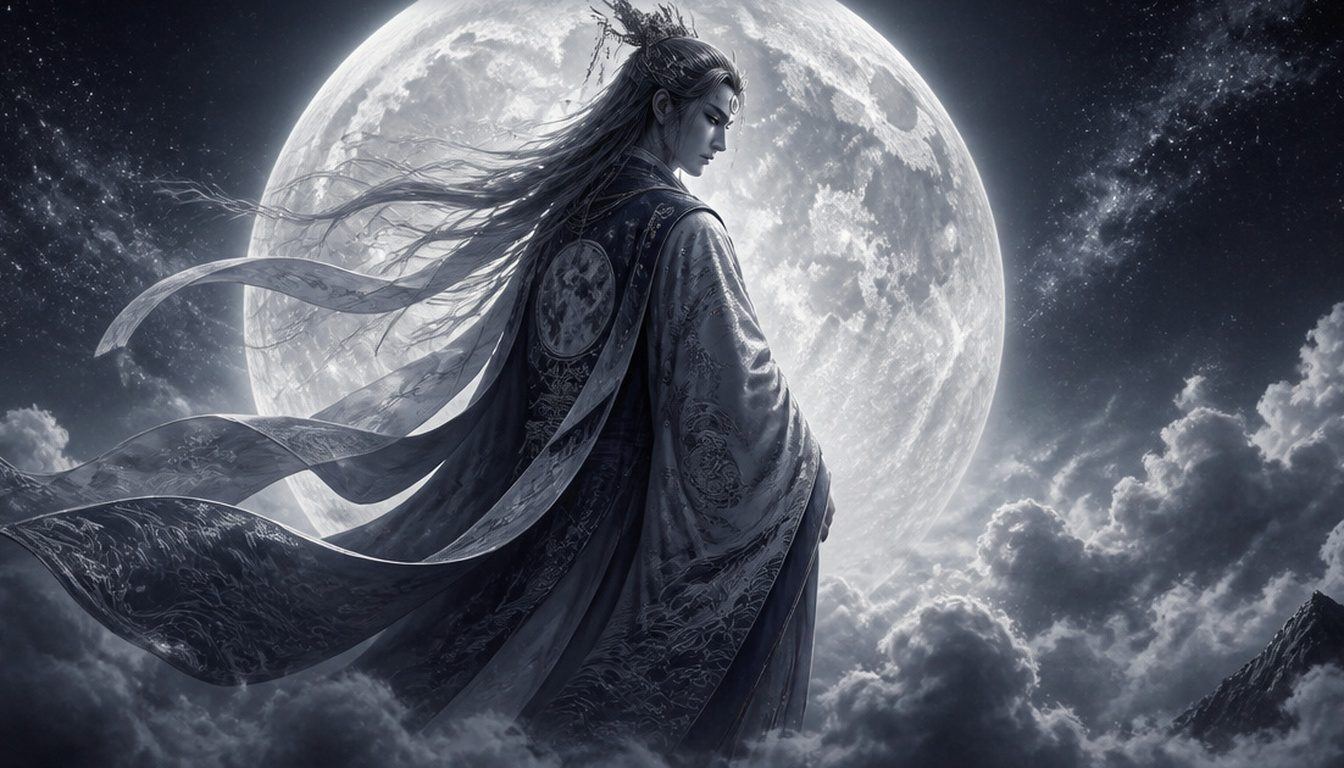
When Izanagi returned from the land of the dead, he went down to a river mouth to wash away its pollution. As he washed his left eye, Amaterasu, the sun goddess, was born. As he washed his right eye, Tsukuyomi (月読命) was born. As he washed his nose, Susanoo was born. Izanagi rejoiced that at the end of all his begetting he had three noble children.
He gave each of them a realm. To Amaterasu he gave the High Plain of Heaven. To Susanoo he gave the sea. And to Tsukuyomi, in the Kojiki's words, he gave the realm of night.
His name is usually read as "moon-reckoner": tsuki, the moon, and yomu, to count or read — the one whose phases measured out the months for people who planted and harvested by the lunar calendar. He is usually understood as a male god, a cool, silver counterpart to his radiant sister.
Chapter Two
The Moon Who Was Not Forgotten
After that, the Kojiki falls silent about him. Amaterasu hides in her cave, Susanoo slays the serpent, Ōkuninushi builds the land — and the moon god does not appear again.
The Nihon Shoki, finished eight years after the Kojiki, remembered him differently. Instead of one account it gathers many, setting the official telling beside a row of "other writings" (aru fumi) that the compilers had collected. In its main account, the moon was born after the sun and given a place beside her in the sky, because his light was second only to hers. In one variant he is told to rule the tides of the ocean. And in another — the eleventh variant on the birth of the gods — he is set beside his sister to share in the affairs of heaven. It is in that variant that his story is told.
Chapter Three
The Errand
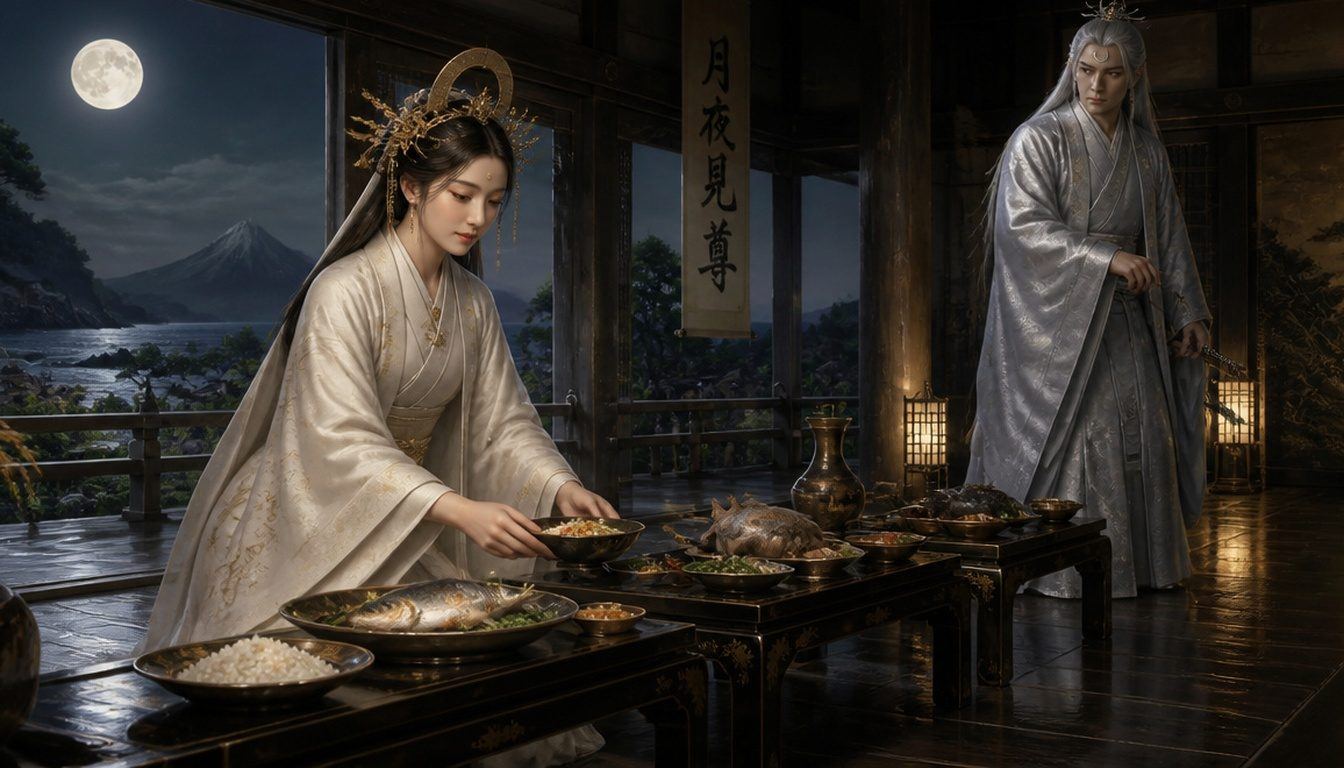
Amaterasu, newly enthroned in heaven, had heard that down in the Central Land of Reed-Plains there lived a goddess named Ukemochi (保食神, "Keeper of Food"). She sent her brother Tsukuyomi down to wait upon her.
Ukemochi welcomed the moon god with a feast. She turned her face towards the land, and boiled rice came from her mouth. She turned towards the sea, and from her mouth came fish of every kind, broad-finned and narrow-finned. She turned towards the mountains, and from her mouth came game, rough-coated and soft-coated. All of it she arranged on a hundred tables and set before her guest.
Chapter Four
A Feast Refused
Tsukuyomi saw where the food had come from, and his face darkened with anger. It was filthy, he said — how dare she serve him things she had spat from her own mouth? He drew his sword and struck her down.
To the moon god it was an insult. To the reader of the myth it is something stranger: the abundance of the whole world — the fields, the sea, the mountains — had been pouring out of a single goddess, and he had cut it off.
Chapter Five
Day and Night Divided
Tsukuyomi returned to heaven and reported everything he had done. Amaterasu was furious. He was a wicked god, she told him, and she would never again look upon his face.
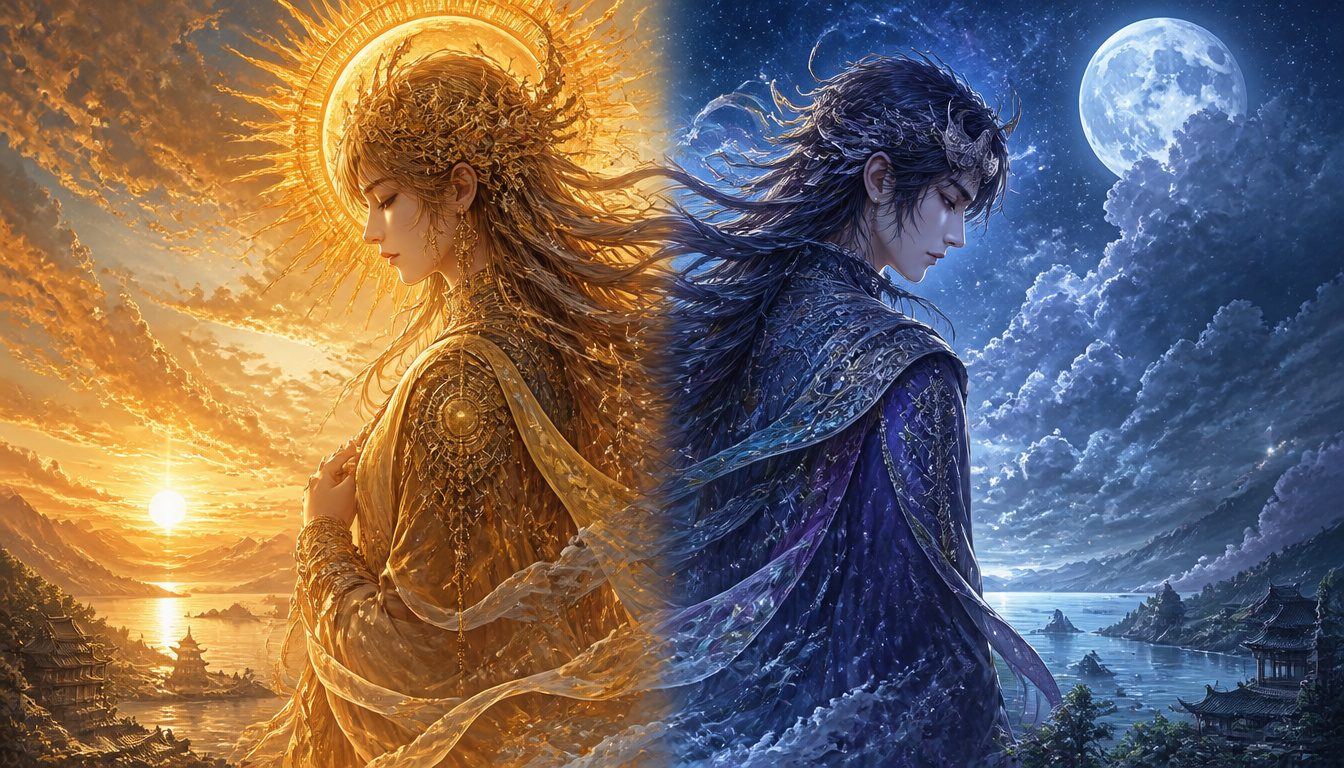
From then on the sun and the moon lived apart, separated by a day and a night. She rules the daylight; he rises only after she has gone. The two can share the sky, but never meet face to face.
Chapter Six
Seeds from the Fallen Goddess
Amaterasu sent another messenger, Ame-no-Kumahito, to see what had become of Ukemochi. The goddess was truly dead. But her body had not stopped giving. From the crown of her head had come the ox and the horse; from her forehead, millet; from her eyebrows, silkworms; from her eyes, barnyard millet; from her belly, rice; and from her loins, wheat and beans, large and small.
The messenger gathered all of it and carried it to heaven. Amaterasu rejoiced: these, she said, were the things that living people would eat to survive. She made the millets, wheat and beans the seed of the dry fields, and rice the seed of the flooded paddies, and sowed the first rice in the fields of heaven. That autumn the ears hung heavy and long. She took the silkworms in her mouth and drew thread from them, and so began the art of raising silk.
Out of a killing came agriculture. The gods' quarrel left humankind its harvest.
Chapter Seven
The Other Telling: Susanoo and Ōgetsu-hime
Readers who know the Kojiki will recognise this story — but with a different god holding the sword. In the Kojiki, the moon god never kills anyone. The food goddess is slain by Susanoo.
In the Kojiki's version, Susanoo has just been expelled from heaven after his rampage — the rampage that drove Amaterasu into her cave. On his way down he asks for food from the goddess Ōgetsu-hime (大気都比売, "Princess of Great Food"). She draws delicacies from her nose, her mouth and her body and prepares them for him. Susanoo, spying on her, thinks she is serving him filth and kills her. From her head grow silkworms; from her eyes, rice; from her ears, millet; from her nose, red beans; from her loins, wheat; from her lower body, soybeans. The creator deity Kamimusubi has them gathered and made into seed.
The two chronicles agree on the shape of the myth: a food goddess who produces food from her own body, an offended god, a killing, and the first crops springing from her corpse. They disagree on who struck the blow, which goddess died, and what the killing explains — in the Kojiki it is the origin of seeds; in the Nihon Shoki it is also the reason the sun and moon never meet. Some scholars have noted that the Nihon Shoki's Tsukuyomi, who in one variant rules the sea and in this one kills a food goddess, looks remarkably like Susanoo — and that a moon god, who measures the farming year, is a fitting figure to stand at the origin of crops. The Kojiki was never wrong and the Nihon Shoki never right; ancient Japan simply remembered the story more than one way.
Chapter Eight
The Moon God Today
Tsukuyomi has no great adventure of his own, but he was never forgotten. At the Grand Shrines of Ise, where his sister Amaterasu is enshrined, he has his own detached shrines — Tsukiyomi-no-miya near the Inner Shrine and Tsukiyomi-no-miya near the Outer Shrine (the names are written with different characters) — and older shrines to him stand in the Kyoto and Ise regions. The Nihon Shoki even records, in the reign of Emperor Kenzō, an oracle in which the moon god spoke through a human medium and asked for land to be offered to the creator deity Takamimusubi.
Each night, when the sun has set and the moon comes up alone, the old story is told again without words: two divine siblings who share the same heaven and have not looked at each other since the day of the feast.
Sources
Sources & Versions
- Kojiki (712), Book One — Chamberlain §X (Tsukuyomi born from Izanagi's right eye), §XI (Izanagi assigns the realms: Tsukuyomi receives the realm of night), §XVII (Susanoo kills Ōgetsu-hime; the seeds). Tsukuyomi does not reappear in the Kojiki.
- Nihon Shoki (720), Book I ("Age of the Gods", part 1), the section on the birth of the deities: main text (sun and moon born of Izanagi and Izanami; the moon sent to the sky beside the sun); a variant in which Tsukuyomi is to rule the tides of the ocean; and the eleventh variant ("In one writing it is said…"), which contains the Ukemochi story told here. The killing of Ukemochi and the separation of day and night are not in the Kojiki.
- Nihon Shoki, Book XV (Emperor Kenzō) — oracle of the moon god.
- Names: Aston gives the messenger as Ame-kuma-bito (天熊人); some modern references read the name Ame-no-Kumanoushi. Ukemochi and Ōgetsu-hime are sometimes identified as the same goddess, but the texts present them separately.
Source URLs:
- Chamberlain, Kojiki §XI: https://en.wikisource.org/wiki/Kojiki_%28Chamberlain,_1882%29/Section_11
- Chamberlain, Kojiki §XVII: https://en.wikisource.org/wiki/Kojiki_%28Chamberlain,_1882%29/Section_17
- Aston, Nihongi Book I: https://en.wikisource.org/wiki/Nihongi/Book_I
- (Also at sacred-texts.com: https://sacred-texts.com/shi/kj/index.htm and https://sacred-texts.com/shi/nihon0.htm)
- Kokugakuin, "Tsukuyomi": https://d-museum.kokugakuin.ac.jp/eos/detail/?id=9136
- Kokugakuin, "Ukemochi": https://d-museum.kokugakuin.ac.jp/eos/detail/?id=9741