Raijin
雷神
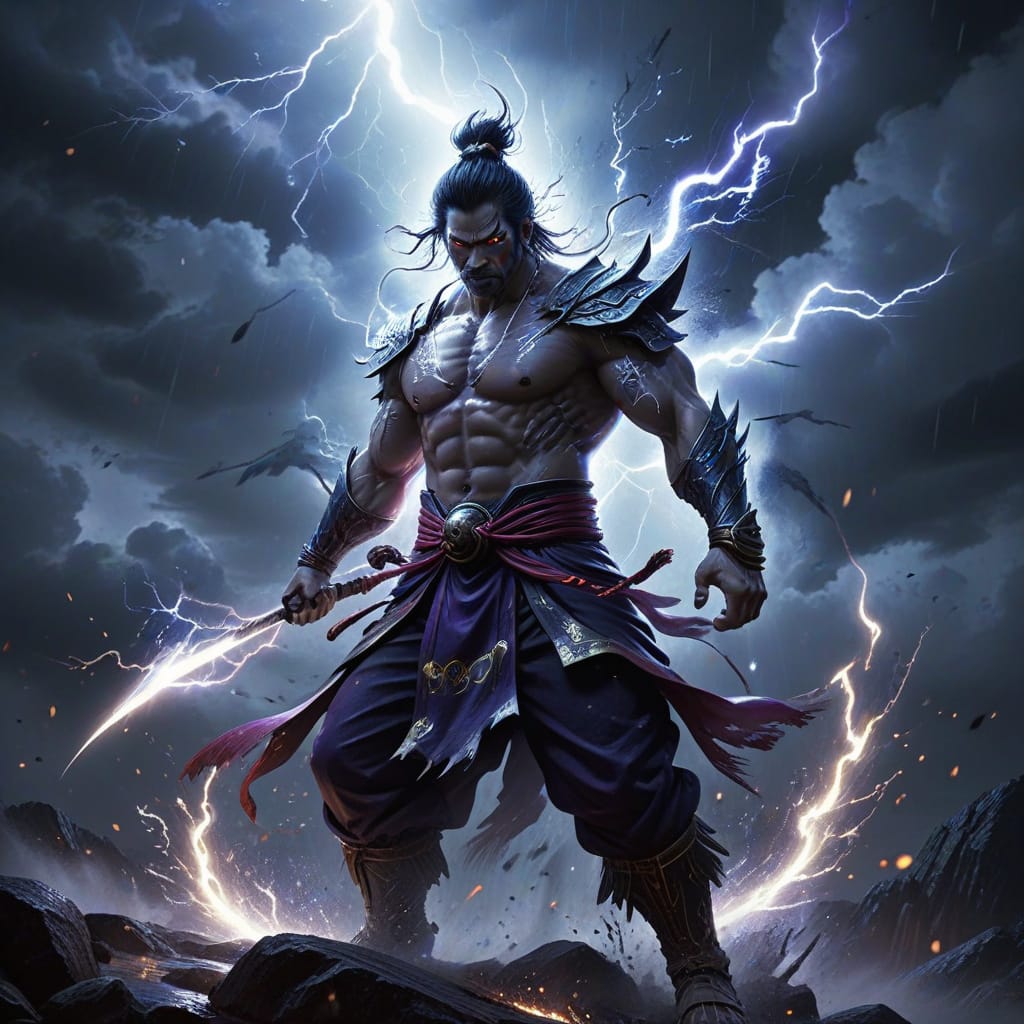
Illustration — Raijin, the Japanese thunder god: a bare-chested warrior with glowing red eyes and a lightning-charged sword amid storm clouds and lightning bolts. About our pictures
Deity (kami)The god of lightning, thunder, and storms. Depicted as a fearsome demon-like figure surrounded by drums that he beats to create thunder. Often paired with Fujin, the wind god, as at Kyoto's Sanjusangendo temple.
At a glance
What is Raijin?
Raijin (雷神) means "thunder god," and it names the kami of thunder and lightning in Japanese religion and folklore. In everyday speech he is often called Kaminari-sama, and kaminari, the ordinary word for thunder, can be read as "the kami sounding." The image most people know comes from temple art: a muscular, demon-like figure with wild hair, a tiger-skin loincloth and a ring of drums, which he beats to make the thunder roll.
Raijin is a god rather than a yokai in the strict sense, but he belongs in any yokai encyclopedia. The line between kami and monster in Japan has always been thin, and the thunder god sits right on it. He was feared as a bringer of fire and death, and honoured as the source of the rain that rice farming depends on. Scholars of Shinto describe him as both a dangerous kami of calamity and a guardian of agriculture.
Appearance and attributes
The familiar Raijin is the creation of Buddhist art. The Kokugakuin University Encyclopedia of Shinto notes that ancient Japanese texts associate the thunder kami with a serpent or a small child. Only from around the Kamakura period (1185–1333) do images show a demonic figure with a drumstick, surrounded by a circle of linked drums. Japanese dictionaries describe the standard form the same way: an oni-like being in a tiger-skin loincloth, carrying a ring of drums on his back and holding drumsticks in his hands. One encyclopedia entry suggests that the drum-bearing image came to Japan with Buddhism.
Raijin is almost always shown with his partner Fūjin, the wind god, who carries a bag of wind over his shoulders. The two often appear as a matched pair at the gates or ends of a temple hall. Many popular sites call them brothers or twins. We have found no classical Japanese text that says so. The pairing comes from art and temple tradition, not from a family tree.
Origins: thunder in the Kojiki
The oldest Japanese account of thunder deities is a grim one. In the Kojiki, compiled in 712, the creator goddess Izanami dies after giving birth to the fire god and goes to Yomi, the land of the dead. Her husband Izanagi follows her and, breaking her command not to look at her, lights a torch. In Basil Hall Chamberlain's 1882 translation he sees her body rotting, and in its different parts "eight Thunder-Deities had been born and dwelt there." The Great-Thunder is in her head and the Fire-Thunder in her breast, with others in her belly, hands, feet and genitals. When Izanagi flees, Izanami sends these eight thunders, with "a thousand and five hundred warriors of Hades," to chase him. He escapes by throwing peaches at the pass between the worlds.
The Encyclopedia of Shinto names these beings Yakusa no ikazuchi, the eight kinds of thunder kami, and notes that the Nihon shoki gives a somewhat different list. It suggests the number eight here most likely means simply "a great many." This is not yet the drum-beating Raijin of later art, but it shows how early thunder was tied to death, decay and the underworld. You can read the full story on our page on Izanagi and Izanami.
Thunder and the rice harvest
Alongside fear there was gratitude. Thunderstorms bring summer rain, and farmers saw the thunder kami as a protector of crops. The Encyclopedia of Shinto points out that two common words for lightning, inazuma and inabikari, contain ina, rice stalks. It was believed that lightning made the rice fertile. Where lightning struck a paddy, farmers would set up fresh bamboo and a sacred rope, shimenawa, and expect a good harvest. Rain-prayer rituals, amagoi, were held at thunder shrines.
The violent side still had to be managed. In some regions, thunder during rice planting was answered with a rite to drive the kami away, using split bamboo or sickle blades raised on poles. Japanese encyclopedias single out Tochigi Prefecture, north of Tokyo, as a land of frequent thunder with several Raiden (thunder-and-lightning) shrines, which, like others in neighbouring Gunma, have long issued charms against lightning.
Famous legends
Sugaru catches the thunder
One of the first tales in the Nihon ryōiki, a collection of Buddhist stories compiled in the early ninth century, is about catching the thunder god. Thunder rolls at an awkward private moment for Emperor Yūryaku, and he orders his servant Sugaru to bring the thunder god to him. Sugaru rides out with a red banner on his lance, calls on the god in the emperor's name and finds that it has fallen to earth near Toyura Temple. The thunder is carried back to the palace in a palanquin. It shines so fiercely that the frightened emperor sends it back with offerings to the place where it fell. Years later, when Sugaru dies, the emperor builds his grave on that same spot. The angry thunder god stamps on the memorial stone and gets caught in the crack, and has to be released by the emperor. The place was remembered as the Hill of Thunder.
Sugawara no Michizane and the thunder god
The most consequential thunder story in Japanese history concerns a real man. Sugawara no Michizane (845–903) was a scholar and minister who was demoted and sent to Dazaifu in Kyushu in 901, where he died two years later. Disasters in the capital were then blamed on his angry spirit. The Encyclopedia of Shinto records that in 930 lightning struck the imperial palace, deeply shaking Emperor Daigo. In the Heian period, lightning strikes in Kyoto came to be read as the curse of a vengeful spirit, a goryō. Michizane's spirit became fused with the thunder kami as Karai Tenjin, "the fire-and-thunder heavenly deity." This was the start of the Tenjin cult at Kitano Tenmangū in Kyoto, founded after oracles in the 940s, which reshaped Japanese belief about thunder. The illustrated scrolls of Kitano's founding legend, the Kitano Tenjin engi, contain some of the best-known early pictures of the thunder god.
The thunder god who takes navels
Generations of Japanese children have been told to cover their bellies when a storm rolls in, or Kaminari-sama will take their navels. A 2022 study by researchers at Musashino University that surveys the saying records the usual explanations. One is that the cool air that follows a summer thunderstorm can upset the stomach of a child sleeping with their belly bare, so the warning is a parent's way of making sure the child is covered. Another is that hugging your belly to hide your navel puts you in a low crouch, which is the safer position in a storm. The same study notes a temple legend from Akishino-dera in Nara, in which it was a priest who captured the thunder god and tore out its navel.
Raijin in temples and art
The definitive sculptures of the pair stand in Kyoto's Sanjūsangendō, the long hall famous for its 1,001 standing images of Kannon. According to the temple, its Fūjin and Raijin statues are Kamakura-period National Treasures. Raijin is 105 cm tall and Fūjin 123 cm, and the temple links them to the sculptor Tankei, who led the rebuilding of the hall's images. The temple says these statues fixed the image of the two gods for every artist who came after.
The most famous painting is Tawaraya Sōtatsu's Wind God and Thunder God Screens, a National Treasure owned by Kenninji temple in Kyoto. The Kyoto National Museum describes it as a pair of two-fold screens on gold leaf from the seventeenth century. The figures seem to float in an endless gold space. Ogata Kōrin and, later, Sakai Hōitsu both made their own versions of it.
In Tokyo, the great Kaminarimon gate of Sensōji in Asakusa is properly called Fūraijinmon, the Gate of the Wind and Thunder Gods. Sensōji explains that the two gods were set there to keep away storm damage and protect the temple, and also as a prayer for good weather and harvests. The statues lost their bodies in a fire in 1865, when only the heads were saved. Their bodies were remade in 1874, and the present gate was rebuilt in 1960.
Frequently asked questions
Are Raijin and Fujin brothers?
No classical Japanese text makes them brothers. They are a traditional artistic and religious pair, set side by side in temples such as Sanjūsangendō and in Sōtatsu's screens, but the "brothers" or "twins" idea appears to be a modern embellishment.
Is Raijin a yokai or a god?
Raijin is a kami, a god of thunder and lightning. He is often included among yokai because of his frightening, oni-like appearance and his role in folk belief, where he could be both a destroyer and a giver of rain.
Why does Raijin carry drums?
The drums make the thunder. From around the Kamakura period Buddhist art showed the thunder god with a ring of linked drums and drumsticks, and that image has stayed standard ever since.
Why do Japanese children hide their belly buttons during thunderstorms?
Children are told that Kaminari-sama will take their navel. The usual explanations are that it keeps a child's stomach covered as cold air follows a summer storm, and that hiding the navel puts you in a low crouch, which is safer during lightning.
Where can I see Raijin in Japan?
Famous images include the Kamakura-period statues at Sanjūsangendō in Kyoto, Sōtatsu's screens owned by Kenninji in Kyoto, and the statues in the Kaminarimon gate of Sensōji in Tokyo.
Sources & further reading
- Raijin, Encyclopedia of Shinto, Kokugakuin University
- Yakusanoikazuchi, Encyclopedia of Shinto, Kokugakuin University
- Tenjin Shinkō, Encyclopedia of Shinto, Kokugakuin University
- Kojiki, tr. B. H. Chamberlain (1882), Section IX: The Land of Hades (Wikisource)
- Raijin entries (Kotobank, Japanese dictionaries and encyclopedias)
- Nihon ryōiki, tr. Hiromi Itō and Jerome Rothenberg (Jacket2)
- Kobayashi et al., "Scientific evaluation for folklore related to lightning" (Musashino University, 2022, Japanese)
- Fūjin and Raijin statues, Sanjūsangendō (official site, Japanese)
- Wind God and Thunder God Screens, Kyoto National Museum
- Kaminarimon (Fūraijinmon), Sensōji (official site, Japanese)
- Sanjūsangendō, World History Encyclopedia
- Raijin (Wikipedia, used as a pointer)
- en.wikipedia.org — Fūjin