Ryujin
龍神
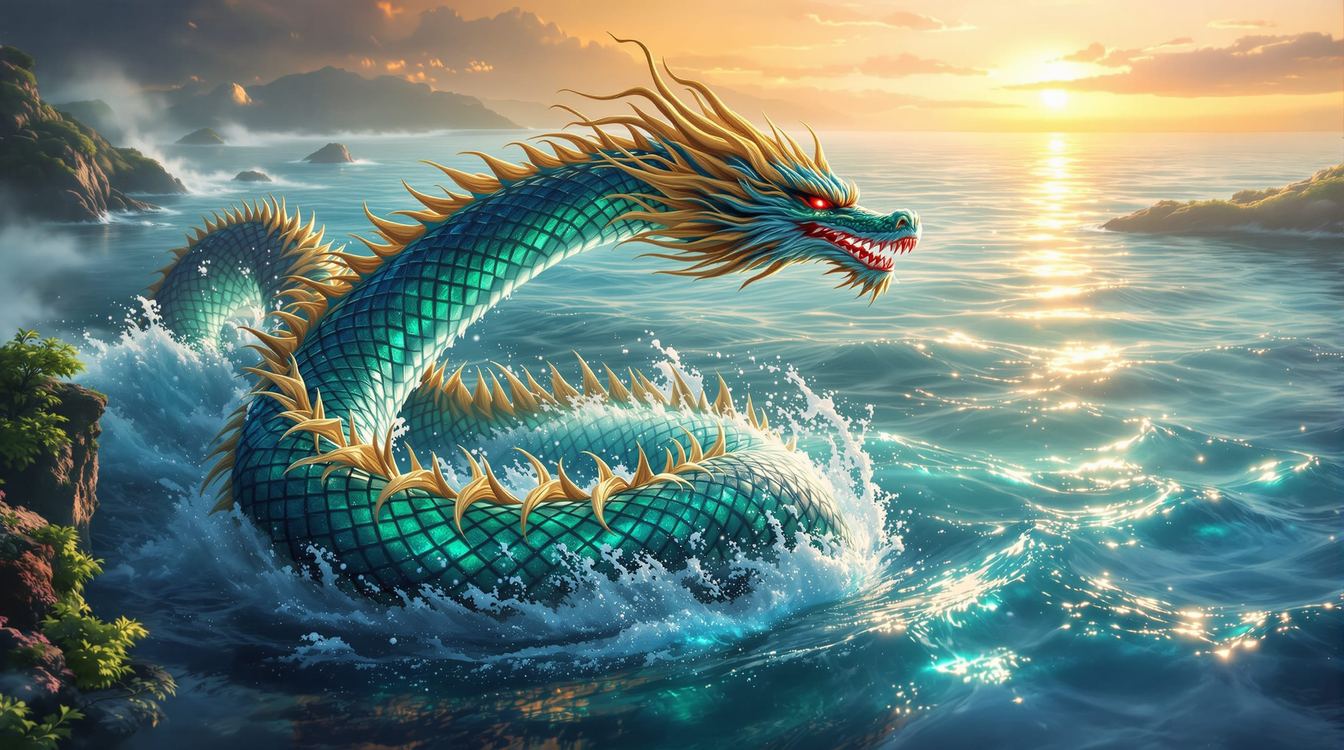
Illustration — Ryujin, the Japanese dragon god of the sea: a turquoise dragon with golden spines and red eyes coils through sunlit waves. About our pictures
Deity (kami)The dragon god of water and the sea, who brings rain and rules the waves. Ryujin lives in the Dragon Palace (Ryugu-jo) beneath the sea and owns the jewels that raise and lower the tides.
At a glance
Who is Ryujin?
Ryūjin (龍神 or 竜神), the "dragon god", is the name Japanese people give to the dragon that rules water. He lives in deep pools, lakes and the sea, brings rain, and owns a palace full of treasure called the Ryūgū, the Dragon Palace. Fishermen pray to him for calm water and good catches. Farmers once prayed to him for rain.
He is not a single god with one fixed story. Shōgakukan's Nipponica encyclopedia says Ryūjin is also called ryūō ("dragon king") or simply ryū ("dragon"). It describes Japanese dragon-god belief as an old native faith in water gods that merged with dragon beliefs brought from China. The Kokugakuin University Encyclopedia of Shinto makes the same point more sharply. Chinese ideas shaped the cult, but the Japanese dragon that people actually worshipped was a deified snake, the symbol of a water god.
Watatsumi and the dragon kings
Japan's oldest written myths have a sea god, but he is not called a dragon. In the Kojiki (712) he is Watatsumi (綿津見神). The Kokugakuin encyclopedia explains the name as "holder of the sea". Izanagi and Izanami produce him while giving birth to the gods, and three more Watatsumi gods appear when Izanagi washes himself after his return from the land of the dead. In the best-known myth, the young prince Hoori loses his brother's fishhook, goes down to Watatsumi's palace, marries his daughter Toyotama-hime and comes home with the jewels that rule the tides. That story is told in full on our page Ryujin's Palace.
The sea god's family matters to the imperial line. In the Kojiki, Toyotama-hime bears Hoori a son, Ugayafukiaezu, and then returns to the sea, leaving her younger sister Tamayori-hime to nurse the child. When he grows up he marries Tamayori-hime, and their youngest son is Kamu-yamato-iware-biko, remembered as Jimmu, the legendary first emperor. Jimmu's grandmother and his mother were therefore both daughters of the sea god. Through them the imperial house traces its descent from the sea as well as from the sun goddess Amaterasu. In the chronicles that ancestor is Watatsumi, not a dragon king. Calling him Ryūjin belongs to the later merger described below.
The dragon kings came with Buddhism. In Buddhist texts they are nāga, serpent beings who live in water and make clouds and rain. Heibonsha's Sekai Daihyakka Jiten notes that they count among the eight kinds of beings who protect Buddhism. Two of them, Nanda and Upananda, are said to have poured pure water over the newborn Buddha. The Lotus Sutra names eight dragon kings in the crowd that heard the Buddha preach, and Japan knew them as the hachidai ryūō, the Eight Great Dragon Kings. In Indian art, Heibonsha adds, these kings wear a cobra's hood on their heads. In Japanese paintings of the Buddha's death they become armoured figures wearing Chinese-style scaly dragons as crowns.
Over time the two pictures merged. Nipponica points to an early sign of this in the Nihon Shoki (720). In the Kojiki, Toyotama-hime shows her true form while giving birth as a wani, a great sea creature. The Nihon Shoki's main text says she turned into a dragon instead, which Nipponica puts down to contact with dragon-god belief. The Kokugakuin encyclopedia is careful about how far the merger went. The ocean gods of the great Sumiyoshi and Munakata shrines are tied to the Watatsumi of myth. But the sea god whom ordinary fishermen prayed to "had little relation to the kami of myth". That popular god was Ryūjin. The encyclopedia adds that Shugendō mountain ascetics are thought to have done much to spread his cult. Britannica Japan likewise suggests that the word ryūjin was first used by medieval Shugendō practitioners.
The Dragon Palace and Urashima
The word ryūgū, "dragon palace", is old in Japan. The Nihon Kokugo Daijiten finds it in a court poem in the Ryōunshū anthology of 814. Its earliest example of Ryūgū-jō, "Dragon Palace castle", is from the Buddhist tale collection Hōbutsushū, of about 1179, where someone goes to the Dragon Palace to beg for a wish-granting jewel.
The idea had deep Buddhist roots. Heibonsha cites sutras that place the palace of the dragon king Sāgara at the bottom of the great ocean, with seven rings of walls all decorated with the seven treasures. The Lotus Sutra tells of Sāgara's daughter, who reaches enlightenment at the age of eight. Chinese writers added a sea dragon king whose palace lay under the sea east of Suzhou. In Japan, Heibonsha says, the Dragon Palace became a paradise across or under the sea, full of beauty, pleasure and riches. It could also be a land of the dead. The Tale of the Heike hints at this when the child emperor Antoku drowns at the end of the Genpei War.
The most famous visitor is Urashima. Nipponica traces his story to the Nihon Shoki entry for the 22nd year of Emperor Yūryaku, the Man'yōshū (volume 9) and a surviving passage from the Tango Fudoki. In those early versions he goes to Tokoyo or Hōrai, the land of immortals, not to a dragon palace. The Nihon Kokugo Daijiten says the name Urashima Tarō only appears from the Muromachi-period otogizōshi stories onward. Nipponica adds that the familiar ride on a turtle's back to Ryūgū-jō is a medieval and later form. The dragon god himself plays little part in it. The tale is set in his palace, and its heroine is the princess Otohime.
Her name is later still. Otohime (乙姫) originally meant simply "younger princess", the opposite of an elder one, as Heibonsha and Nipponica both explain. The Nihon Kokugo Daijiten finds it used for the princess of the Dragon Palace only from 1563. The earlier versions call her a woman transformed from a turtle or, in the Man'yōshū, the daughter of the sea god. Dictionaries treat the myth of Hoori and Toyotama-hime as a forerunner of the Urashima story, not as the same tale, and none of the sources we have read identifies Otohime with Toyotama-hime or her younger sister. The link is made locally, though. At Ryūgū Jinja on Cape Nagasakibana in Ibusuki, Kagoshima, which is said to be where Urashima set out, a Japan Tourism Agency text describes the enshrined goddess Toyotama-hime as the model for Otohime. That is a shrine tradition, not something the old texts say.
Folk tales gave the Dragon Palace a kinder face. In Ryūgū dōji, "the Dragon Palace boy", an old man throws firewood into a pool as an offering and is rewarded with a strange child who brings him wealth. In Ryūgū nyōbō, a man who gives flowers to the water is given a beautiful wife from the palace. Nipponica sums these stories up: Ryūjin gives riches to people who please him, and his palace is a land of treasure.
The tide jewels
The best-known treasures of the sea god are two jewels, one to raise the tide and one to lower it. In the Kojiki, Watatsumi gives them to Hoori as the shiomitsu-tama and shiohiru-tama. The Nihon Kokugo Daijiten quotes the Nihon Shoki version, which roughly translated says: "If you dip the tide-flowing jewel, the tide will suddenly rise."
Later the jewels were attached to Empress Jingū's legendary campaign across the sea to Korea. They now went by the Sino-Japanese names kanju (干珠, "ebb jewel") and manju (満珠, "flood jewel"). The Nihon Kokugo Daijiten finds kanju in the song collection Gyokurin'en (1319), which praises the reign of Okinaga-tarashi-hime, the empress's name, for using the power of the ebb and flood jewels to subdue the three Korean kingdoms. Its example for manju comes from the war chronicle Taiheiki (late fourteenth century), in which the jewels are borrowed from the treasures of the Dragon Palace. By then the jewels of the Kojiki's sea god had become the property of the Buddhist dragon king.
Rain prayers
Because the dragon god commands water, he was the god to ask for rain. Heibonsha says that rain prayers were often held at the pools and deep river bends where Ryūjin was thought to live. Nipponica records a harsher custom. People threw filth or the hearts of cattle and horses into such pools to anger the dragon, so that it would send rain. Straw ropes twisted into the shape of a dragon or serpent were used in rain rituals and tug-of-war contests. When a whirlwind rose from the water, people said the dragon was climbing to heaven. This, Nipponica suggests, shows the dragon joining with the cult of the thunder god Raijin.
Esoteric Buddhism had its own rain rite, the shōugyō-hō. The Nihon Kokugo Daijiten describes it as a ritual in which the great dragon kings are called on for rain in times of drought. Tradition credits Kūkai with starting it. Its earliest dated mention is the diary of Fujiwara no Michinaga, for the sixth month of 1018. Heibonsha's encyclopedia, in its entry on the painter Jōchi, tells the legend behind the rite. When Kūkai prayed for rain at the Shinsen'en garden in Kyoto in 824, a dragon king called Zennyo Ryūō appeared. Jōchi's painting of Zennyo Ryūō, dated 1145 and kept at Kongōbu-ji on Mount Kōya, is the only Heian painting whose date and artist are both known. Even a place name keeps this link. The Ryūjin hot spring in Wakayama, Nipponica says, takes its name from a shrine to the dragon king Nanda. Heibonsha records the legend that Kūkai recommended the spring to the public after a message from that dragon king in a dream.
Fishermen and the sea
On the coast, Ryūjin is the god of the sea itself. The Kokugakuin encyclopedia says fishermen prayed to him for good catches and calm seas. They held festivals for him under names such as uramatsuri ("inlet festival"), isomatsuri ("beach festival") and shiomatsuri ("tide festival"). Nipponica adds that on the day of the dragon-god festival many fishing communities stayed off the water, as an apology for disturbing the sea.
The most widespread taboo was against dropping metal, especially blades, into the sea. Both encyclopedias explain it the same way. Snakes were believed to hate metal, and the rule shows the old water-snake cult still lying under the dragon. Heibonsha records another custom from Izumo. Sea snakes that wash ashore in mid-November are laid on seaweed on an offering stand and presented at shrines as Ryūjin. Heibonsha also lists the sailors' god of Konpira in Kagawa as a form of dragon-god faith. The Buddhist name Konpira comes from the Sanskrit kumbhīra, a crocodile, which China turned into a dragon king.
Frequently asked questions
Is Ryujin the same as Watatsumi?
Not exactly. Watatsumi is the sea god of the Kojiki and Nihon Shoki, and is never called a dragon there. Ryūjin is the later dragon god formed from native water-snake beliefs and the Buddhist and Chinese dragon kings. The two came to be identified, but the Kokugakuin encyclopedia notes that the dragon god of fishermen had little to do with the god of the myths.
What is Ryugu-jo?
It is the Dragon Palace, the home of the dragon king under the sea, or in some tales under a pool or river. Japanese dictionaries trace the word ryūgū to 814 and Ryūgū-jō to about 1179. It is best known as the palace Urashima Tarō visits.
What are the tide jewels?
They are two jewels, one that makes the sea rise and one that makes it fall. In the Kojiki the sea god gives them to Hoori. Later writings call them kanju and manju and link them to Empress Jingū's legendary campaign. The Taiheiki says they were borrowed from the Dragon Palace.
Did Ryujin send the kamikaze that wrecked the Mongol fleets?
No early source says so. The Kokugakuin encyclopedia gives the traditional claim: the "divine wind" of the Mongol invasions came from the Kazahinomi-no-miya, a wind-god shrine at Ise. Linking it to Ryūjin is a modern claim with no early source.
Why don't fishermen drop metal into the sea?
Folk belief held that the sea's dragon god, like snakes, hates metal. Dropping a knife or other blade into the water was thought to anger him. Scholars read the taboo as a trace of the older belief that water gods were snakes.
Sources & further reading
- 竜神: *Digital Daijisen*, Nipponica, Heibonsha *Sekai Daihyakka Jiten* and Britannica Japan entries (Kotobank)
- Ryūjin shinkō (dragon-kami faith), Kokugakuin University *Encyclopedia of Shinto*
- *Kojiki*, tr. B. H. Chamberlain (1882), Section 42: the parturition-house and Tamayori-hime (Wikisource)
- *Kojiki*, tr. B. H. Chamberlain (1882), Section 43: the children of Ugayafukiaezu (Wikisource)
- Watatsumi, Kokugakuin University *Encyclopedia of Shinto*
- Umi no kami (kami of the sea), Kokugakuin University *Encyclopedia of Shinto*
- Kaze no kami (kami of wind), Kokugakuin University *Encyclopedia of Shinto*
- 竜王: Heibonsha *Sekai Daihyakka Jiten* entry (Kotobank)
- 八大竜王: *Digital Daijisen* and Nipponica entries (Kotobank)
- 竜宮: Heibonsha *Sekai Daihyakka Jiten* and *Mypedia* entries (Kotobank)
- 龍宮: *Nihon Kokugo Daijiten* entry (Kotobank)
- 乙姫: Heibonsha, Nipponica and Britannica Japan entries (Kotobank)
- 弟姫・乙姫: *Nihon Kokugo Daijiten* and *Daijisen* entries (Kotobank)
- 海幸山幸: *Daijisen* and *Nihon Kokugo Daijiten* entries (Kotobank)
- Ryūgū Jinja, Ibusuki: "Unlocking the Ryugu Legend", Japan Tourism Agency multilingual commentary database
- Same text, Chinese version naming Toyotama-hime as Otohime's model (Japan Tourism Agency, PDF)
- 竜宮城: *Nihon Kokugo Daijiten* entry (Kotobank)
- 浦島太郎: *Nihon Kokugo Daijiten* and Nipponica entries (Kotobank)
- 潮満瓊: *Nihon Kokugo Daijiten* entry (Kotobank)
- 干珠: *Nihon Kokugo Daijiten* entry (Kotobank)
- 満珠: *Nihon Kokugo Daijiten* entry (Kotobank)
- 請雨経法: *Nihon Kokugo Daijiten* entry (Kotobank)
- 善女竜王: *Nihon Jinmei Daijiten* and Heibonsha entries (Kotobank)
- 龍神 (Ryūjin village and hot spring): Nipponica entry (Kotobank)
- Wikipedia: Ryūjin (pointer to further reading)