Amaterasu
天照大御神
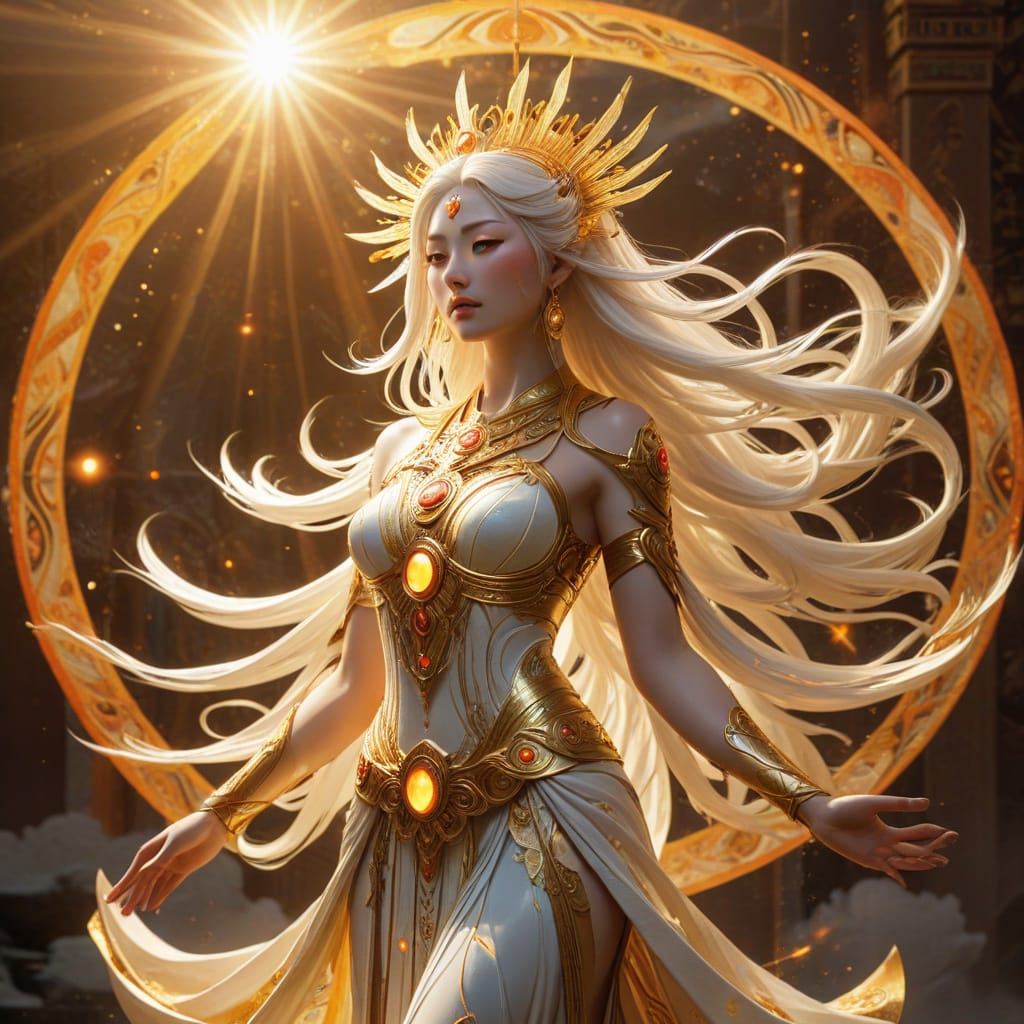
Illustration — Amaterasu, the Japanese sun goddess: a white-haired woman in gold and white armour with a sunburst crown before a blazing sun. About our pictures
Deity (kami)The sun goddess and the highest deity in the myths of the Kojiki and Nihon Shoki. Born from Izanagi's left eye in the Kojiki's telling, she rules the heavens and is the divine ancestor of the Japanese imperial family. When her brother Susanoo's outrages drove her to hide in a cave, the world was plunged into darkness.
At a glance
Who is Amaterasu?
Amaterasu Ōmikami (天照大御神), "the great august deity who shines in heaven", is the sun goddess of Japanese myth. She rules the Plain of High Heaven, Takamanohara, and is honoured as the ancestral deity of the imperial house. Her main shrine is the Inner Shrine of Ise Jingū in Mie Prefecture, where a sacred mirror stands for her presence.
She is a kami, not a yokai. She belongs in this collection because so many of Japan's founding myths turn on her: the contest with her brother Susanoo, her retreat into the Heavenly Rock Cave, and the descent of her grandson to rule the earth. The Yamakawa Dictionary of Japanese History points out that "Amaterasu" is really a title made of words of praise. The Nihon Shoki also calls her Ōhirume no muchi (大日孁貴). Several dictionaries read hirume as "woman of the sun", a priestess who served the sun.
Two chronicles, two births
Her story is told in the two court chronicles of the early eighth century, the Kojiki (712) and the Nihon Shoki (720). They do not agree on how she was born.
In the Kojiki, the god Izanagi returns from the land of the dead (told on our page Izanagi and Izanami) and bathes to wash off its pollution. Amaterasu is born as he washes his left eye, the moon god Tsukuyomi from his right eye, and Susanoo from his nose. In Chamberlain's 1882 translation, Izanagi rejoices that "at my final begetting" he has "gotten three illustrious children". He gives Amaterasu his jewel necklace and charges her to rule the Plain of High Heaven.
The main text of the Nihon Shoki tells it differently. Izanagi and Izanami, having made the islands, mountains, rivers and trees, decide to produce a "lord of the universe" (Aston's 1896 translation) and together bear the Sun-Goddess. Her light shines through all six directions, so her parents send her up to heaven by the ladder that still joined it to earth. The Nihon Shoki also quotes variant accounts. One repeats the eye-washing story. Another says she was born from a white-copper mirror that Izanagi held in his left hand. The Nihon Kokugo Daijiten sums this up as three birth traditions: from water, from a womb, and from a mirror.
The chronicles also differ on a famous food myth. In the Kojiki, Susanoo kills the food goddess Ōgetsuhime. In a Nihon Shoki variant it is Tsukuyomi who kills the food goddess Ukemochi, and Amaterasu, angry, refuses to see him again, so that sun and moon live apart. In that version Amaterasu then sows the grains that came from the goddess's body, and she starts the growing of rice and the keeping of silkworms.
The cave, the mirror and the descent
When Susanoo comes up to heaven, Amaterasu fears he means to take her realm and meets him armed. The two hold a contest of pledges, ukei, and produce children from each other's possessions. The five sons born from her jewels she claims as her own. Susanoo then runs wild. He wrecks her rice fields, defiles her hall and throws a flayed horse into her weaving hall. Here the chronicles part again. In the Kojiki a weaving maiden is struck by her shuttle and dies. In the Nihon Shoki main text Amaterasu herself is wounded by the shuttle. Either way she shuts herself in the Heavenly Rock Cave, Ama-no-Iwato, and the world goes dark. The gods lure her out with a mirror, jewels, prayers and the dance of Ame-no-Uzume. The whole story is told on our page Amaterasu and the Heavenly Rock Cave.
Uzume's dance is remembered as the origin of kagura, Shinto sacred dance. Heibonsha's Mypedia notes that plays called Iwato kagura, which act out the opening of the cave, are found especially in Kyushu. Nipponica adds that the Iwato scene is the best-loved piece in the Izumo-style kagura found all over Japan.
After the cave, Amaterasu gives the orders that shape the rest of the myth. The Kokugakuin University Encyclopedia of Shinto describes how she and the god Takamimusuhi decide that her descendants will rule the "Central Land of Reed Plains", the earth. She sends envoys to win the land from its own gods. Then she sends her grandson Ninigi down to rule it and gives him her mirror as her "spirit vessel", mitamashiro. Heibonsha's encyclopedia notes that in the Nihon Shoki Takamimusuhi often takes the leading part in these scenes and is even called the imperial ancestor. In the reign of the first emperor, Jinmu, the Kokugakuin encyclopedia adds, she sends a sword and the guiding crow Yatagarasu to help him.
The mirror and the regalia
The mirror, Yata no kagami (八咫鏡), is one of the three imperial regalia, the sanshu no jingi. The other two are a curved jewel and the sword Kusanagi, which Susanoo took from the tail of the serpent Yamata no Orochi. The Kokugakuin encyclopedia explains the tradition. The emperors kept the mirror and sword with them until the reign of Emperor Sujin, who had copies made and sent the originals away. The mirror went to Ise and the sword later went to Atsuta Shrine in Nagoya. The palace copy of the mirror is kept in the Kashikodokoro, one of the three shrines inside the palace grounds. Heibonsha's Mypedia notes that, according to the Nihon kiryaku and other records, the palace mirror was damaged in fires in 960, 1005 and 1040. The palace sword was lost at sea with the child emperor Antoku at the battle of Dan-no-ura, and another sword was later named in its place.
Historians do not all accept the story as handed down. Mypedia notes a view that until the early Heian period only the mirror and sword were regalia, with the set of three becoming settled around the ninth century.
Ise Jingū
The Nihon Shoki tells how Amaterasu came to Ise. Under Emperor Sujin she was worshipped in the palace together with another god, but the emperor feared their power. He gave her to Princess Toyosuki-iri-hime to worship at the village of Kasanui in Yamato. Under the next emperor, Suinin, Princess Yamato-hime carried her on a long search through Uda, Ōmi and Mino until they reached Ise. There, in Aston's translation, the goddess said that Ise, "of the divine wind", is the land where waves come in from the eternal world, "a secluded and pleasant land", where she wished to dwell. A shrine was built on the upper Isuzu River. These reigns are legendary, so the dates are traditional. Ise Jingū's own site dates the founding to "approximately 2,000 years ago". Heibonsha's encyclopedia points out that the Kojiki does not tell the story of Yamato-hime's journey at all.
Scholars have read this story in different ways. Nipponica sets out a theory that Amaterasu was first a local sun god of the fishing people of Ise, taken up by the court and raised to the head of the gods. Heibonsha's encyclopedia sees the founding of Ise as the point where the ancestral god of one clan became the highest ancestral god of the whole state.
The shrine is rebuilt in full every twenty years in the Shikinen Sengu. Ise Jingū's site dates the first rebuilding to the fourth year of Empress Jitō, 690. The 62nd took place in 2013, and the 63rd is now under way. For centuries, the Kokugakuin encyclopedia explains, no one but the emperor could make private offerings to Amaterasu. Ordinary pilgrims were never turned away, however. Travelling Ise priests called oshi spread her worship across the country. Mass pilgrimages called okage mairi swept Japan roughly once every sixty years from 1650 to 1867. The first emperor to visit the shrine in person did so only in 1869.
Amaterasu in later belief
Medieval Buddhism folded Amaterasu into its own system. Heibonsha's encyclopedia notes a view that the idea goes back to the building of the Great Buddha at Nara in the eighth century, when Amaterasu, the sun and the cosmic Buddha Dainichi were said to be one and the same. The Buddhist story collection Shasekishū (1283) already says that the Inner and Outer Shrines at Ise are the two forms of Dainichi. These ideas, known as Ryōbu Shintō, lost ground in the Edo period and were banned after the Meiji Restoration.
Her gender was not always fixed either. In a Nihon Shoki variant she calls herself a woman, and Susanoo calls her his elder sister. Yet the Kokugakuin encyclopedia notes that some medieval scholars read her as a male god, and Nipponica also mentions the view. Her name lives on in the many Shinmei shrines across Japan, which Heibonsha's Mypedia lists as places where she is worshipped. It also lives on in the kagura stages where Uzume still dances outside the cave.
Frequently asked questions
Is Amaterasu the most important kami in Shinto?
She is the highest deity in the court myths of the Kojiki and Nihon Shoki, the ruler of heaven and ancestor of the imperial line. Ise Jingū, her main shrine, has a special rank among Japanese shrines. Shinto has no single creed, though, and local shrines and households honour many other kami.
How was Amaterasu born?
The Kojiki says she was born from Izanagi's left eye as he purified himself after visiting the land of the dead. The Nihon Shoki main text says Izanagi and Izanami bore her together as the ruler of the world. A variant in the Nihon Shoki has her born from a mirror held in Izanagi's left hand.
Why did Amaterasu hide in a cave?
Her brother Susanoo wrecked her rice fields, fouled her hall and threw a flayed horse into her sacred weaving hall. She shut herself in the Heavenly Rock Cave, and the world went dark until the gods drew her out.
What is the sacred mirror?
The Yata no kagami is the mirror Amaterasu gave her grandson Ninigi to stand for her spirit. It is one of the three imperial regalia. By tradition the original is enshrined at Ise Jingū, and a copy is kept in the imperial palace.
Can you see the mirror at Ise?
No. Ise Jingū says the mirror is kept inside the main sanctuary behind four rows of fences. Visitors worship from in front of the gate in the third fence and may not enter the inner courtyard.
Sources & further reading
- Amaterasu, Kokugakuin University *Encyclopedia of Shinto*
- Sanshu no shinki (three regalia), Kokugakuin University *Encyclopedia of Shinto*
- Ise Shinkō, Kokugakuin University *Encyclopedia of Shinto*
- 天照大神: *Nihon Kokugo Daijiten*, Heibonsha, *Mypedia*, Nipponica and Yamakawa entries (Kotobank)
- 伊勢神宮: Nipponica and other entries (Kotobank)
- 三種の神器: *Mypedia*, Britannica Japan and other entries (Kotobank)
- 両部神道: Heibonsha and other entries (Kotobank)
- 岩戸神楽: *Nihon Kokugo Daijiten*, Nipponica and *Mypedia* entries (Kotobank)
- *Kojiki*, tr. B. H. Chamberlain (1882), Section XI: Investiture of the Three Deities (Wikisource)
- *Kojiki*, tr. B. H. Chamberlain (1882), Section XVI: The Door of the Heavenly Rock-Dwelling (Wikisource)
- *Nihongi*, tr. W. G. Aston (1896), Book I (Wikisource)
- *Nihongi*, tr. W. G. Aston (1896), Book V: Emperor Sujin (Wikisource)
- *Nihongi*, tr. W. G. Aston (1896), Book VI: Emperor Suinin (Wikisource)
- About Ise Jingu, Ise Jingū (official site)
- History of the Jingū, Ise Jingū (official site, Japanese)
- Shikinen Sengu, Ise Jingū (official site, Japanese)
- 古事記: *Daijisen* and *Nihon Kokugo Daijiten* entries (Kotobank)
- 日本書紀: *Daijisen* and *Nihon Kokugo Daijiten* entries (Kotobank)
- Wikipedia: Amaterasu (pointer to further reading)