
Chapter One
The Final Straw
Susanoo's wild nature had shown itself from the start. His father Izanagi had banished him for refusing to rule the sea and weeping to go to his dead mother's land, so he climbed up to the Plain of High Heaven to take leave of his sister. Fearing he had come to seize her realm, she met him armed for battle, and to prove his good intentions the two produced children through a solemn pledge. Susanoo declared that he had won—and, flushed with victory, began to run wild. He broke down the ridges between his sister's rice fields, filled in her irrigation ditches, and strewed excrement in the hall where she held the feast of the new rice.
Amaterasu, the sun goddess, at first made excuses for her brother: the filth, she said, must be something he had vomited while drunk, and he must have broken up the fields because he begrudged the land they took up. But his outrages only grew worse. As she sat in her sacred weaving hall, overseeing the weaving of the gods' garments, he broke a hole in its roof and dropped in a heavenly piebald horse that he had flayed backwards. One of the heavenly weaving maidens was so startled that she struck herself with her shuttle and died. It was too much to bear.
Chapter Two
The World Goes Dark
Terrified at the sight, Amaterasu shut herself inside the Heavenly Rock Cave, Ama-no-Iwato, and made its rock door fast behind her. The moment she disappeared, the Plain of High Heaven and the land below were plunged into eternal night.
The eight hundred myriads of gods gathered in the dry riverbed of the Tranquil River of Heaven, desperately trying to devise a plan to lure Amaterasu from her cave. For without her light, there could be no day.

Chapter Three
The Divine Plan
The gods asked Omoikane, the "thought-gathering" god, a son of the creator deity Takamimusubi, to devise a scheme. Under his plan they gathered sacred objects: iron was taken from the heavenly mines and a mirror was made by the goddess Ishikoridome, while the jewel-making god Tamanoya strung a long cord of curved jewels. The gods Ame-no-Koyane and Futodama read the omens by heating a stag's shoulder blade. Then they uprooted a great sakaki tree from the heavenly Mount Kagu, hung the jewels from its upper branches, the mirror from its middle branches and white and blue cloth offerings from its lower branches, and solemn prayers were recited before the cave.
They also gathered the "long-singing birds" of the eternal night—roosters—and set them crowing, as if to announce a dawn that could not come. And the strong god Ame-no-Tajikarao took up a hidden position beside the rock door.
But the most important part of the plan fell to Ame-no-Uzume, the goddess later honoured as the patron of dancers and performers.
Chapter Four
The Sacred Dance
Ame-no-Uzume tied club moss from Mount Kagu around herself as a sash, crowned her hair with a vine and took a bunch of bamboo leaves in her hands. Before the cave door she laid an upturned tub and stamped on it until it boomed, dancing as if possessed by a god. As she danced she bared her breasts and pushed the cord of her skirt down low—until the whole Plain of High Heaven shook, and the eight hundred myriads of gods burst into laughter together.
Inside the cave, Amaterasu heard the laughter. She was astonished. She had thought that her retreat would leave Heaven and the land below in darkness. How could the gods be laughing and celebrating? What could possibly be so amusing?
Chapter Five
The Return of Light
Unable to contain her curiosity any longer, Amaterasu opened the rock door just a crack and called out from inside. Why, she asked, was Ame-no-Uzume making merry, and why were all the gods laughing, when the world should be dark?
Ame-no-Uzume answered that they were rejoicing because a deity even more illustrious than Amaterasu herself had appeared.
As she spoke, Ame-no-Koyane and Futodama pushed the mirror forward and held it up before her. The Kojiki does not say what she believed she saw, only that the radiant sight in the mirror—her own light—made her more and more astonished, and she edged out of the doorway to gaze at it.
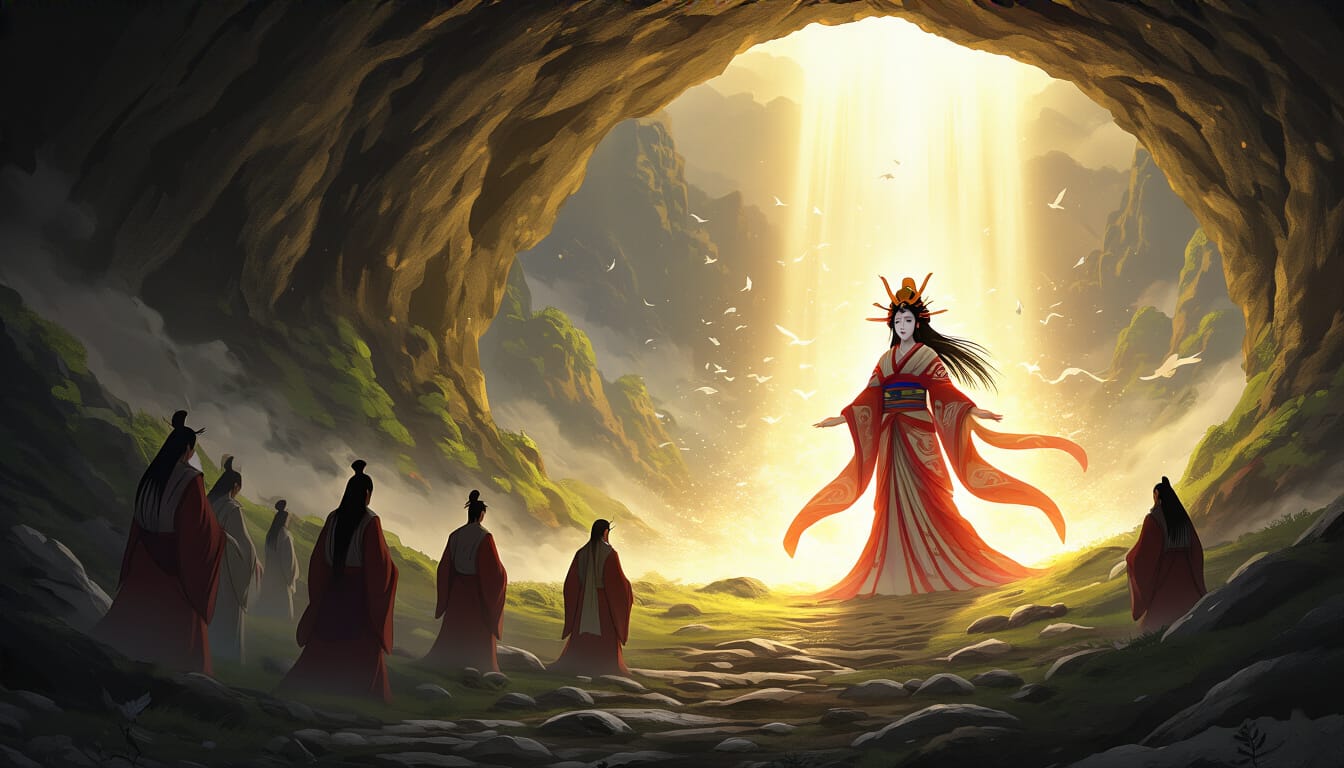
At that moment Ame-no-Tajikarao, who had been standing hidden beside the door, took her hand and drew her out. Futodama at once stretched a sacred rope—the shimenawa—across the entrance behind her and told her she could go back no further.
Epilogue
Light Restored
The moment Amaterasu came out of the cave, light returned to the Plain of High Heaven and to the land below, and all of creation could see again.
As for Susanoo, the eight hundred myriads of gods took counsel and punished him: they fined him a thousand tables of offerings, cut off his beard, had his fingernails and toenails pulled out, and expelled him from Heaven. He went down to the land of Izumo, where he would face the eight-headed serpent Yamata no Orochi. But Amaterasu remained in Heaven, bringing light and warmth to the world.
The mirror and the jewels that helped lure her out were later given to her grandson Ninigi when he descended from Heaven to rule the land below, and she told him to revere the mirror as if it were her own spirit. Together with the sword Kusanagi they became the three Imperial Regalia, a reminder that even in our darkest moments, there are those who will work tirelessly to bring back the light.
Sources
Sources & Versions
This telling follows the Kojiki (712), Book One, in Basil Hall Chamberlain's 1882 translation: §XII (Susanoo's weeping and banishment by Izanagi), §XIII "The August Oath" and §XIV (the pledge and the children born of it), §XV "The August Ravages," §XVI "The Door of the Heavenly Rock-Dwelling" and §XVII "The August Expulsion"; the gift of the mirror and jewels to Ninigi is in §XXXIII. In the Kojiki this episode comes before Susanoo's descent to Izumo and his fight with Yamata no Orochi, not after it. The Nihon Shoki (720), Book I, in W.G. Aston's 1896 translation, tells the story in its main text and several variants, with differences: in the main text Susanoo also lets piebald colts loose to lie down in the rice fields, and it is Amaterasu herself who is startled and wounds herself with her shuttle; in one variant the victim is the goddess Wakahirume, who dies. The main text has Ame-no-Uzume hold a spear wrapped in grass, kindle fires and speak inspired words while standing on her upturned tub, and has Ame-no-Tajikarao lead Amaterasu out as soon as she peeps through the door—no mirror trick is described there. In the Nihon Shoki main text the rope is drawn by the ancestors of the Nakatomi and Inbe priestly clans (Ame-no-Koyane and Futodama), and Susanoo's punishment includes having his hair plucked out. Chamberlain reads the Kojiki as saying several weaving women died; the original can also be read as a single maiden. Kokugakuin University's Encyclopedia of Shinto notes that Ame-no-Uzume's dance was later regarded as the origin of the spirit-pacifying rite (chinkonsai) and of sacred performance.
- Kojiki (Chamberlain, 1882), §XV — The August Ravages of His-Impetuous-Male-Augustness
- Kojiki (Chamberlain, 1882), §XVI — The Door of the Heavenly Rock-Dwelling
- Kojiki (Chamberlain, 1882), §XVII — The August Expulsion
- Kojiki (Chamberlain, 1882), §XXXIII — The descent of the August Grandchild
- Nihongi (Aston, 1896), Book I — The Age of the Gods, Part I
- Encyclopedia of Shinto (Kokugakuin University) — Amaterasu
- Encyclopedia of Shinto (Kokugakuin University) — Amenouzume
- Encyclopedia of Shinto (Kokugakuin University) — Tajikarao