Gashadokuro
がしゃどくろ
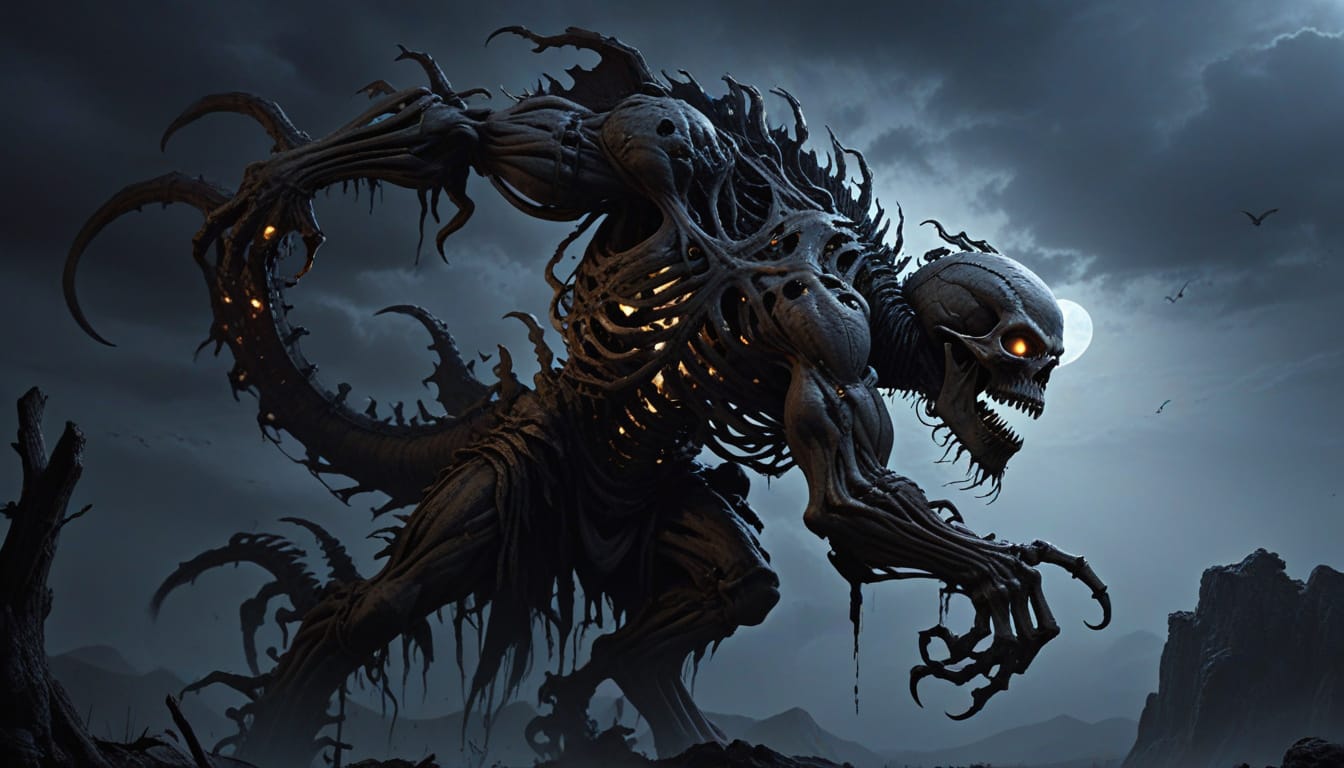
Illustration — Gashadokuro, the Japanese giant skeleton yokai: a towering skeletal monster with glowing eyes and claws stalks under a stormy moonlit sky. About our pictures
SpiritGiant skeletal spirits formed from the bones of people who died of starvation or in battle without proper burial. Towering many times taller than a human, they roam at night seeking to bite off the heads of travelers.
At a glance
What is a gashadokuro?
The gashadokuro is a giant skeleton yokai. In the usual description it is put together from the bones of people who died and were never buried, such as soldiers left on the battlefield or travellers who starved by the roadside. It roams in the dark and attacks any living person it meets. It is also one of the most misunderstood yokai, because it is usually presented as an ancient Japanese legend. It is not one.
The gashadokuro is a modern creation. It first appeared in print in 1966, in a Japanese girls' magazine, and it owes its famous look to a woodblock print made more than a century earlier for a different story. In just over fifty years it has gone from a magazine feature to a fixture of yokai encyclopedias, games and toy shops. How that happened is a useful lesson in how yokai lore is made, and the creature does draw on fears much older than itself.
The name is written in kana, がしゃどくろ. Dokuro means a skull or skeleton. Gasha is usually taken to be a sound word, like the English "clatter," for the rattle of dry bones. Some recent books and games write the name with the characters 餓者髑髏, "skeleton of the starving." That spelling came later and was chosen to suit the meaning; the name was not first written that way.
Appearance and powers
The basic picture has hardly changed since the 1960s. The gashadokuro is a skeleton many times the height of a person. Its bones clatter as it moves, it walks about at night, and it seizes and crushes the people it finds. Some English-language sites give it an exact size or say it bites off the heads of its victims. Those details do not come from the earliest descriptions, and this site does not repeat them as fact.
In the version made popular by the yokai books of the 1970s, a gashadokuro is not a single ghost but a gathering. The bones and lingering resentment of many people who died without funeral rites pile together into one huge body. That is why it is linked with battlefields and with places struck by famine, and why it is described as hostile to the living rather than tied to any one grudge.
Origins and history
The 1966 magazine feature
The Japanese research summarised on Japanese Wikipedia traces the first printed gashadokuro to the November 1966 issue of Bessatsu Shōjo Friend, a girls' magazine. The issue carried a special feature on "the Japanese yokai beside you," written by Saitō Morihiro. Saitō described a giant skeleton whose bones clattered as it walked. According to the same research, he later said his idea came from a British ghost story about the "black knight" of Glamis Castle, which had appeared in the magazine Bokura in 1965. Japanese folklore, in other words, was not even the starting point.
How the gashadokuro spread
The 1960s and 1970s were a boom time for yokai in Japanese children's publishing, and new creatures moved quickly from one book to the next. Saitō's article was reprinted in a 1968 Akita Shoten book on the monsters of the world, compiled by Yamauchi Shigeaki. Around the same time the manga artist Mizuki Shigeru and the writer Satō Arifumi took up the creature, and both kept including it in their illustrated yokai guides through the 1970s. Satō's 1972 Ichiban kuwashii Nihon yōkai zukan ("The most detailed illustrated guide to Japanese yokai") pictured it. Through books like these the gashadokuro came to sit beside kappa and tengu as though it had always belonged there.
The popular Japanese culture magazine Wa-raku makes the same point in a feature on the creature: unlike yokai handed down in folk tradition, the gashadokuro was born in the middle of the Shōwa era, out of 1960s children's books.
The borrowed image: Kuniyoshi's skeleton
The picture most people have in mind when they think of a gashadokuro is older than the name. Around 1844 the ukiyo-e master Utagawa Kuniyoshi designed a famous triptych now usually called Takiyasha the Witch and the Skeleton Spectre. The Victoria and Albert Museum, which holds a copy, gives the artist's own long title: in the ruined palace at Sōma, Takiyasha, the daughter of Masakado, gathers allies by sorcery, and Ōya no Tarō Mitsukuni comes to investigate the monsters and finally destroys them.
The story behind the print concerns Taira no Masakado, the tenth-century warlord who rebelled against the court and was killed. In the tale, his daughter Princess Takiyasha calls up the ghosts of her father's fallen soldiers, and the imperial envoy Mitsukuni faces them in the abandoned palace. Kuniyoshi filled half the triptych with a single enormous skeleton leaning out of the darkness and reaching through the torn blinds. It is one of the most striking images in Japanese printmaking.
The episode comes from Utō Yasukata chūgiden, a yomihon novel by Santō Kyōden published at the end of 1806. Japanese research on the print notes that Kyōden's book has many human-sized skeletons. The single giant is Kuniyoshi's own invention for the sake of drama.
The print has nothing to do with the word "gashadokuro," which did not exist until the 1960s. But when Mizuki, Satō and others needed a picture of their giant skeleton, Kuniyoshi's was the obvious model. It has defined the creature's look ever since, so much so that the print is now often described, wrongly, as a picture of a gashadokuro. Some retellings go further and claim that Takiyasha raised "the first gashadokuro." That turns a modern borrowing into a fake ancient origin.
Older skulls, unrelated stories
Japanese literature does have much older skeleton stories, and one is sometimes mixed up with the gashadokuro. Mizuki's guide placed an old Buddhist tale from the ninth-century Nihon ryōiki under its gashadokuro entry. In it, a man pulls a bamboo shoot from the eye socket of a skull and makes it an offering, and the grateful skull later repays him. The tale is about kindness to the dead and has no giant and no attack. It is a separate tradition, and the gashadokuro does not descend from it.
Why the gashadokuro feels ancient
If the gashadokuro is so new, why does it seem so old? Partly because of the print: an Edo-period masterpiece lends any creature borrowed from it an air of age. But the deeper reason is that its idea is genuinely old. Fear of the dead who were never given proper rites runs through Japanese religion and folklore. So does the belief that the resentment of those who died badly can linger and do harm. The yurei and the vengeful onryō both grow from that soil. The gashadokuro gives those fears a body. It is a modern invention built from very old materials, and that is exactly how many yokai have always been made.
In art and popular culture
Since the 1970s the gashadokuro has spread far beyond the books that created it. Mizuki's illustrations kept it in front of Japanese readers for decades, and it has since become a stock monster of manga, anime and games; Japanese reference works note that recent creative works favour the 餓者髑髏 spelling. Kuniyoshi's triptych, meanwhile, is widely reproduced and very often captioned as a gashadokuro, which it is not. Copies of the print are held in museums including the Victoria and Albert Museum, the British Museum and the Honolulu Museum of Art.
Frequently asked questions
Is the gashadokuro a real Japanese legend?
It is a real yokai in the sense that it is now part of Japanese yokai culture, but it is not a traditional folk legend. The earliest known description appeared in a Japanese girls' magazine in November 1966, and the creature spread through yokai books of the late 1960s and 1970s.
What does gashadokuro mean?
Dokuro means skull or skeleton. Gasha is generally understood as an imitation of the clattering sound its bones make. The spelling 餓者髑髏, "starving skeleton," came later and was chosen to match the meaning.
Is Kuniyoshi's giant skeleton print a gashadokuro?
No. Kuniyoshi's triptych of about 1844 shows a skeleton spectre summoned by Princess Takiyasha, a scene from Santō Kyōden's 1806 novel. Writers in the 1960s and 1970s borrowed its skeleton as the image of their gashadokuro, which is why the two are now so often confused.
How big is a gashadokuro?
The earliest descriptions simply call it a giant skeleton, many times taller than a person. Exact figures given on some websites have no traceable source.
What is the gashadokuro made of?
In the lore popularised by 1970s yokai encyclopedias, it gathers from the bones and lingering resentment of people who died without burial, especially soldiers killed in battle and people who starved.
Sources & further reading
- Gashadokuro (Japanese Wikipedia, used as a pointer to the Japanese research it cites)
- Gashadokuro (English Wikipedia)
- Gashadokuro feature, Wa-raku (Japanese)
- Utagawa Kuniyoshi, Takiyasha the Witch and the Skeleton Spectre (Victoria and Albert Museum)
- Takiyasha the Witch and the Skeleton Spectre (Wikipedia)
- Ōtaka Yōji, "Shitennō shōtō iroku and Utō Yasukata chūgiden," Bulletin of the National Institute of Japanese Literature 30 (2004)