Nue
鵺
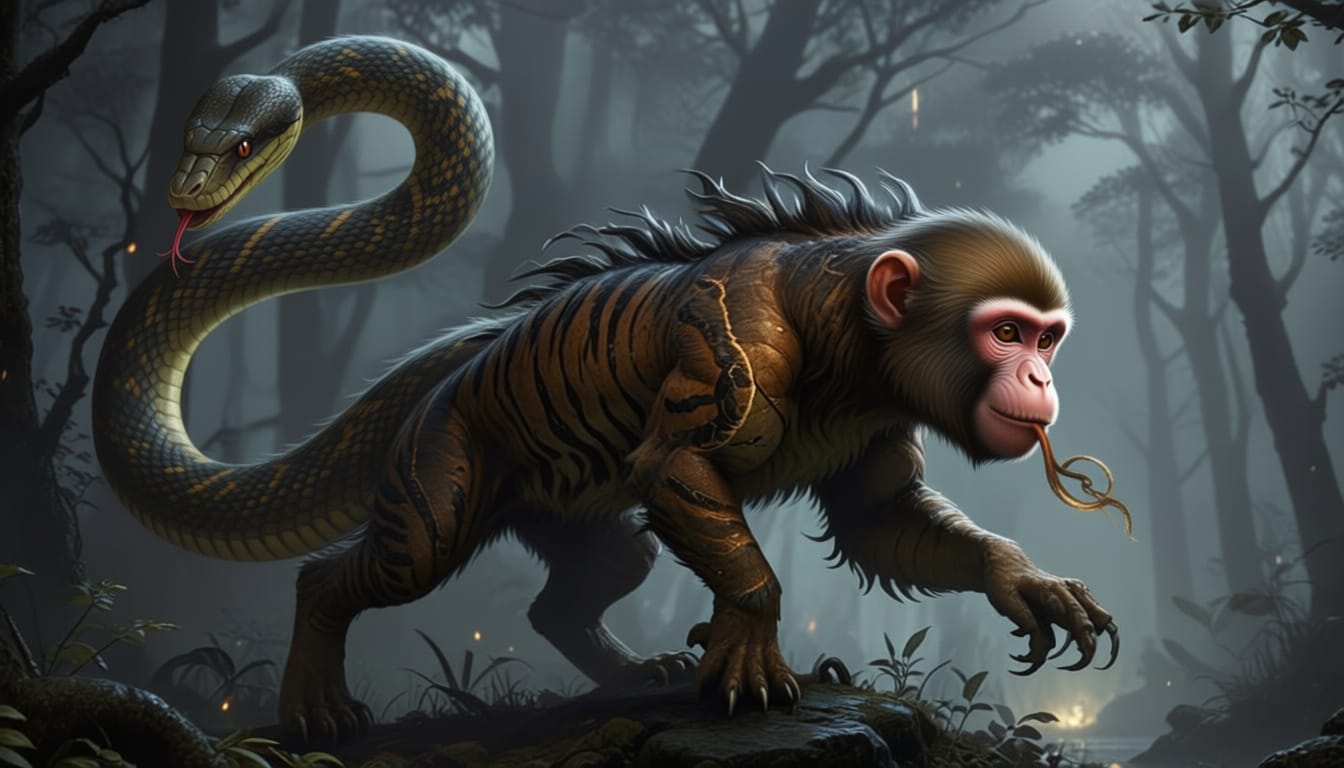
Illustration — Nue, the Japanese chimera yokai: a creature with a monkey face, tiger-striped body and a snake tail in a misty forest. About our pictures
DemonA chimera-like yokai with the head of a monkey, body of a tanuki, legs of a tiger, and a snake for a tail. Its eerie cry sounds like the scream of a thrush bird and is considered an omen of misfortune and illness.
At a glance
What is a nue?
The nue (鵺) is Japan's best-known chimera. In its classic form it has the head of a monkey, the body of a tanuki, the limbs of a tiger and a snake for a tail. It comes down out of a black cloud at night and gives an eerie, mournful cry. The creature belongs to one famous episode in The Tale of the Heike, in which the warrior-poet Minamoto no Yorimasa shoots it down over the imperial palace in Kyoto, and nearly everything later told about the nue grows from that scene.
The word nue is older than the monster. It was originally the name of a real bird, the White's thrush, called toratsugumi in modern Japanese. The bird sings at night in dark woodland with a thin, sad whistle, and Japanese reference works note that since ancient times it was thought unlucky and uncanny. Some people still say that when it calls, a death or a fire will follow. The monster of the Heike was said to cry like this bird, and over time the bird's name passed to the beast.
Appearance and the sound of the nue
The standard description comes from the Heike: a monkey's head, a tanuki's body, a snake's tail and a tiger's hands and feet, with a voice like the nue bird. English translations often call the body a "badger's," because tanuki was long translated that way. Other medieval texts do not agree on the details. The Genpei jōsuiki, a longer version of the same war chronicle, describes a monkey's head, a tiger's back, a fox's tail and a tanuki's feet. A Heike manuscript held by the National Archives of Japan gives yet another mix, including a snake's belly and cat's feet. The parts change from text to text. What stays the same is the idea of an animal made of other animals, with the frightening voice of a night bird.
That mixture is the heart of the creature's meaning. By extension, Japanese dictionaries record, the word nue came to describe anything of unclear identity: a person or thing whose true nature cannot be pinned down.
Origins: the Tale of the Heike
The cloud over the palace
The Tale of the Heike is the great war epic of medieval Japan, telling the rise and fall of the Taira clan in the twelfth century. The nue episode is part of the story of Minamoto no Yorimasa (1104–1180), a Minamoto warrior who was also one of the finest waka poets of his day.
In the reign of Emperor Konoe, in the Ninpei era (1151–1154), the emperor is struck with terror every night. Around the hour of the ox, about two in the morning, a black cloud drifts over the palace and the emperor falls ill. Prayers and rites have no effect. The court remembers that an earlier Minamoto hero had driven off such a threat by plucking his bowstring, and it orders Yorimasa, a famous archer, to stand guard.
Yorimasa waits with a single trusted retainer, I no Hayata. When the cloud comes, he sees a strange shape inside it and lets fly. The creature falls to the ground and Hayata rushes in and finishes it with his blade. They see that it has a monkey's head, tanuki's body, snake's tail and tiger's limbs. The relieved emperor rewards Yorimasa with a sword named Shishiō, "Lion King." The body of the monster is shut inside a hollowed-out log boat, an utsubo-bune, and set adrift.
Was the monster called a nue?
There is a subtle point here that most retellings miss. In the Heike the beast Yorimasa shoots in Konoe's reign is not given a name. It is only described as crying like a nue. The text then tells a second, shorter story set in the Ōhō era (1161–1163), under Emperor Nijō. Here a strange bird, a nue, cries over the palace and troubles the emperor, and Yorimasa brings it down with a large whistling arrow. Later tradition merged the two, and the nameless chimera of the first story became "the nue." So the creature's name is a later label taken from its voice.
What happened to Yorimasa
The nue made Yorimasa's reputation, but his end was tragic. In 1180, already in his seventies, he joined Prince Mochihito in a plot to raise the Minamoto against the all-powerful Taira. The plot was discovered too early. Yorimasa was defeated at Uji and died at the Byōdō-in temple. But the prince's call to arms, which Yorimasa had helped send out to Minamoto clans across the country, outlived them both.
The nue's grave and the Noh play
What became of the drifting log boat? Local legend gave it a landing place. In Miyakojima Ward in Osaka there is a mound called the Nue-zuka, said to be where the nue was buried. Osaka City explains that, according to an early Edo-period gazetteer, the boat carrying the corpse was carried down the Yodo River and came to rest on a sandbank there, where the body rotted. The mound is said to have been raised by local people who feared the monster's curse. A rival Nue-zuka tradition exists in Ashiya in Hyōgo Prefecture. Edo-period gazetteers were already doubtful about both.
Ashiya is also the setting of the Noh play Nue, attributed to Zeami, the great playwright of Noh. A travelling monk who has been refused lodging spends the night in a riverside chapel. A boatman appears in a battered boat and reveals that he is the ghost of the nue. He tells how Yorimasa's arrow brought him down and how his body was sealed in a log boat and cast into the Yodo River. When the monk prays for him, the ghost returns in its monstrous form to tell its story again, and finally sinks into darkness with the setting moon. What makes the play striking is that it tells the story from the monster's side. The hero's glory is seen through the eyes of the creature he killed. Japanese scholars have read it as a play of longing for things that are passing away.
In art and popular culture
Yorimasa shooting the nue became a favourite subject of musha-e, prints of warriors. Utagawa Kuniyoshi designed a version around 1842. Tsukioka Yoshitoshi returned to the story twice: in I no Hayata Killing the Nue at the Imperial Palace (1890), from his series New Forms of Thirty-six Ghosts, and in an 1888 print of Yorimasa from his One Hundred Views of the Moon. The scene was also painted on a votive tablet presented to Sensōji temple in Edo in 1781.
The name has carried into modern culture too: the manga artist Kihara Toshie used Nue as the title of an Edo-period picaresque series published from 1988 to 1991. The-noh.com, introducing the Noh play, compares the creature to the Chimera of Greek myth and to the engineered monsters of science fiction.
Frequently asked questions
What animals make up a nue?
In The Tale of the Heike, the nue has a monkey's head, a tanuki's body, a tiger's limbs and a snake for a tail. Other medieval versions mix the parts differently, for example giving it a fox's tail and a tiger's back.
What does a nue sound like?
Its cry is compared to the nue bird, the White's thrush, which whistles thinly and sadly at night. Japanese tradition has long treated this birdsong as an unlucky omen, and the monster took its name from the voice.
Who killed the nue?
The warrior-poet Minamoto no Yorimasa shot it down from a black cloud over the imperial palace in Kyoto, and his retainer I no Hayata finished it with his blade. The emperor rewarded Yorimasa with the sword Shishiō.
Is the nue in the Tale of the Heike?
Yes. The episode is one of the best-known in the Heike. In the main story the creature is not actually named; it is described as crying like a nue, and the name was attached to the monster later.
What does "nue" mean as a word?
Originally the name of a night-singing thrush, nue came to mean the chimera of the Heike and, by extension, anything of unclear nature or identity.
Sources & further reading
- Nue entries (Kotobank, Japanese dictionaries and encyclopedias)
- Minamoto no Yorimasa entries (Kotobank, Japanese)
- Nuetaiji, JAANUS dictionary of Japanese art
- Yorimasa and the nue in the Heike monogatari, National Archives of Japan digital exhibition (Japanese)
- Miyakojima Ward historical sites guide: Nue-zuka (Osaka City, PDF, Japanese)
- Nue (Noh play), the-noh.com
- Yoshitoshi, Ii no Hayata Killing the Nue at the Imperial Palace (Fitzwilliam Museum)
- A Closer Look: Yorimasa and the Nue (Ronin Gallery)
- Nue (Wikipedia, used as a pointer)