Rokurokubi
轆轤首
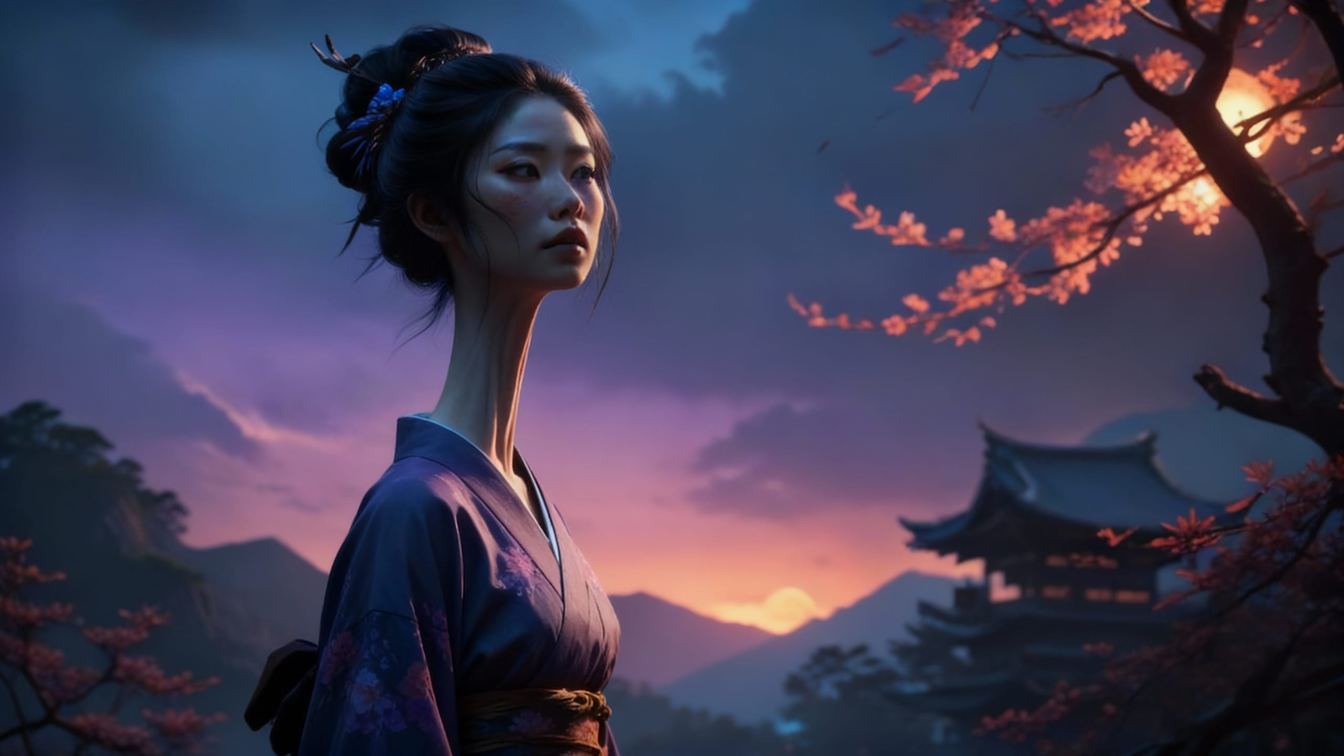
Illustration — Rokurokubi, the Japanese long-necked yokai: a woman in a purple kimono with a slightly elongated neck at dusk beside a pagoda. About our pictures
SpiritPeople who appear normal during the day but whose necks stretch to incredible lengths at night. A related type, the nukekubi, can detach its head entirely and send it flying through the night.
At a glance
What is a rokurokubi?
A rokurokubi is a person, usually a woman, whose neck stretches at night. By day she looks entirely ordinary. Once she is asleep, her head rises far above her body on a long, thin neck, to lick the oil in the lamp, to drink, or to wander. Japanese dictionaries define the rokurokubi as a monster whose long neck stretches and shrinks at will, and they note a second sense: a sideshow act of the same name.
The same dictionaries also give nukekubi, "slipping-out head", as another name for it. That is a reminder that the word has long covered two different ideas. In one, the neck stretches but stays attached. In the other, the head comes off completely and flies about on its own. The Nipponica encyclopedia defines the rokurokubi as a strange phenomenon in which the neck stretches at midnight to lick lamp oil, or the head flies.
Origins and earliest records
Why the creature is called rokuro-kubi is not clear. Rokuro is the word for a potter's wheel, a pulley or windlass, and the sliding collar that opens an umbrella. The folklorist Inokuchi Shōji, writing in Nipponica, lists several guesses. The name might come from the feel of clay drawn up on a potter's wheel, from the work of woodturners, from an optical illusion, or from the way an umbrella's handle seems to lengthen as its collar is pushed up. None is proven.
The word is already in use by the early Edo period. The Nihon Kokugo Daijiten cites, as its earliest example, a comic linked verse in the haikai anthology Takatsukuba (1638). It pairs people who "slip out by night" with a rokurokubi spotted by moonlight. The joke works because the creature's defining habit, getting out at night, was already familiar.
The flying head has Chinese roots. Inokuchi notes that the Soushen ji, a Chinese collection of strange tales from the Six Dynasties period, tells of a maidservant of a general of the state of Wu whose head flew out every night. Edo essayists repeated Chinese reports of a people called hitōban, "flying-head barbarians". The Seikai zokudan describes them with a red line around the neck, flying at night with their ears for wings and eating insects. One Edo miscellany even lists a "Flying-Head Country" among Japan's legendary neighbours, alongside countries of giants, dwarfs and long-armed people.
The stretching neck in Edo writing
Edo essayists collected rokurokubi reports with a mix of horror and curiosity, and many treated the condition as an illness rather than a curse. Tachibana Shunki's Hokusō sadan records that in the tenth month of Kansei 1 (1789), in Tsuruga in Echizen, a household heard a maidservant groaning late at night. They went to see if she was ill and found her head climbing a folding screen. It rose a foot or two, fell back and rose again. Nichibunken's database files the account under rikonbyō, the illness in which the soul leaves the body.
The Kasshi yawa tells of a maid suspected of being a rokurokubi. Her employer watched her sleep and saw a vapour rise from her chest, and then her neck stretched until her head was resting against the transom. In Ban Kōkei's Kanden kōhitsu, a haikai poet who spent the night with a courtesan in the Shin-Yoshiwara quarter found her neck stretched about a foot as she slept. Ban suggested that she simply had unusually elastic skin on her neck.
Others framed it as heredity or retribution. Satō Seiyū's Chūryō manroku reports a "rokurokubi village" deep in the mountains of Yoshino, whose people all wore neck-wraps from childhood. A sequel to the Kasshi yawa blames a farmer for killing a white dog: his daughter became a rokurokubi, and one night her wandering head was bitten to death by a white dog. In a happier story told by Ishikawa Kōsai, a rich family's daughter had a neck that stretched five or six feet at night. One husband fled, but her marriage to a doctor cured her. In Ihara Saikaku's Shoen ōkagami, a courtesan's head slips out and visits a man without her knowing anything about it.
How did the two kinds of rokurokubi come together? A study by Maesaka Hideki notes that the encyclopedia Wakan sansai zue describes the head and body as joined by a fine thread. Some yokai writers suggest this is where the long neck came from: artists drew the thread, and viewers took it for a neck.
Hearn's "Rokuro-Kubi"
The story most English readers know is Lafcadio Hearn's "Rokuro-Kubi", published in Kwaidan (1904). It is in fact a nukekubi tale. A samurai of the Kikuji house in Kyushu becomes a wandering priest named Kwairyō after his lord's fall. One night in the mountains of Kai province, a woodcutter gives him shelter in a lonely cottage. When he goes for a drink of water, he finds five bodies lying in the next room without their heads. He remembers a rule from the Sōshinki, Hearn's spelling of the Soushen ji: if the body of a rokuro-kubi is moved while its head is away, the head can never return. He drags the master's body outside and finds the heads in the woods, eating worms and insects and discussing how to eat him. In the fight that follows, the master's head bites onto his sleeve and will not let go, even after it dies. Kwairyō walks on to Suwa in Shinano with a goblin's head dangling from his robe.
Local traditions
The rokurokubi was told aloud as well as written down. On the old road between Iwamura and Akechi in Gifu, a long-haired, red-tongued rokurokubi was said to hang down from the pines. It was thought to be a transformed snake, and people said the trees' branches all point downward because of it. A samurai who met it waited for it in a pass between two hills and cut off its long neck. In Ibaraki in Osaka, a merchant couple in the early Meiji years were said to have seen their daughter's neck stretch night after night. Prayers did not help, and when the rumour spread, the family moved away.
In Kagawa, people said a nukekubi could be recognised by a ring around her neck, and warned against marrying such a woman. In Sendai, a temple was said to have moved to its present site because a nukekubi licked the priest's neck with a cold tongue whenever he chanted the evening sutras. In Chiba, a legend tells of the diviner Abe no Seimei fleeing on his wedding night when his bride turned out to be a rokurokubi.
Sideshows, theatre and prints
The rokurokubi also became a sideshow act (misemono). A 1957 recollection from Ina in Nagano describes the reality: a curtain, a pretty girl in front of it, and a head that now and then rose high above her. Kabuki borrowed the name too. A dictionary of play titles lists two pieces popularly called Rokuro-kubi, one first staged at Osaka's Naka-za in 1837 and one at Tokyo's Haruki-za in 1897. The National Diet Library notes that Toriyama Sekien and Utagawa Toyokuni drew the rokurokubi as a woman. Tsukioka Yoshitoshi broke the pattern with a male rokurokubi bursting from a wicker basket. Comic stories joked that a rokurokubi had no trouble with sake, but that dry okara (soy pulp) was hard going on the way down.
Frequently asked questions
What is the difference between rokurokubi and nukekubi?
A rokurokubi, in the modern sense, has a neck that stretches while staying attached. A nukekubi's head comes off entirely and flies about at night. Older Japanese sources use the two names interchangeably, and dictionaries still give nukekubi as another name for the rokurokubi.
Is a rokurokubi a yokai or a human?
Mostly human. Nearly every story describes an ordinary person, often a young woman or servant, whose neck stretches or whose head wanders while she sleeps, often without her knowing. Edo writers explained it as an illness, an inherited condition or karmic punishment.
Why do rokurokubi lick lamp oil?
Licking the oil in the night lamp is one of the habits most often attributed to them. Nipponica lists it alongside explanations that the neck stretches in search of food or water, or when the sleeper's mind relaxes.
Where does the rokurokubi come from?
The flying-head form has Chinese roots. The Soushen ji tells of a maid whose head flew every night, and Edo essayists repeated Chinese accounts of a "flying-head" people. The neck-stretching form seems to have developed in Japan, possibly from pictures of the thread said to join a flying head to its body.
Is Lafcadio Hearn's "Rokuro-Kubi" accurate to the folklore?
Hearn's story follows the older, head-detaching type rather than the stretching neck. Its key rule, that moving the body strands the head, comes from the Chinese Soushen ji, which Hearn cites by name.
Sources & further reading
- Kotobank: ろくろ首 (Nipponica, entry by Inokuchi Shōji)
- Kotobank: 轆轤首 (Daijisen; Nihon Kokugo Daijiten; kabuki title dictionary)
- Nichibunken Kaii/Yōkai Densho Database: rokurokubi records
- Nichibunken record 3680007: *Hokusō sadan*, Tsuruga 1789
- Nichibunken record 3200012: *Seikai zokudan*, the hitōban
- Nichibunken record 3540022: *Zassetsu nōwa*, the Flying-Head Country
- Nichibunken record 0700550: *Kasshi yawa*, the vapour from the chest
- Nichibunken record 3170028: *Kanden kōhitsu*, Shin-Yoshiwara
- Nichibunken record 3950051: *Chūryō manroku*, the Yoshino village
- Nichibunken record 0700551: *Kasshi yawa* sequel, the white dog
- Nichibunken record 0700552: Ishikawa Kōsai, the cured bride
- Nichibunken record 0700549: Saikaku, *Shoen ōkagami*
- Nichibunken record 0700545: *Wakan sansai zue*, the thread (Maesaka 2001)
- Nichibunken record 1460476: Gifu, the snake rokurokubi
- Nichibunken record 0550079: Ibaraki, Osaka (Meiji era)
- Nichibunken record 0470035: Kagawa, the ring on the neck
- Nichibunken record C0411205-000: Sendai, the nukekubi of Kōzen-in
- Nichibunken record 0030209: Chiba, Abe no Seimei's bride
- Nichibunken record 0160024: Ina, the sideshow (1957)
- Nichibunken record 0700553: Edo comic tale, sake and okara
- National Diet Library Image Bank: Toriyama Sekien's yokai books
- Lafcadio Hearn, *Kwaidan* (1904), Project Gutenberg
- Wikipedia: Rokurokubi (pointer)