Noppera-bo
のっぺらぼう
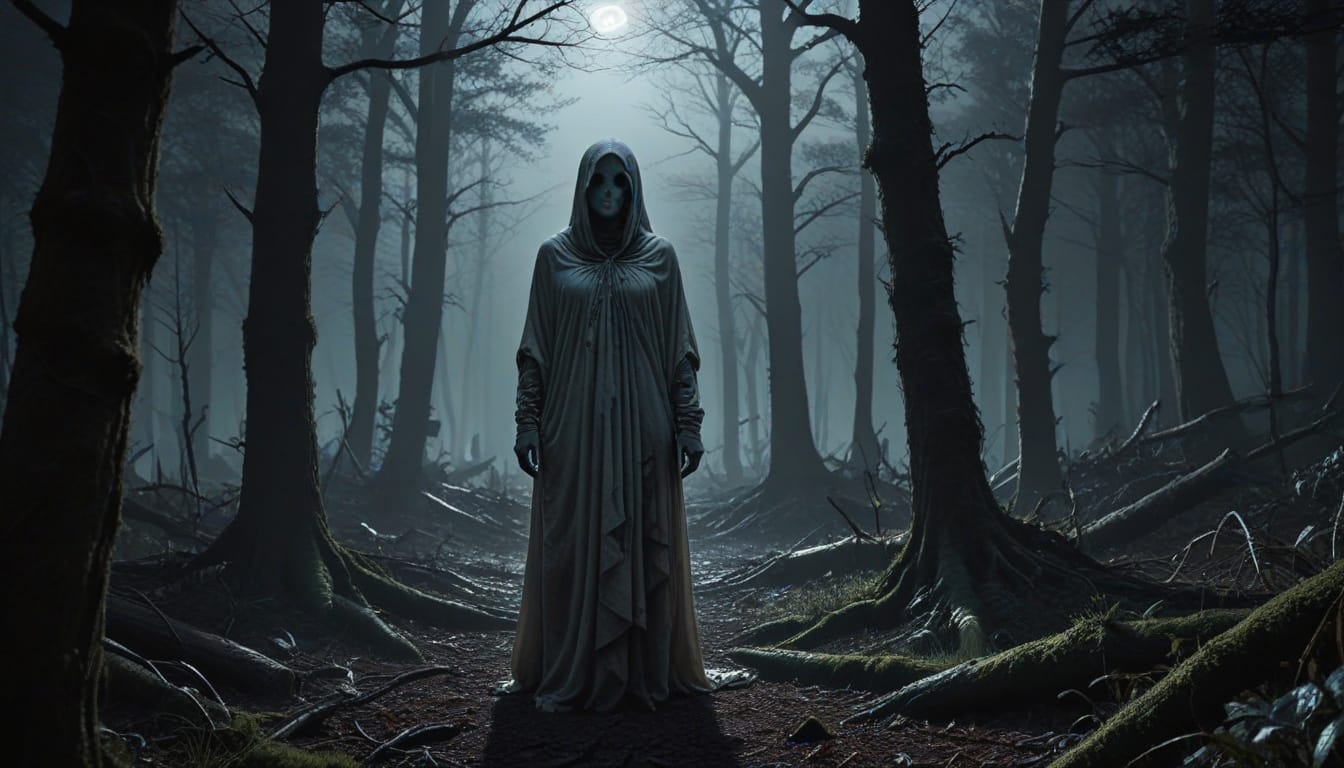
Illustration — Noppera-bo, the Japanese faceless ghost: a pale hooded figure with a blank mask-like face stands in a dark moonlit forest. About our pictures
SpiritFaceless ghosts that appear as normal humans until they reveal their blank, featureless faces. They enjoy frightening travelers at night but are generally harmless.
At a glance
What is a noppera-bo?
A noppera-bō is a faceless apparition. From behind, or at a distance, it looks like an ordinary person: a weeping girl, a monk on a mountain path, a child playing in a lane. When it turns around, the face has no eyes, no nose and no mouth, only smooth, blank skin. Dictionaries define the yokai simply as a monster with no eyes, nose or mouth on its face, and note that similar tales are told all over Japan.
The noppera-bō is not usually dangerous. Its whole power lies in the moment of the reveal. In story after story, the victim runs, faints or falls ill, but is not attacked. That makes it one of the purest examples of a Japanese yokai whose purpose is simply to frighten.
The word
Noppera-bō began as an ordinary adjective. The Nihon Kokugo Daijiten gives its first meaning as something completely flat and even, without bumps or hollows, with an example from a satirical dangibon (comic sermon book) of 1754. Later meanings include something with no variation at all. The novelist Natsume Sōseki used it in Sanshirō (1908) for students who sit through lectures and graduate in a blank, featureless way. The same dictionary gives a separate sense, a tall monster with no eyes, nose or mouth, and its earliest example of that sense comes from the comic verse collection Yanagidaru in 1813.
A close cousin, nuppera-bō, appears even earlier, in a haikai collection of 1704, written with characters meaning "no face". The dictionary's note explains that the word originally described anything flat and smooth. Applied to a head it meant a shaven pate. Applied to a face it could mean heavy make-up or a featureless monster. Applied to character it meant someone vague and impossible to pin down.
A related figure in Edo-period yokai scrolls and books is the nuppeppō. It is drawn as a squat, round lump with a face, arms and legs, and no clear line between head and body, and it is sometimes counted as a kind of noppera-bō.
Hearn's "Mujina"
The noppera-bō's most famous appearance in English is Lafcadio Hearn's story "Mujina", in Kwaidan (1904). It is set on Kii-no-kuni-zaka, a slope on the Akasaka road in Tokyo, with a wide old moat on one side and the long walls of a palace on the other. Hearn says that before street lamps and rickshaws, people would walk miles out of their way rather than climb it alone after dark. He admits he does not know why the slope is named after Kii Province. The answer is that the residence of the Kii branch of the Tokugawa family once stood on its west side.
Hearn's witness is an old merchant of the Kyōbashi quarter. Hurrying up the slope late one night, he sees a young woman crouching by the moat and crying. He fears she means to drown herself and begs her to tell him what is wrong. At last she turns, drops her sleeve and strokes her face with her hand, and he sees that it has no eyes, nose or mouth. He runs until he reaches the lantern of a roadside noodle-seller. He collapses there, and he cannot bring himself to describe what he saw. The noodle-seller asks whether it was anything like this, and strokes his own face, which turns as smooth as an egg. At the same moment the light goes out.
The title points to the culprit. A mujina is a folk name for the tanuki or the badger. Like the fox and the tanuki, it was believed to bewitch people. Hearn never explains this to his readers. He says only that the slope was feared "All because of a Mujina that used to walk there", and leaves the reader to infer that both faces were the same animal's trick.
Who is behind the blank face?
Japanese reference works note that the noppera-bō is sometimes said to be a mujina or tanuki in disguise. The connection turns up in local tradition as well as in Hearn. A 1938 report from Takayama in Gifu, filed under both mujina and noppera-bō, tells of a carpenter at work behind an old house. He saw a girl of about seven, in a long-sleeved kimono, dancing in the lane between two storehouses. When he called to her she turned around, and she had no face. Then she vanished, leaving behind only a pair of worn-out geta.
Other accounts name no culprit at all. The faceless figure simply appears, and the story ends when the witness flees.
Regional encounters
The details change from place to place, but the shape of the encounter stays strikingly constant. In Kagawa on Shikoku, several collections record the same tale from the mountains of Nakatado. At dusk a man walking alone over a pass called Kubikiri-tōge ("Neck-Cutting Pass") is relieved to see a monk in black robes walking ahead of him. He calls out, and when the monk turns, the face is blank. The man runs back the way he came.
In Osaka's merchant quarter of Senba, a story recorded in 1962 tells of a girl of seventeen or eighteen in a bright yūzen-dyed kimono, crying in the drizzle with her face hidden in her sleeve. When a passer-by tugged the sleeve aside, she was a noppera-bō. Then her body began to stretch, until he was looking up at something as tall as a telegraph pole.
The noppera-bō is not confined to roads. On the island of Kuchinoerabu, south of Kyushu, fishermen who landed at a river mouth for drinking water heard a strange cry upstream. A creature with no eyes or nose and a shining, bald head came down at them. They fled to their boat, and it followed them into the sea up to its chest. A storyteller on Sado Island likewise told of a faceless monster met out on the sea, and of a man who saved himself by throwing setsubun beans at it, the beans scattered every year to drive out demons.
The second scare
What makes Hearn's version so effective is its doubled ending. The victim escapes the first faceless figure and runs to someone he trusts, only to meet the same blank face again. In Hearn the second face belongs to the noodle-seller. The Osaka tale reaches for a similar twist in a different way: the first shock is the missing face, and the second is the body growing taller and taller. In each case the moment of relief is the trap.
That structure explains why the noppera-bō works so well in the retelling of ghost stories. The faceless yokai has no history to explain and no grudge to settle. It needs only a lonely place, someone kind enough to stop, and a turn of the head.
Frequently asked questions
Is a noppera-bo dangerous?
Almost never. In nearly every recorded story the noppera-bō only shows its blank face, and the harm comes from the victim's own terror. Some versions end with the creature vanishing or the witness fleeing in panic. None of the records consulted here describe it injuring anyone.
What is the difference between a noppera-bo and a mujina?
A mujina is a folk name for the tanuki or the badger, one of the animals said to bewitch people. Noppera-bō names the faceless apparition. In Hearn's story "Mujina", and in some local tales, the faceless figure is understood to be a mujina in disguise.
Where does the Mujina story take place?
On Kii-no-kuni-zaka, a slope in Moto-Akasaka in Tokyo's Minato ward. Hearn did not know where the name came from, but it refers to the Kii branch of the Tokugawa family, whose residence stood beside the slope.
Why does the noppera-bo have no face?
The folklore gives no single reason. The word itself began as an everyday description of something flat and smooth. Where a cause is given, the faceless figure is often an animal such as a mujina or tanuki playing a trick.
Is the noppera-bo a ghost or a yokai?
It is usually treated as a yokai rather than a yūrei, because it is not the spirit of a particular dead person and has no grudge to settle. It exists to frighten, often as the disguise of a shape-shifting animal.
Sources & further reading
- Kotobank: のっぺらぼう (Digital Daijisen; Nihon Kokugo Daijiten; Daijisen Plus)
- Kotobank: ぬっぺら坊 (Nihon Kokugo Daijiten)
- Kotobank: ぬっぺっぽう
- Kotobank: 狢 (Nipponica, entry by Inokuchi Shōji)
- Kotobank: 紀伊国坂 (Daijisen Plus)
- Lafcadio Hearn, "Mujina", in *Kwaidan* (1904), Project Gutenberg
- Nichibunken Kaii/Yōkai Densho Database: noppera-bō records
- Nichibunken record 1830067: Takayama, the faceless girl and the geta (1938)
- Nichibunken record 2440001: Sado, tonchibu and the setsubun beans (1958)
- Nichibunken record 0470124: Kagawa, the monk at Kubikiri Pass (1985)
- Nichibunken record C3720078-000: Kagawa Prefectural History, the faceless monk
- Nichibunken record 0030407: Kagawa, Kubikiri Pass (1991)
- Nichibunken record 2180483: Osaka Senba, the girl in yūzen (1962)
- Nichibunken record 1630001: Kuchinoerabu-jima, the shining bald monster (1968)
- Wikipedia: Noppera-bō (pointer)