Kuchisake-onna
口裂け女
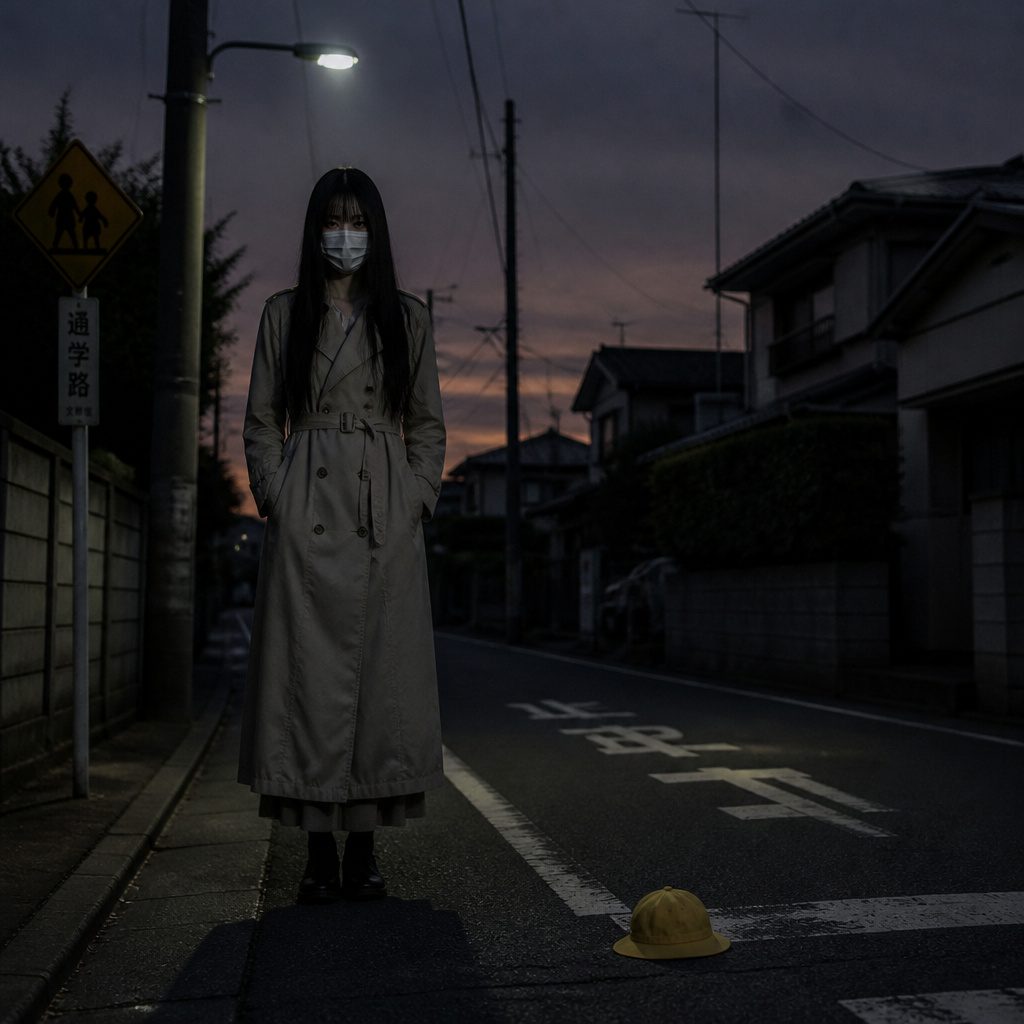
Illustration — Kuchisake-onna, the slit-mouthed woman: a long-haired woman in a surgical mask and trench coat on a dusk street, a yellow hat dropped. About our pictures
SpiritA tall woman in a surgical mask who stops a lone child on the way home and asks, "Am I pretty?" Whatever the answer, the mask comes down to reveal a mouth slashed from ear to ear, and the question is asked again. Folk wisdom offers escape routes: call her "average", toss her candy, or mutter "pomade" three times.
At a glance
What is Kuchisake-onna?
Kuchisake-onna, the "slit-mouthed woman", is the most famous of Japan's modern yokai. She does not come from a medieval scroll or an Edo-period picture book. She grew out of children's gossip in the late 1970s. In the classic version she is a tall woman in a long coat, with her lower face hidden behind a white gauze mask of the kind Japanese people often wear in cold and hay-fever season. She steps into the path of a child walking home alone and asks, "Watashi kirei?" ("Am I pretty?"). If the child says yes, she pulls down the mask to show a mouth that runs from ear to ear, and asks the question again.
What sets her apart from older yokai is that her birth can be roughly dated. Folklorists can point to a prefecture, a season and a newspaper column. That makes her one of the clearest examples of how a monster is made, how it spreads, and how it outlives the panic that created it.
Appearance and powers
Reports gathered by local folklore societies in the 1980s and 1990s are indexed in the Nichibunken (International Research Center for Japanese Studies) database of strange phenomena and yokai lore. They agree on the central image and disagree on almost everything else. A 1986 report from Akune in Kagoshima gives her short hair and lipstick. A 1990 report from Fukuoka says the visible half of her face is beautiful, that she runs unnaturally fast, and that she can turn violent without warning.
A 1989 report from Setagaya in Tokyo says she is fond of the number three. She therefore haunts Sangenjaya, whose name contains the word "three", and knocks on the doors of room 3 in apartment blocks. In that version she laughs loudly at children who run away, but she never chases them.
The story picked up costumes and weapons as it travelled. Iikura Yoshiyuki, a folklorist at Kokugakuin University, wrote about the legend for nippon.com. The variations he heard in interviews include a red coat, a sickle, superhuman speed and a hatred of hair pomade. The writer Yoshida Yūki, who researches modern ghost stories, argues that her most violent features belong mainly to the 1979 boom. These include the attacks on children and the knife or scissors. Earlier versions, in his reading, mostly had her show her mouth and give chase.
Origins and history
The usual account traces the rumour to Gifu Prefecture at the end of 1978. One theory that Iikura reports places it in the town of Yaotsu. There, an elderly woman from a farming family was said to have seen a slit-mouthed woman standing in a corner of her garden. A local newspaper wrote up the story, and children repeated it and added to it. Japanese accounts name the paper as the Gifu Nichi Nichi Shimbun, now the Gifu Shimbun. They date its first mention of the rumour to a short column on 26 January 1979.
The rumour then left Gifu. Iikura links its speed to cram schools, which were attracting more and more children at the time. Juku brought together pupils from different school districts, so a story told in one classroom reached several others within days. Children then passed it on to cousins in other cities by telephone. Other newspapers and television stations picked it up, and within about six months it was being told across Japan. A Shizuoka prefectural history records simply that around 1979, primary-school children were talking about where Kuchisake-onna would appear.
Adults took it more seriously than a schoolyard tale usually earns. Iikura notes that teachers and parents patrolled the streets and arranged for children to walk home in groups. He also points out that cram-school pupils were walking unfamiliar streets after dark, past drinkers and night workers. In his view, the slit-mouthed stranger gave that very real anxiety a face. The panic faded about as fast as it had spread, around the start of the 1979 summer holidays, when children stopped meeting every day. The figure stayed, though. In Iikura's words, she became an established monster.
Did she exist before 1979?
It is often said that Kuchisake-onna is far older, and English-language yokai references sometimes trace her to the Edo period. The evidence for an unbroken line is thin. Yoshida's research suggests that stories about a woman with a slit mouth were circulating across Japan by the mid-to-late 1970s, a few years before the Gifu boom. The earliest media record he found ends with the "monster" revealed as an ordinary woman wearing frightening make-up. Nichibunken's database holds 59 reports under the name kuchisake-onna. All of them come from folklore journals and prefectural histories published between 1986 and 1999. The safest summary is that older tales of women with uncanny mouths may have fed the legend, but the character people know today took shape in 1978–79.
Protection and folk practice
Like many school legends, Kuchisake-onna came with escape rules, and these spread as widely as the legend itself.
The best-known remedy is pomade, the scented hair oil once popular with men. A 1999 survey of high-school students in Utsunomiya, Tochigi, recorded that saying "pomade" three times makes her vanish. Japanese retellings often explain that she hates the smell because the surgeon who disfigured her wore it, but this is a later explanation, not part of the earliest reports.
The same 1999 report says she is delighted if you give her bekkō-ame, a hard amber candy made from caramelised sugar, and Iikura heard the same remedy. In many tellings she stops to pick up the sweets, and that gives you time to run. Many retellings also advise a non-committal answer such as "you look average". The idea is that it confuses her long enough for you to escape, since both "yes" and "no" are said to end badly. Some rules are taboos rather than escapes: one 1998 collection from Kyoto records that anyone who says her name aloud must say "gomen nasai" ("I'm sorry") ten times.
These rules show the legend working as children's folklore usually does. A frightening story arrives together with a ritual that lets the listener feel in control of it.
In film, manga and pop culture
Kuchisake-onna moved quickly from rumour to screen. The director Shiraishi Kōji's feature film Kuchisake-onna (released in English as Carved) opened in Japan in March 2007, with Mizuno Miki as the slit-mouthed woman. Kuchisake-onna 2 followed in 2008. It is set in Gifu Prefecture in 1978 and offers a fictional origin story that ties the legend to the place and year where the real rumour began. She has since become a regular figure in manga, anime and horror games, and she usually appears beside Hanako-san and other school ghosts as the face of the modern Japanese urban legend.
Frequently asked questions
Is Kuchisake-onna real?
No. Kuchisake-onna is a rumour, and there is no evidence that any such creature exists. The rumour itself is a real historical event, though. It began in Gifu Prefecture around the end of 1978, reached the newspapers in early 1979, and frightened children across Japan until the summer holidays that year.
What do you say to Kuchisake-onna?
Folk tradition offers several answers. The best known are to say "pomade" three times, to give her bekkō-ame hard candy, or to give a vague answer such as "you look average" so that she hesitates and you can get away. These remedies vary from region to region, like the legend itself.
Where did the Kuchisake-onna legend start?
Most accounts trace it to Gifu Prefecture in late 1978. One theory names the town of Yaotsu. The story spread from there through schools, cram schools and the press, and by the middle of 1979 it was known across Japan.
Why does Kuchisake-onna hate pomade?
The hatred of pomade was one of the details children added as the rumour spread, and Iikura records it among the variants he collected. Later retellings explain it by saying her surgeon used the hair oil, but there is no single original reason. It works mainly as a ready-made magic word that children could use.
Is Kuchisake-onna a yokai or a ghost?
She is usually counted as a modern yokai, or gendai yōkai, and is the classic example of an urban legend. Some retellings give her a human past as a disfigured woman. Even so, she behaves less like a yūrei tied to one person's death than like a roaming monster with rules of her own.
Sources & further reading
- Iikura Yoshiyuki, "Japanese Urban Legends from the 'Slit-Mouthed Woman' to 'Kisaragi Station'" (nippon.com)
- Iikura Yoshiyuki, same article, Chinese edition naming the *Gifu Nichi Nichi Shimbun* (nippon.com)
- Yoshida Yūki, excerpt from *Gendai Kaidan Kō* on the pre-1979 rumour (Bunshun Online, 2022)
- Nichibunken Kaii/Yōkai Densho Database: all 59 *kuchisake-onna* records
- Nichibunken record 0490056: Akune, Kagoshima (1986)
- Nichibunken record 1140522: Setagaya, Tokyo (1989)
- Nichibunken record 0210002: Fukuoka (1990)
- Nichibunken record C0222223-000: Shizuoka prefectural history (1991)
- Nichibunken record 0890010: Kyoto (1998)
- Nichibunken record 0970138: Utsunomiya, pomade and *bekkō-ame* (1999)
- allcinema: *Kuchisake-onna* (2007), dir. Shiraishi Kōji
- eiga.com: *Kuchisake-onna 2* (2008)
- Wikipedia: Kuchisake-onna (pointer to further reading)
- yokai.jp — kuchisake-onna-1979
- scholarworks.iu.edu — 39643