Yurei
幽霊
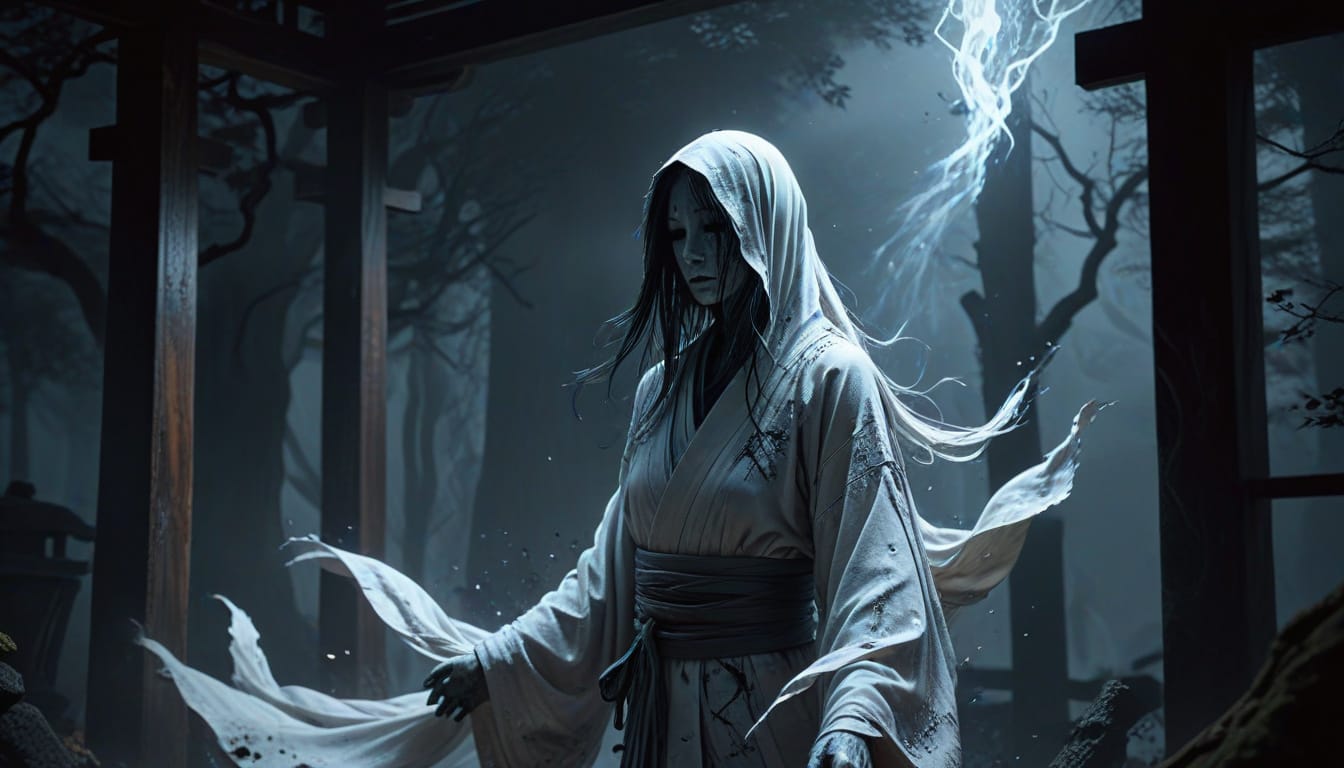
Illustration — Yurei, the Japanese ghost: a pale woman with long black hair in a tattered white burial kimono drifts through a dark shrine. About our pictures
SpiritGhosts of the deceased who remain in the physical world due to powerful emotions or unfinished business. Typically appear in white burial kimono with long, disheveled black hair and no feet.
At a glance
What is a yurei?
Yūrei (幽霊) is the ordinary Japanese word for the ghost of a dead person. The two characters mean something like "dim" or "faint" and "spirit", and the word sits alongside near-synonyms such as bōrei (亡霊, "departed spirit") and shiryō (死霊, "spirit of the dead"). Where many yokai are creatures in their own right (foxes, goblins, animated objects), a yurei was once a human being. What keeps it from moving on is the manner of its death or the feeling it carried out of life.
In the traditional picture, every person has a soul, a reikon. After death that soul should be guided by funeral and memorial rites until it joins the family ancestors, who are welcomed back each summer at Obon. Things go wrong when a death is sudden or violent, when the rites are neglected, or when the dead person dies gripped by jealousy, love, hatred, grief or a thirst for revenge. A soul in that state may linger as a yurei until the rite is performed or the emotional knot is undone.
Appearance and powers
The "classic" Japanese ghost is so familiar that it is easy to forget it is a convention with a history. She (the iconic yurei is usually a woman) wears the white clothing in which the dead were dressed for burial, sometimes with a small white triangular cloth on the forehead, known as a tenkan or hitai-eboshi. Her long black hair hangs loose and tangled. Her arms are raised with the hands drooping limply from the wrists, and below the waist she fades away into nothing. Floating balls of pale fire, hitodama, may drift beside her.
Yurei are tied to particular people and places rather than roaming at random. They are said to appear in the dead of night, in the "hour of the ox" around two in the morning, and they favour graves, riverbanks and willow trees. Their powers are mostly those of presence: they can be seen and heard by the person they have come for, they can possess, sicken or drive a victim mad, and the most dangerous among them can pursue an enemy to death. Not every yurei is hostile. The ubume is the ghost of a woman who died in childbirth; in tales of this kind, which Japanese tradition also calls "child-raising ghosts" (kosodate yūrei), a dead mother returns to care for the child she left behind, often bringing it sweets.
Folklorists have sorted ghosts into rough types. Beside the ubume there are funa-yūrei, the drowned, who rise around boats at sea and ask for a ladle so they can fill the hull with water; the safe answer, according to tradition, is to hand over a ladle with its bottom knocked out. Most feared of all is the onryō, the spirit that died with a grudge.
Origins and history
The fear of the angry dead is old in Japan, and it was a matter of state long before it was a matter of theatre. The Kokugakuin University Encyclopedia of Shinto describes goryō: spirits, especially of people who had lost their positions of power, that were blamed for calamities and epidemics falling on the population at large. Rites to calm and send them away, called goryō-e, became part of court religion. The same encyclopedia separates the onryō from the goryō: an onryō is not an epidemic deity, and its harm is aimed at specific people. That personal, targeted grudge is the engine of most yurei stories.
The look of the yurei is much younger than the belief. Earlier pictures show ghosts in the form they had in life. By the Edo period (1603–1868) they were increasingly drawn as corpses laid out for burial, with white robes and the triangular headcloth. The footless ghost is often credited to the painter Maruyama Ōkyo (1733–1795), but Japanese scholarship treats that as a popular myth: a footless ghost already appears in an illustrated jōruri (puppet-play) book printed in Kyoto in 1673. Through the early 1700s, artists drew ghosts with two legs, with thin legs, or with a hazy lower body, and as late as the 1780s one writer remarked that some ghosts had legs and some did not. The convention settled only gradually, helped along by prints, paintings and the stage.
A scroll known as Oyuki no maboroshi (The Ghost of Oyuki), attributed to Ōkyo, is held by the Spencer Museum of Art at the University of Kansas, and paintings of this kind became so popular that whole collections were formed. The rakugo storyteller Sanyūtei Enchō (1839–1900), a master of ghost stories, gathered hanging scrolls of wandering spirits; fifty of them were later given to Zenshō-an, the Tokyo temple where he is buried, which shows them every August during the Obon season.
Famous legends
Tōkaidō Yotsuya Kaidan. Tsuruya Nanboku IV's kabuki play opened at the Nakamura-za in Edo in the summer of 1825; the date of its premiere, 26 July by the modern calendar, is now marked in Japan as "Ghost Day". Its heroine Oiwa is poisoned and disfigured as part of a scheme that lets her husband, Iemon, marry into a richer family. She dies and returns again and again, haunting Iemon and those who wronged her until they are destroyed. The play was so successful that Oiwa became the model vengeful ghost of the Japanese stage.
Banchō Sarayashiki. The story of Okiku, the "plate mansion" ghost, exists in many versions. In the folk form she is a servant accused of losing one of a set of ten precious plates and killed for it; thrown into a well, she rises each night to count the plates, "one, two..." up to nine, and wails for the missing tenth. A puppet-play version opened in 1741, a kabuki version followed in 1824, and in 1916 the playwright Okamoto Kidō rewrote it as a tragic love story. A well at Himeji Castle is pointed out as Okiku's.
The peony lantern. Okiku and Oiwa are often grouped with Otsuyu, the lovesick ghost of Botan Dōrō ("The Peony Lantern"), as the three great yurei of Japan. Otsuyu shows the other face of the yurei: not wrath but a love that refuses to end at death.
Protection and folk practice
The surest way to quiet a yurei, according to tradition, is to do what it lacks: perform the missing rites, give the body a proper burial, or in some way settle the matter that keeps it bound. Buddhist priests and mountain ascetics were engaged to hold services for those who had died in ways likely to produce a restless ghost, and some especially dangerous spirits were enshrined and worshipped so that their anger would be turned to protection. Paper talismans called ofuda, placed at doorways, are said to keep malevolent ghosts out. Onryō are the hardest case; a spirit made of a grudge is not easily talked out of it.
In art, theatre and pop culture
Edo-period kabuki, ukiyo-e prints and hanging-scroll paintings fixed the image of the white-robed, long-haired, footless woman, and that image has never gone away. It returned with force in 1998, when Nakata Hideo's film Ringu gave the world Sadako. Her long black hair and white clothes are not in Suzuki Kōji's original novel; they were a deliberate revival of the classical female ghost of paintings and kabuki, moved into a world of videotapes and television sets. The J-horror boom that followed, including the Ju-on films, carried the yurei into global horror.
Frequently asked questions
What is the difference between yurei and yokai?
A yurei is specifically the ghost of a dead human being, held in this world by an unfinished rite or a powerful emotion. "Yokai" is a much broader word covering all kinds of strange beings and phenomena, from shapeshifting animals to haunted objects. In English-language guides yurei are often listed among the yokai, but in Japanese the two are usually distinguished.
Why do Japanese ghosts have no feet?
The footless ghost is an artistic convention that took shape during the Edo period. It is often credited to the painter Maruyama Ōkyo, but a footless ghost already appears in a Kyoto puppet-play book of 1673, and for decades afterwards artists drew ghosts both with and without legs. Paintings, prints and kabuki staging gradually made the fading lower body standard.
Why do yurei wear white?
They are shown in the white clothing in which the dead were dressed for burial, sometimes with a small white triangular cloth on the forehead. Earlier art showed ghosts as they looked in life; the white-robed corpse image became standard during the Edo period.
Who are the three most famous Japanese ghosts?
They are usually named as Oiwa of Yotsuya Kaidan, Okiku of Banchō Sarayashiki, and Otsuyu of Botan Dōrō, the peony lantern story. The first two are tales of betrayal and revenge, the third a tale of love beyond death.
Is Sadako from Ringu a yurei?
Yes, in the sense that matters. Sadako is a vengeful dead woman, and her look (long black hair, white clothes) was a conscious revival of the classical female ghost of Edo-period paintings and kabuki, added in the 1998 film rather than taken from the novel.
Sources & further reading
- Goryō — Encyclopedia of Shinto, Kokugakuin University
- 幽霊 — Japanese Wikipedia (footless ghosts, 1673 illustration, Yotsuya premiere and Ghost Day, funa-yūrei)
- Yūrei — Wikipedia (pointer; classifications, appearance, protection)
- Yotsuya Kaidan — Wikipedia
- Banchō Sarayashiki — Wikipedia (versions and dates)
- Maruyama Ōkyo, *Oyuki no maboroshi* — Spencer Museum of Art
- Encho Matsuri and Ghost Paintings — Japan Tourism Agency multilingual database
- Encho Matsuri: History — Japan Tourism Agency multilingual database
- J-Horror Rises Again — Nippon.com