Futakuchi-onna
二口女
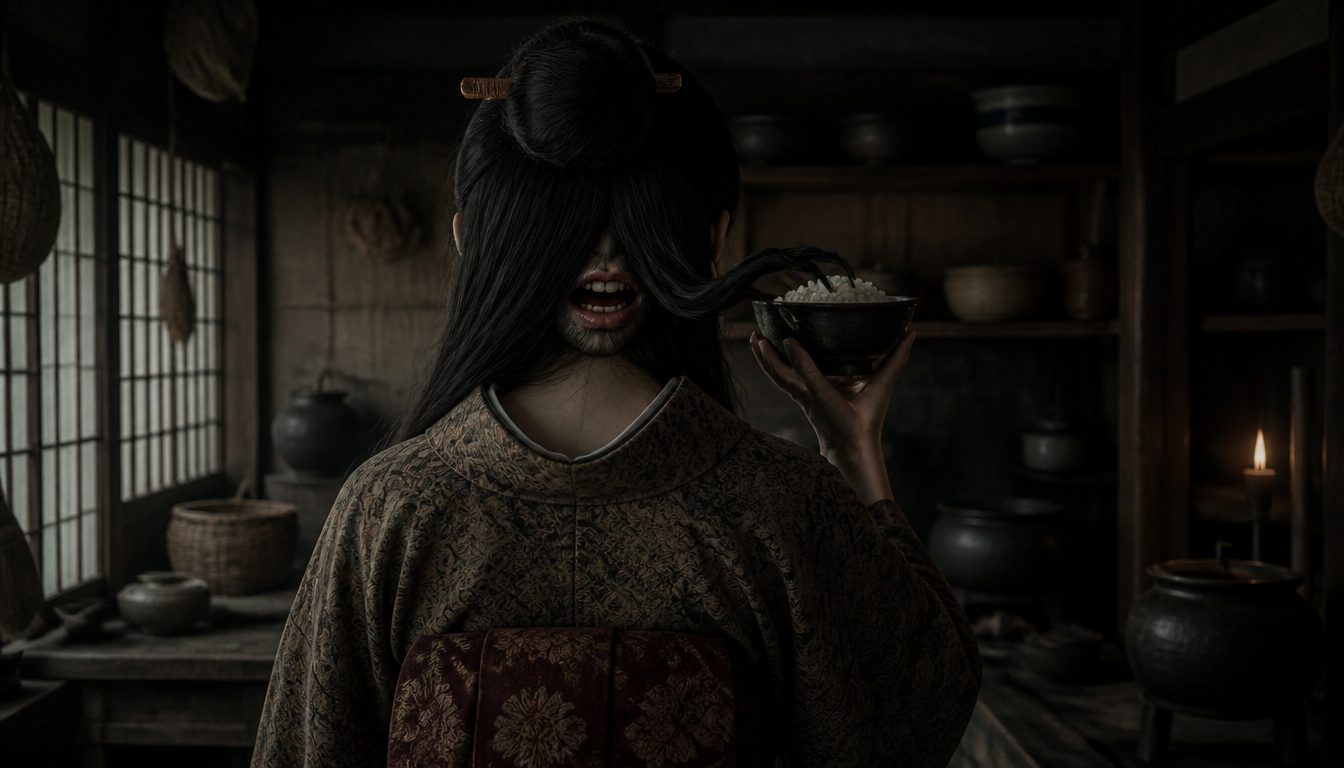
Illustration — Futakuchi-onna, the two-mouthed woman: seen from behind, a mouth gapes in her head's back as her hair lifts a rice bowl. About our pictures
SpiritA woman who seems to eat almost nothing, yet hides a second, ravenous mouth in the back of her skull beneath her hair. In the illustrations her hair snakes out to feed it; in the 1841 text the wound speaks and demands food.
At a glance
What is a futakuchi-onna?
Futakuchi-onna (二口女) means "two-mouthed woman." She looks like an ordinary woman, but hidden under the hair at the back of her head is a second mouth. Japanese dictionaries define her in just those terms: a female yokai with a second mouth on the back of the head, who uses her hair to carry food to it. They name the Edo-period collection of strange tales Ehon hyaku monogatari as one of the places she is described.
The name actually covers two different traditions that are often mixed up. One is a single moral tale from a nineteenth-century picture book, about a cruel stepmother and a wound that will not heal. The other is a much older and very widespread folktale about a man who wanted a wife who never ate. Seeing how the two were tied together explains why the futakuchi-onna has become one of the best-known yokai today.
The stepmother in the Ehon hyaku monogatari
The Ehon hyaku monogatari ("Picture Book of a Hundred Stories") was published in 1841. Its text is by an author who wrote as Tōsanjin, and its pictures are by the artist Takehara Shunsen. The book is also known by the title Tōsanjin yawa. In 2026 the novelist Kyōgoku Natsuhiko published a modern Japanese translation with a transcription of the original, and his publisher picked out the futakuchi-onna as one of the book's best-known yokai.
Her story there is short and harsh. A woman marries a man who already has a child from his first marriage. She favours her own child and gives the stepchild so little food that it starves to death. Some time later, an axe strikes her on the back of the head. In most summaries it is her husband's, swung by accident as he splits firewood. The wound does not heal. It takes the shape of a mouth that hurts until food is put into it, and that eventually begins to speak. Princeton Public Library's notes for an exhibition of yokai paintings by Minako Ota describe it as a mouth that demands food and whispers about her crime. They also stress that the story is a lesson in karmic retribution: the deformity is punishment for her cruelty. Modern summaries of the book place the story in Shimōsa province, part of present-day Chiba.
The picture and the text do not quite agree
The futakuchi-onna most people know comes from Takehara Shunsen's illustration, not from the text. In the picture her hair rises up like a set of snakes and lifts food to the mouth at the back of her head. Princeton's exhibition notes point out that the original text is about a spiritual illness, and the serpent-like hair belongs to the famous illustration. In other words, the book's author describes a sick woman being punished, while the artist drew a monster.
This wound that talks and must be fed belongs to a wider Japanese idea, the jinmensō, or "human-face sore." The Nihon Kokugo Daijiten defines it as a swelling that takes on the shape of a human face. It quotes the 1666 story collection Otogibōko, which describes a sore on the left thigh shaped like a human face, with eyes and a mouth. A popular name for the condition, the dictionary adds, was manma-kui, "rice-eater," because putting grains of rice into the wound was said to stop the pain. The stepmother's second mouth is the same kind of punishment: a sin that turns into a hungry wound.
The wife who doesn't eat
The older story is the folktale Kuwazu nyōbō, "the wife who doesn't eat." It is one of Japan's best-known folktales, and its outline is recorded in standard Japanese encyclopedias. A stingy man says he wants a wife who eats nothing. A woman arrives who seems to fit his wish. She works hard and never touches food in front of him. But the household rice keeps vanishing. One day the man pretends to go out and spies on her. He sees her cook a huge pot of rice and shovel it into a great mouth on the top of her head.
Once she knows she has been seen, the wife shows what she really is. In the most common version she shuts the man in a bathtub or a cooper's tub and carries him off into the mountains to eat him. He escapes by grabbing a branch, and hides in a thicket of iris and mugwort that the monster cannot enter. Many tellings end by saying this happened on the fifth day of the fifth month. That is why iris and mugwort are hung from the eaves on that day, the old boys' festival, to keep evil away.
The wife's true form changes from region to region. The Heibonsha World Encyclopedia lists a yamauba (mountain witch), an oni, a snake or a spider. It notes that the spider becomes much more common the further west the story is told. Folk records collected by Nichibunken give many examples. In Iwate, the bride with no mouth turns out to have one in her head and chases her husband as an oni. In Kanagawa, a spider takes the form of a girl to become the bride. In Aomori, the husband watches her eat "like a spider" from a mouth in her head, and then hides in a marsh full of mugwort and iris. In Kōchi, the monster says she will come back as a spider on New Year's Eve, so the man waits by the fire and throws the spider into the flames when it drops from the hearth hook.
The Nipponica encyclopedia suggests two reasons for this ending. It explains the taboo against spiders seen at night, which in many places should be killed. It also suggests that the man is so often a cooper because travelling coopers were among the people who told the story. The same encyclopedia notes that stories of a wife who supposedly eats nothing, but eats in secret while her husband is away, are found across Europe and among Spanish-speaking communities in the West Indies. Sometimes even the detail that the wife is really a demon is the same.
One name, two monsters?
Today, the name futakuchi-onna is often given to both figures: the punished stepmother of 1841, and the monster bride of the folktale with her mouth hidden in her hair. Some Japanese yokai reference works treat them as different beings. The stepmother is a human being suffering from a disease brought on by her own sin. The folktale bride is a yamauba, spider or other monster in disguise. The image of hungry hair and a hidden mouth has joined them in popular culture anyway.
What the two have in common is a concern with food and fairness. In one, a woman who starves a child is condemned to feed a mouth that is never satisfied. In the other, a man who resents feeding a wife gets a wife who eats more than anyone. Both stories turn on the cost of keeping a household fed.
Frequently asked questions
What is the story of Futakuchi-onna?
In the 1841 Ehon hyaku monogatari, a stepmother lets her stepchild starve. Later an axe wounds the back of her head, and the wound becomes a mouth that demands food and speaks of her guilt. A separate folktale, "the wife who doesn't eat," tells of a bride who secretly eats through a mouth in her head.
Where is the second mouth of a futakuchi-onna?
On the back of the head, hidden under her hair. In the folktale versions the mouth is usually described as being on the top or in the middle of the head.
Is Futakuchi-onna the same as the "wife who doesn't eat"?
They are often merged, but they come from different sources. The stepmother is a person punished with a disease, while the folktale wife is a monster in disguise, such as a yamauba or a spider. Some reference works treat them as separate yokai.
Why do people hang iris and mugwort on Children's Day?
One folk explanation comes from the "wife who doesn't eat." The husband escapes the monster by hiding in iris and mugwort, which she cannot touch, and the story says this happened on the fifth day of the fifth month. So the plants are hung from the eaves on that day to ward off evil.
Who drew the famous Futakuchi-onna picture?
Takehara Shunsen illustrated the Ehon hyaku monogatari in 1841. His picture of her hair rising like snakes to feed the mouth at the back of her head is the image most people know. That detail is not in the book's own text.
Sources & further reading
- Kotobank: 二口女 (Daijisen Plus)
- Kotobank: 食わず女房 (Heibonsha World Encyclopedia, entry by Nomura Keiko; Nipponica, entry by Kojima Yoshiyuki; Nihon Jinmei Daijiten)
- Kotobank: 人面瘡 (Nihon Kokugo Daijiten; Daijisen Plus)
- Futakuchi-onna, *Spirits Among Us* exhibition notes, Princeton Public Library
- KADOKAWA: 絵本百物語, modern translation and transcription by Kyōgoku Natsuhiko (2026)
- Nichibunken Kaii/Yōkai Densho Database: kuwazu nyōbō records
- Nichibunken record 1231019: Iwate, the bride with a mouth in her head
- Nichibunken record C1450092-000: Kanagawa, the spider bride
- Nichibunken record C0220093-000: Aomori, mugwort and iris
- Nichibunken record 2450261: Kōchi, the spider on New Year's Eve
- Nichibunken record 1231001: Tsushima, the greedy carpenter
- Wikipedia (Japanese): 二口女, used as a pointer to the *Ehon hyaku monogatari* text and its editions
- Wikipedia: Futakuchi-onna (pointer)
- en.wikipedia.org — Ehon Hyaku Monogatari
- yokai.jp — ehon-hyaku-monogatari