Hanako-san
トイレの花子さん
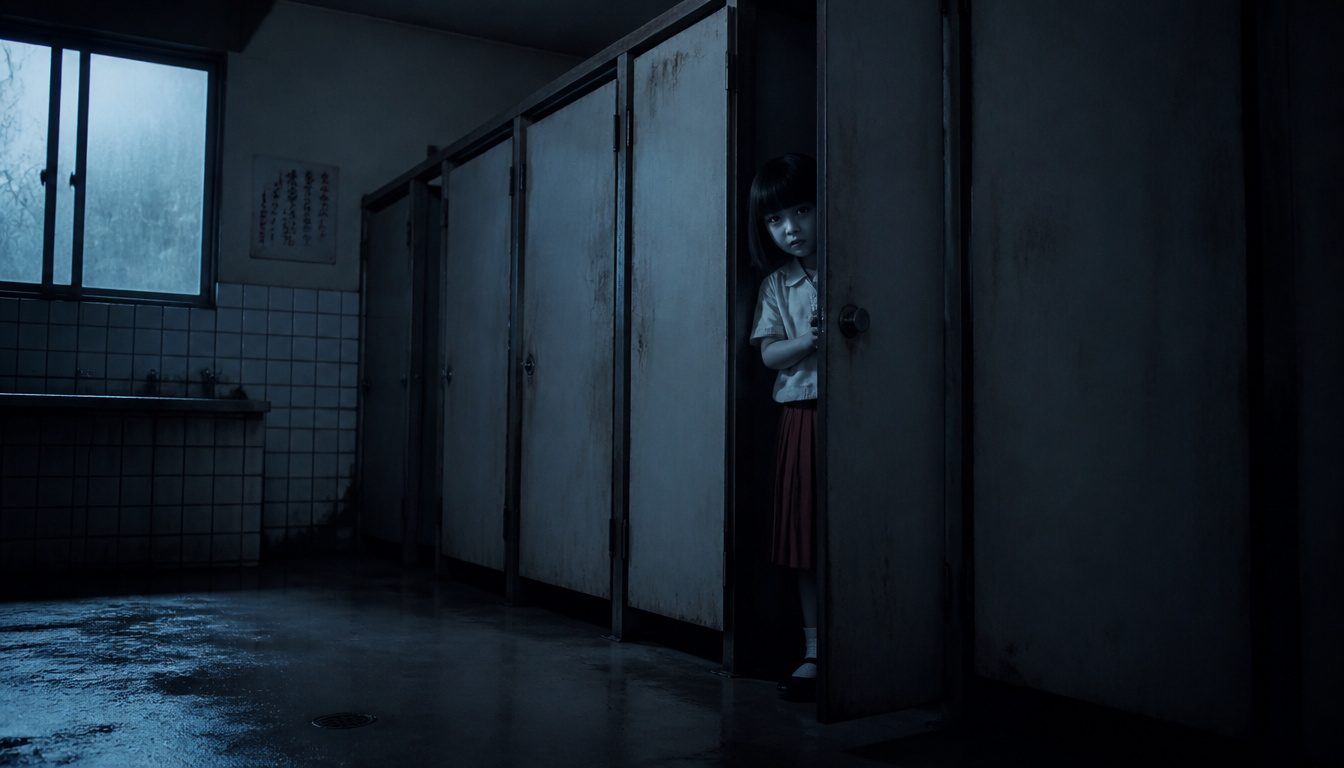
Illustration — Hanako-san of the toilet, the Japanese school ghost: a bob-haired girl in a red skirt peers from a dark bathroom stall. About our pictures
SpiritThe ghost of a girl who haunts a school toilet, usually the third stall of a girls' bathroom on the third floor. Knock three times, ask "Hanako-san, are you there?", and a small voice may answer. In some versions a hand pulls you in; in others she is lonely, even kindly.
At a glance
Who is Hanako-san?
Toire no Hanako-san, "Hanako of the toilet", is the best-known ghost of Japanese schools. She is said to live in one stall of a girls' toilet, most often the third stall on the third floor. If you knock and call her name, a girl's voice answers. Sometimes that is all that happens. In other versions something reaches out, or she wants you to play, or she chases you.
Hanako-san is not a figure from old scrolls or Edo-period picture books. She belongs to gakkō no kaidan, the "school ghost stories" that children tell one another, and her story is passed on in schoolyards rather than in books. That makes her a modern legend, like Kuchisake-onna. Because she lives in children's talk rather than in a fixed text, almost every school seems to have its own version.
The ritual
The best way to see what children actually say about Hanako-san is through the folklore surveys collected in the Nichibunken database (the International Research Center for Japanese Studies). Its records of her come from regional folklore journals published between 1990 and 2001. They show both a shared core and a great deal of local variation.
A 1999 survey of high-school students in Tochigi Prefecture records the version most people know. Hanako-san lives in the third stall of the third-floor toilet. You knock on the door three times and say "Hanako-san, asobimashō" ("Hanako-san, let's play"). She answers "Hāi" and appears. Another student in the same survey, from Utsunomiya, described a quieter form. You call "Hanako-san" three times at a closed stall, and she knocks three times from inside in reply.
Other schools had other rules. In a 1992 report from Yamagata City, a second-year primary pupil said Hanako-san was in the second stall from the left in the toilets on the west side of the school. A 1998 survey in Hamamatsu, Shizuoka, recorded a taboo rather than a summons: no one should go into the third stall from the front, because Hanako-san or other ghosts appear there and pull people in.
Many Hanako-sans
The surveys show how freely children reshaped her. A 1990 report from Yamagata says that if you call "Hanako-san" as you leave the toilet, a voice answers "Hāi". A gentle reply means you are safe. A reply in an unpleasant voice that seems to rise from deep underground means something may happen, so take care. The same report records a version in which Hanako-san is not a girl at all. In that version she is a three-headed lizard three metres long, which uses a girl's voice to lure people close.
In a 1990 report from a Yokohama primary school, Hanako-san had a male counterpart, Yōsuke-san, in the boys' toilet. Other children there named Tarō-san and Jirō-san instead. Some rules were taboos about her name. A Kobe high-school student told a 2001 survey that anyone who says "Hanako-san" aloud must face north and say "gomen nasai" ("I'm sorry") ten times. A university student from Matsue, recalling her primary school, said simply that Hanako-san would chase anyone who refused to play with her.
Retellings often give her a tragic past, but the records collected from children seldom include one. In the reports above she has no backstory at all. She is a voice, a knock, a set of rules and, now and then, a hand.
How old is the legend?
Her origin is uncertain, and it is best stated carefully. English-language yokai references often say the legend goes back as far as the 1950s. Japanese writers point a little earlier. Both nippon.com and the book site Real Sound report an account from about 1948 at a primary school in Iwate Prefecture, in present-day Kitakami. There, a girl's voice was said to come from the third stall of the gymnasium toilet, and a white hand reached up from the bowl. Real Sound names its source as a companion volume to Asazato Itsuki's dictionary of modern yokai. Neither article says how the account was first recorded, so it is best treated with some caution. The folklorist Yoshioka Kazushi, interviewed by nippon.com, concludes that Hanako-san seems to have begun as one of the many "hand from the toilet" stories.
Stories about schools themselves are much older than Hanako-san. Yoshioka notes that they began circulating once the 1872 Gakusei education law created schools across Japan.
The 1990s boom
What made Hanako-san a national figure was the school-ghost boom of the 1990s. According to Yoshioka, the category of "school ghost stories" took hold after the folklorist Tsunemitsu Tōru published a collection in 1990 in Kodansha's KK Bunko series. Tsunemitsu had gathered the stories from his own pupils while teaching at a junior high school. Kodansha followed with a children's series, and Poplar Publishing started a rival series the next year. These became a new genre of children's literature and set off a huge boom.
The boom reached the cinema in the summer of 1995. Toire no Hanako-san, directed by Matsuoka Jōji and distributed by Shochiku, opened on 1 July. In it, rumours that a new transfer student is Hanako-san spread through a primary school troubled by a series of crimes. A week later, on 8 July, Toho released Gakkō no Kaidan (School Ghost Stories), directed by Hirayama Hideyuki and credited as based on Tsunemitsu and the Japanese Folktale Society.
Yoshioka also traces how she gained a face. At first Hanako-san was only a voice. In the 1990s, children's books, manga and anime fixed her image as a girl with a bobbed haircut, a white blouse and a red skirt, which is how most people picture her today. Real Sound suggests that older images of red-clad children, among them the zashiki-warashi, may have shaped that look.
Hanako-san today
Hanako-san has kept changing. The manga Jibaku Shōnen Hanako-kun (Toilet-Bound Hanako-kun) by AidaIro, serialised in Square Enix's Monthly G Fantasy, was adapted as a television anime that began on TBS in January 2020. It plays on the school rumour that a "Hanako-san" in the third stall of the third-floor girls' toilet of the old school building will grant any wish.
Yoshioka sees school ghost stories as more than idle scares. In his account, they work as a rite of passage that binds a group of children together and as a way of talking to one another. He found that toilets were the most common setting, followed by ordinary classrooms. Haunting the places children use every day lets them attach rules to the ghost, such as which stall, what time and what words to say, and those rules give them a sense of control over their fear. He also believes that a story like Hanako-san's would struggle to spread nationwide today. Children's friendships have split into small groups that share their own stories, and they have far less unsupervised time after school.
Frequently asked questions
How do you summon Hanako-san?
The best-known version says to go to the third stall of the girls' toilet on the third floor, knock three times and say "Hanako-san, let's play". Her answer is said to be "Hāi". Every school seemed to have its own variation, though, including different stalls, different words and different results.
Is Hanako-san dangerous?
It depends on the telling. In many reports she only answers or appears. Others say she pulls people into the toilet or chases anyone who will not play, and a few make her something far stranger. She is a children's legend, so the danger is part of the dare.
Is Hanako-san a real story?
She is a real legend, not a real ghost. Folklorists have collected her story from schools across Japan since at least 1990, and one reported version dates to about 1948. Her backstories vary from telling to telling, and none of them is documented as history.
When did the Hanako-san legend start?
No one knows for certain. English-language sources often say the 1950s. Japanese sources cite an account from an Iwate primary school around 1948, and most of the versions collected by folklorists date from the 1990s.
Why is Hanako-san always in the third stall?
Not always: some schools placed her in the second stall from the left or the third from the front. In the collected versions, threes keep recurring: three knocks, three calls and the third floor. No source records a single original reason.
Sources & further reading
- Yoshioka Kazushi, interview on school ghost stories (nippon.com, Japanese, 2023)
- Real Sound Book: the roots of Hanako-san, Kokkuri-san and Kuchisake-onna (2024)
- Nichibunken Kaii/Yōkai Densho Database: *Hanako-san* records
- Nichibunken record 0970079: third floor, third stall, Tochigi (1999)
- Nichibunken record 0970080: three calls and three knocks, Utsunomiya (1999)
- Nichibunken record 1140615: second stall from the left, Yamagata (1992)
- Nichibunken record 0890009: the forbidden third stall, Hamamatsu (1998)
- Nichibunken record 1140574: a gentle voice or a dreadful one, Yamagata (1990)
- Nichibunken record 1140575: the three-headed lizard, Yamagata (1990)
- Nichibunken record 2210104: Hanako-san and Yōsuke-san, Yokohama (1990)
- Nichibunken record 2610019: the name taboo, Kobe (2001)
- Nichibunken record 2610018: play or be chased, Matsue (2001)
- Yokai.com: Toire no Hanako-san (the "1950s" dating in English references)
- Jorudan: *Toire no Hanako-san* (1995), dir. Matsuoka Jōji
- eiga.com: *Gakkō no Kaidan* (1995), dir. Hirayama Hideyuki
- Anime! Anime!: *Jibaku Shōnen Hanako-kun* TV anime (2020)
- Wikipedia: Hanako-san (pointer to further reading)
- bigthink.com — japanese-bathroom-ghosts