Tengu
天狗
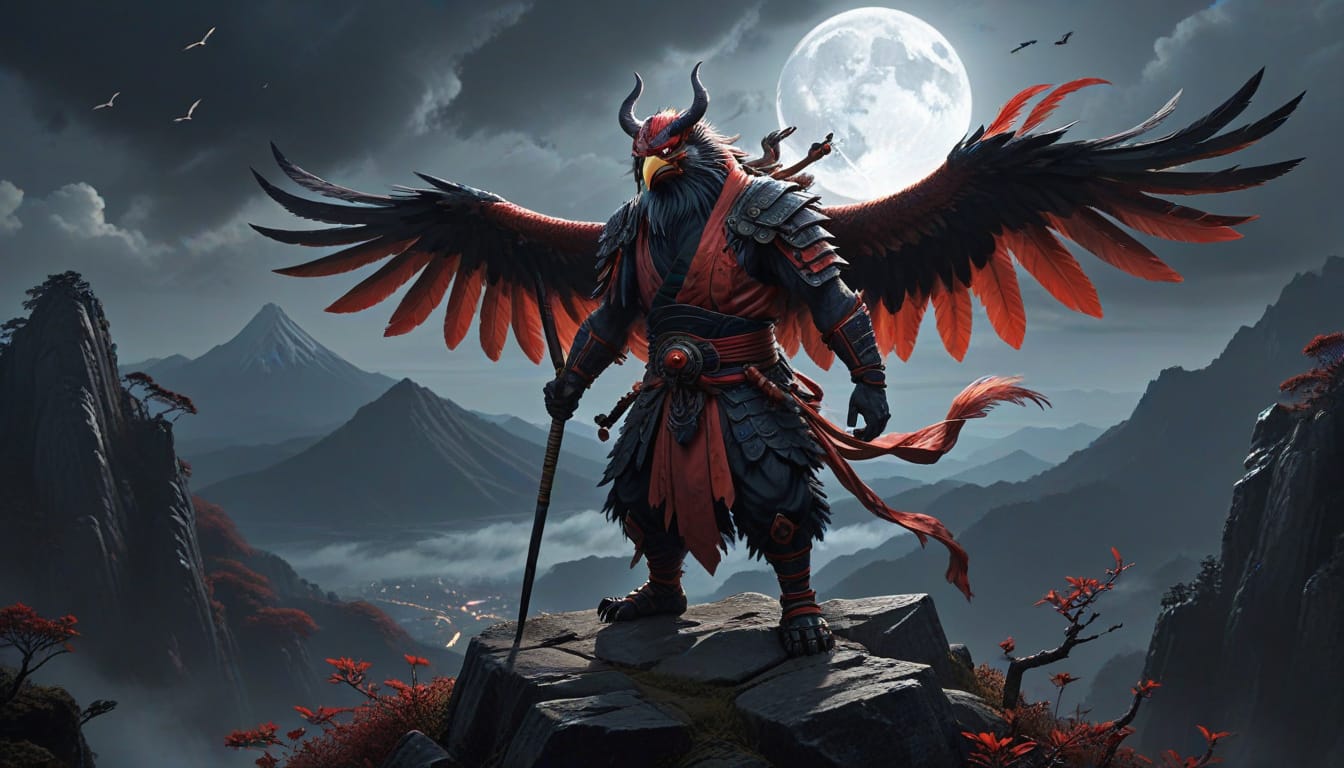
Illustration — Tengu, the Japanese mountain goblin: a horned bird-headed warrior with red-black wings stands on a mountain peak under a full moon. About our pictures
DemonMountain-dwelling supernatural beings with both avian and human characteristics. They possess great martial skill and magical powers, and are depicted either red-faced with long noses or with the beak of a crow.
At a glance
What is a tengu?
The tengu is the spirit of Japan's mountains: a winged, bird-like being that haunts high forests and remote peaks, commands great powers and enormous pride, and over the centuries has been cast as an enemy of Buddhism, a teacher of warriors, and a revered guardian. Few yokai have changed character as dramatically. The tengu of a twelfth-century tale and the tengu on a souvenir mask at a mountain temple today are related, but they are not the same creature.
The name is written 天狗, "heavenly dog," and that is the first puzzle. Nothing about the tengu of Japanese art looks like a dog. The answer lies in the word's journey from China, where it named something quite different, to Japan, where it was attached to a mountain goblin and eventually to some of the most respected spirits in Japanese religion.
Appearance and powers
Two main kinds of tengu appear in Japanese art. The karasu-tengu, or "crow tengu," has a bird's head and beak, wings and often feathers, and usually plays the role of a lesser tengu or a follower. The greater tengu, daitengu, are more human in form: red-faced, with a strikingly long nose, wings on their backs, and the dress of the yamabushi, the mountain ascetics of the Shugendō tradition, including their small black cap (tokin) and the pompom-decorated sash. The long nose seems to be a comparatively late development, probably dating from around the fourteenth century, perhaps as a humanised version of the bird's beak.
Tengu are masters of the sword and of martial arts. They fly, and in many stories they disguise themselves or snatch people away into the mountains. A greater tengu is often shown carrying a fan of feathers, hauchiwa, which in folk tales can raise great winds or make a person's nose grow and shrink. Above all, tengu are proud. In Japanese, to "become a tengu," tengu ni naru, means to grow conceited.
Origins and history
The Chinese tiangou, "heavenly dog," was a fierce, dog-like creature associated with meteors and with war. The word first appears in Japan in the Nihon Shoki, the court chronicle completed in 720. In an entry for the ninth year of Emperor Jomei's reign (637), a great star moves across the sky from east to west with a noise like thunder. Some say it is a falling star, others "earth-thunder," but the Buddhist monk Bin (Min) declares that it is neither: it is the Celestial Dog, whose bark sounds like thunder. In this first Japanese appearance, the tengu is not a bird or a mountain spirit at all, but a portent in the sky.
By the Heian period the word had come to name a very different being. In the Konjaku monogatarishū, the great story collection of the early twelfth century, tengu are troublesome opponents of Buddhism. They mislead the faithful, set fires at temples, play tricks on priests, carry off monks and possess women. A belief grew that proud or corrupt monks might themselves be reborn as tengu, and the Tengu zōshi picture scroll, dated 1296 and now in the Nezu Museum, satirises the arrogant clergy of the great temples by showing them as beaked tengu.
Not every medieval tengu was a villain. The Kamakura-period Buddhist collection Shasekishū already describes good tengu that command the bad ones and protect the Buddhist teaching. From the thirteenth century, tengu also became closely associated with the yamabushi, the ascetics who trained in the same mountains the tengu were said to haunt, which is why tengu wear yamabushi dress. From about the seventeenth century, tengu were more and more often presented as protectors of particular temples, mountains and forests. Some scholars have also seen the influence of Garuda, the bird deity of Hindu and Buddhist tradition, known in Japan as Karura, in the tengu's winged form.
Famous legends
Sōjōbō and the young Yoshitsune. The most famous tengu is Sōjōbō, the great tengu of Mount Kurama north of Kyoto. Legend says that the boy Ushiwakamaru, later the celebrated general Minamoto no Yoshitsune (1159–1189), was sent to Kurama's temple as a child and secretly learned swordsmanship and strategy from the tengu in the valley of Sōjōgatani. The story is best known from the Noh play Kurama Tengu, in which the great tengu, disguised as a mountain priest, befriends the boy at a cherry-blossom viewing, reveals himself, and promises to teach him the secrets of the art of war. The older chronicle of Yoshitsune's life, the Gikeiki, describes Sōjōgatani as a deserted place haunted by tengu.
Emperor Sutoku, the tengu emperor. Sutoku was a real emperor who lost the Hōgen Rebellion of 1156 to his brother Go-Shirakawa and was exiled to Sanuki on Shikoku, where he died in 1164. In the war tale Hōgen monogatari, Sutoku, embittered when the sutras he had copied in exile are sent back to him, swears a curse in his own blood, lets his hair and nails grow wild, and becomes a great tengu while still alive. He is remembered as one of the great vengeful spirits of Japanese history, and the tengu Sagamibō is said to guard his tomb at Shiramine.
Torakichi, the tengu's apprentice. Belief in tengu was still very much alive in the nineteenth century. In 1822 the scholar Hirata Atsutane published Senkyō ibun, a long work based on his interviews with Torakichi, a teenage boy from Edo who claimed to have been taken away and trained by tengu in the other world. Atsutane questioned him at length about the tengu's realm, treating his answers as evidence of a hidden spiritual world. The book is a vivid record of how seriously some people took the tengu's habit of spiriting away children.
Regional traditions and sacred mountains
Many mountains in Japan have their own named tengu. Sōjōbō rules Kurama, and Tarōbō of Mount Atago, west of Kyoto, was counted by the scholar Hayashi Razan among the greatest of them. At Mount Takao on the western edge of Tokyo, the temple of Yakuō-in is a centre of tengu and Izuna faith, and statues of a long-nosed tengu and a crow tengu stand before its Izuna Gongen hall. The temple explains the beaked one as a tengu still in training and the long-nosed one as a seasoned ascetic, and says tengu act as messengers of the gods and buddhas, punishing evildoers and protecting the good. Its principal deity, Izuna Daigongen, is described as combining several figures, including Karura, the Buddhist form of Garuda.
The long nose also links the tengu to the Shinto deity Sarutahiko, whom the Nihon Shoki describes as having a nose seven hands long. Sarutahiko is often regarded as one model for the long-nosed tengu.
In art, theatre and popular culture
Tengu have been a favourite subject in Japanese art since the medieval picture scrolls. The scenes of Yoshitsune learning swordsmanship from the tengu of Kurama were painted and printed again and again, and during the Edo period the tengu took on a lighter, sometimes comic image alongside the fearsome one. The Noh play Kurama Tengu keeps the Kurama legend on the stage.
In modern popular culture, tengu appear in films, manga and games, from the crow-tengu characters of the Touhou Project series to fighting-game characters. The Pokémon Shiftry is said to be based on them.
Frequently asked questions
Are tengu good or evil?
Both, depending on the period and the story. Early Japanese tales present tengu as enemies of Buddhism who trick monks and spirit people away, while later tradition, from about the seventeenth century, increasingly treats them as protective mountain spirits worshipped at temples and shrines.
Why do tengu have long noses?
The long nose is a fairly late feature, probably added around the fourteenth century, perhaps as a human version of the beak of the earlier bird-like tengu. It is also linked with the long-nosed deity Sarutahiko and has come to symbolise the tengu's pride.
What is the difference between a karasu-tengu and a daitengu?
The karasu-tengu, or crow tengu, has a bird's head and beak and is usually a lesser tengu. The daitengu, or great tengu, is more human in form, with a red face, long nose and the dress of a mountain ascetic.
Why are tengu called "heavenly dogs"?
The name comes from the Chinese tiangou, a dog-like omen linked with meteors. Its first Japanese use, in the Nihon Shoki, is for a thundering meteor in 637; only later did the word come to mean the winged mountain spirit.
Sources & further reading
- Tengu (Wikipedia, used as a pointer to primary texts)
- Tengu, JAANUS dictionary of Japanese art, Columbia University
- Nihongi, tr. W. G. Aston, vol. 2 (Jomei, year 9), Internet Archive
- Nihongi, tr. W. G. Aston, vol. 1 (Sarutahiko), Internet Archive
- Kurama-Tengu (Wikipedia)
- Wilburn Hansen, When Tengu Talk: Hirata Atsutane's Ethnography of the Other World (University of Hawai'i Press)
- Sutoku Tennō, yokai.jp
- Mt. Takao Yakuōin Temple (Hachioji tourism)