Baku
獏
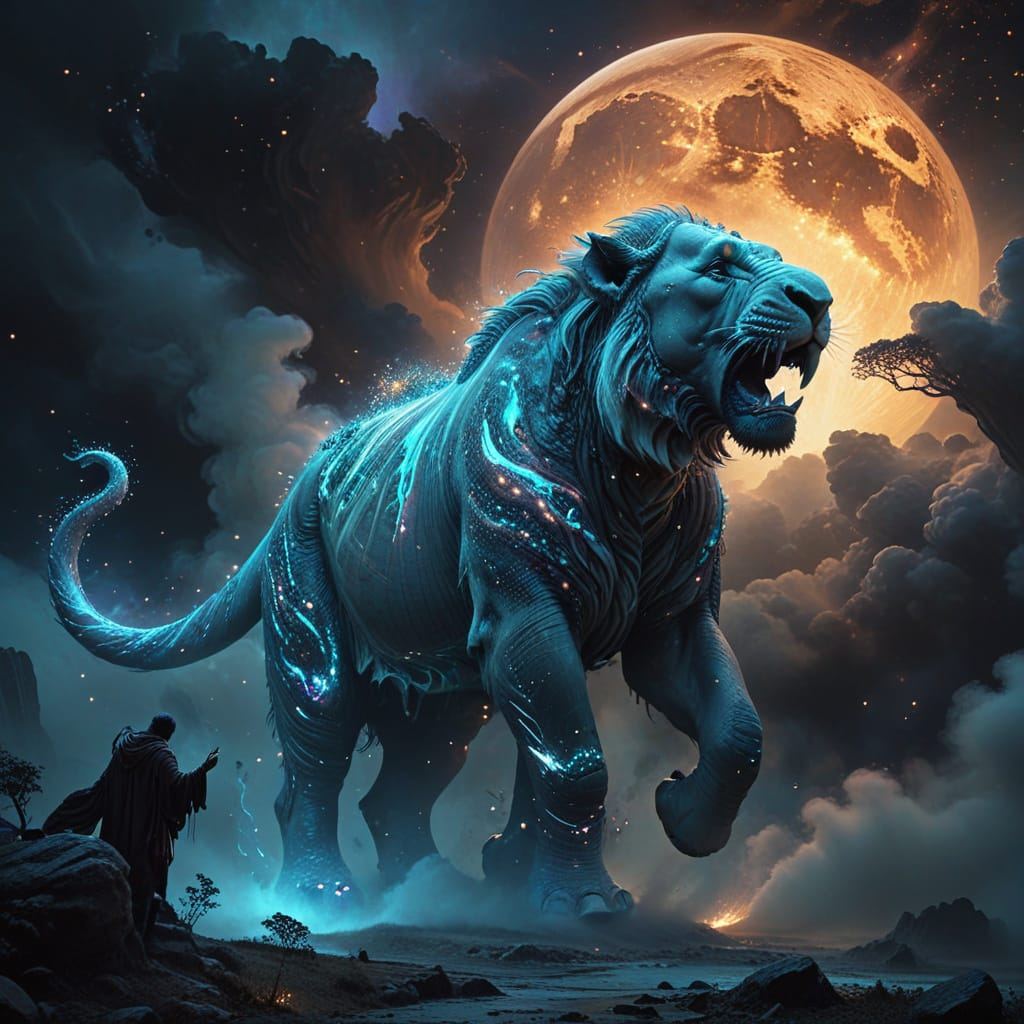
Illustration — Baku, the Japanese dream eater: a huge glowing blue lion-like beast roars beneath an orange moon as a robed figure watches. About our pictures
Animal yokaiA dream-eating beast with an elephant's trunk, a rhinoceros's eyes, an ox's tail and a tiger's feet on a bear-like body. In Japan it devours nightmares and is a benevolent charm that protects sleepers from bad dreams.
At a glance
What is the baku?
The baku (獏, also written 貘) is the beast that eats bad dreams. In Japan it is best known as a charm. People drew it, wrote its name on pillows and on New Year pictures of the treasure ship, and called on it after a nightmare. Japanese dictionaries describe it as an imaginary animal from China, put together from parts of other animals. The Nihon Kokugo Daijiten gives the usual list: the trunk of an elephant, the eyes of a rhinoceros, the tail of an ox and the feet of a tiger, on a body shaped like a bear's.
The baku has two lives. In China it was a beast whose skin kept away disease and whose picture kept away evil. In Japan it took on the job it is famous for today, eating nightmares. The same word also became the Japanese name of a real animal, the tapir.
The mo in China
The Chinese name is mo (貘). The oldest Chinese dictionaries treat it as a real animal. The Shuowen jiezi, the classic Chinese character dictionary, as quoted in the online dictionary Zdic, says it is "like a bear, yellow and black, and comes from Shu", the region of modern Sichuan. Other early glosses collected there say it licks up and eats copper and iron, and that its teeth are so hard that iron hammers break on them. The scholar Su Song is quoted as saying that people of the Tang dynasty painted the mo on screens.
The text that fixed its image is a short piece by the Tang-dynasty poet Bai Juyi, "In Praise of a Mo Screen" (Mo ping zan). Its preface reads, in a rough translation: "The mo has the trunk of an elephant, the eyes of a rhinoceros, the tail of an ox and the feet of a tiger, and lives in the mountain valleys of the south. Sleeping on its skin wards off pestilence; drawing its shape wards off evil." Bai explains that he had long suffered from headaches, kept a small screen around his head when he slept, and had a painter put the mo on it. He adds that, according to the Classic of Mountains and Seas, the beast eats only iron and copper.
The poem itself turns this into a joke about his own times. In the distant past, it says, weapons were few and metal was plentiful, so the mo ate its fill. Now iron is melted for weapons and copper is cast into Buddhist statues, and not an ounce is left, so the poor mo must starve. "It is not the mo that is to be pitied," Bai ends, "but the times."
Bai's preface talks about pestilence and evil, not dreams. Japanese reference works disagree about where the dream-eating comes in. The Nihon Kokugo Daijiten and the Heibonsha Mypedia encyclopedia describe the Chinese beast itself as an eater of nightmares. A Nippon.com article says the opposite, that the baku gained the ability to devour bad dreams only after it reached Japan. The Chinese passages quoted above do not mention dreams.
The baku in medieval Japan
The baku was being used as a charm in Japan by the early fourteenth century. The Nihon Kokugo Daijiten gives as its first Japanese example a line from the Enkyō-bon text of the Heike monogatari, copied in 1309–10. Roughly translated, it says that what people still call the baku, draw in pictures and use as a protective charm is this very beast. The passage says nothing about dreams. The dictionary illustrates its entry with a baku from the Chōjū giga, the famous animal scrolls.
The Edo-period scholar Kojima Seisai, in the essay collection Kanchū seiwa, believed the dream-eating idea was old. According to the summary in the Nichibunken Kaii-Yōkai database, he wrote that the baku's dream-eating was known early. He pointed to the character 獏 on the sail of a treasure-ship picture associated with Emperor Go-Yōzei, who reigned from 1586 to 1611. He also noted a picture of a baku on a pillow in the Ruijū zōyōshō, a court furnishings manual completed around 1146 according to Nipponica. That is Kojima's reading of the manual, and this article has not checked the manual itself.
Treasure ships and the first dream
The baku's best-known job in Japan was guarding the first dream of the New Year. People put a picture of a takarabune, a treasure ship, under the pillow to bring a lucky dream. The custom is described in more detail on the Seven Lucky Gods page. The Nihon Kokugo Daijiten says the practice is believed to have existed already in the Muromachi period, and that at court pictures were handed out with the character for the nightmare-eating baku drawn on the sail. Originally, it says, the custom belonged to New Year's Eve or the night of Setsubun and was meant to drive away misfortune. The oldest surviving designs show a ship carrying only ears of rice. Ships crowded with the seven gods and treasure became popular in the middle of the Edo period.
Nipponica's entry on the treasure ship cites the Edo essay collection Kiyū shōran. Drawing on the Anzai zuihitsu, that work says ship pictures were unknown in ancient times but can be found from the Muromachi period on. Nipponica explains that the character for baku was written on the sail because the baku was said to eat bad dreams. Heibonsha's Sekai Daihyakka adds that in the medieval period a picture of a rice-laden ship was laid under the pillow on New Year's Eve. If a bad dream came, the picture was thrown into water. The picture's first purpose, it suggests, was to send bad luck away over the sea.
"Let the baku eat last night's dream"
Folklore surveys of the twentieth century recorded short spells that hand a bad dream over to the baku. All of them are in the Nichibunken database.
- In Aso, Kumamoto Prefecture, a 1936 report says that after a bad dream you should say three times, as soon as you get up, "I will let the baku eat last night's dream."
- In Ogachi District, Akita Prefecture, a 1940 report says that if you had a bad dream on the night of the second day of the New Year, you should look up at the sky the next day and say three times, "I give last night's dream to the baku of heaven." The baku would then eat it.
- In the Shōnai region of Yamagata Prefecture, an old man told a 1957 survey that a baku in the sky rules over dreams. After a bad dream you should say nothing to anyone, face the sun, and say three times, "I offer last night's dream to the baku of heaven."
- In Yuzawa, Akita Prefecture, a 1977 survey recorded the words "I give it to the baku", said three times to escape misfortune.
One record points the other way. A 1965 survey of a village in Miyazaki Prefecture found that before a coffin was carried out, people said twice, "We won't let the baku eat it" or "We won't let the kasha eat it." The kasha is a demon that steals corpses. Here the baku appears as a danger, not a protector. The record gives no explanation.
The iron-eater, carvings and the tapir
The Chinese idea of the mo as an eater of iron and copper also came to Japan. It is often used to explain baku carvings on religious buildings. A TV Tokyo programme about Nikkō, broadcast on 16 January 2021, said that the baku is among the most common animals in the 5,173 carvings at Nikkō Tōshōgū. It explained that the baku eats iron and copper, so it can only live in peaceful times, because in wartime its food becomes weapons. That is a modern explanation of the carvings. This article has not found an Edo-period document stating that it was the builders' intention.
The Japan Tourism Agency's multilingual explanation database has a text on a baku-shaped pillow said to have been used by Toyotomi Hideyoshi (1537–1598). It describes the pillow as wooden, covered on top with leather and cotton. The text suggests the pillow was meant to keep away nightmares, and perhaps weapons too, since the baku eats metal. It adds that baku were often carved on gates for a similar reason. The text gives these as possibilities, not established facts.
Japanese uses the same word for the tapir, the hoofed animal of Southeast Asia and the Americas. Dictionaries such as the Nihon Kokugo Daijiten and Daijisen list the tapir as a second meaning of baku. Nippon.com explains that the tapir was named after the mythical beast because its long snout recalls the baku's elephant trunk. It notes that Japanese zoos usually write the animal's name in katakana, バク.
Frequently asked questions
Does the baku really eat dreams?
In Japanese belief it does, and that is its main role. People asked it to eat bad dreams with spells and pillow charms. In the Chinese sources quoted here, the mo protects against disease and evil and eats iron and copper. They do not mention dreams. Japanese reference works disagree about whether the dream-eating began in China or in Japan.
What does a baku look like?
The standard description goes back to the Tang poet Bai Juyi: an elephant's trunk, a rhinoceros's eyes, an ox's tail and a tiger's feet. Japanese dictionaries add a body shaped like a bear's.
Why is "baku" written on treasure-ship pictures?
Pictures of a treasure ship were put under the pillow at New Year to bring a lucky first dream. According to the Nihon Kokugo Daijiten and Nipponica, the character for baku was written on the sail because the baku eats bad dreams. Pictures of this kind were handed out at the imperial court.
Is the baku the same as the tapir?
No. The baku is an imaginary beast. Japanese later used the same word for the tapir, apparently because its long snout looks like the baku's trunk.
Is the baku dangerous?
In almost all Japanese folklore it is a helper. One 1965 record from Miyazaki Prefecture is an exception. In it, mourners recite a spell to stop the baku, like the corpse-stealing kasha, from taking the dead.
Sources & further reading
- 貘: *Nihon Kokugo Daijiten* and Heibonsha *Mypedia* entries (Kotobank)
- 獏: *Daijisen* entry (Kotobank)
- Bai Juyi, *Mo ping zan* with preface, from the *Quan Tang wen* (Chinese Wikisource)
- 貘: *Shuowen jiezi*, Kangxi dictionary and other glosses (Zdic)
- 宝船: *Nihon Kokugo Daijiten*, Nipponica and Heibonsha entries (Kotobank)
- 類聚雑要抄: Nipponica entry (Kotobank)
- 後陽成天皇: *Daijisen* entry (Kotobank)
- Nichibunken record 5290001: Kojima Seisai, *Kanchū seiwa*, on the baku
- Nichibunken record 1233109_005: Aso, Kumamoto (1936)
- Nichibunken record 1231054_007: Ogachi, Akita (1940)
- Nichibunken record 1060001: the baku of heaven, Shōnai (1957)
- Nichibunken record 1422114_001: Yuzawa, Akita (1977)
- Nichibunken record 2360804: the baku and the kasha, Miyazaki (1965)
- TV Tokyo, *Shutsubotsu! Adomachikku Tengoku*, Nikkō episode (16 January 2021)
- Japan Tourism Agency multilingual explanation: Hideyoshi's baku-shaped pillow (PDF, MLIT)
- Nippon.com: "Real Animals and Mythical Counterparts" (2015)
- Wikipedia: Baku (mythology) (pointer to further reading)
- en.wikipedia.org — Baku (mythology)