Raiju
雷獣
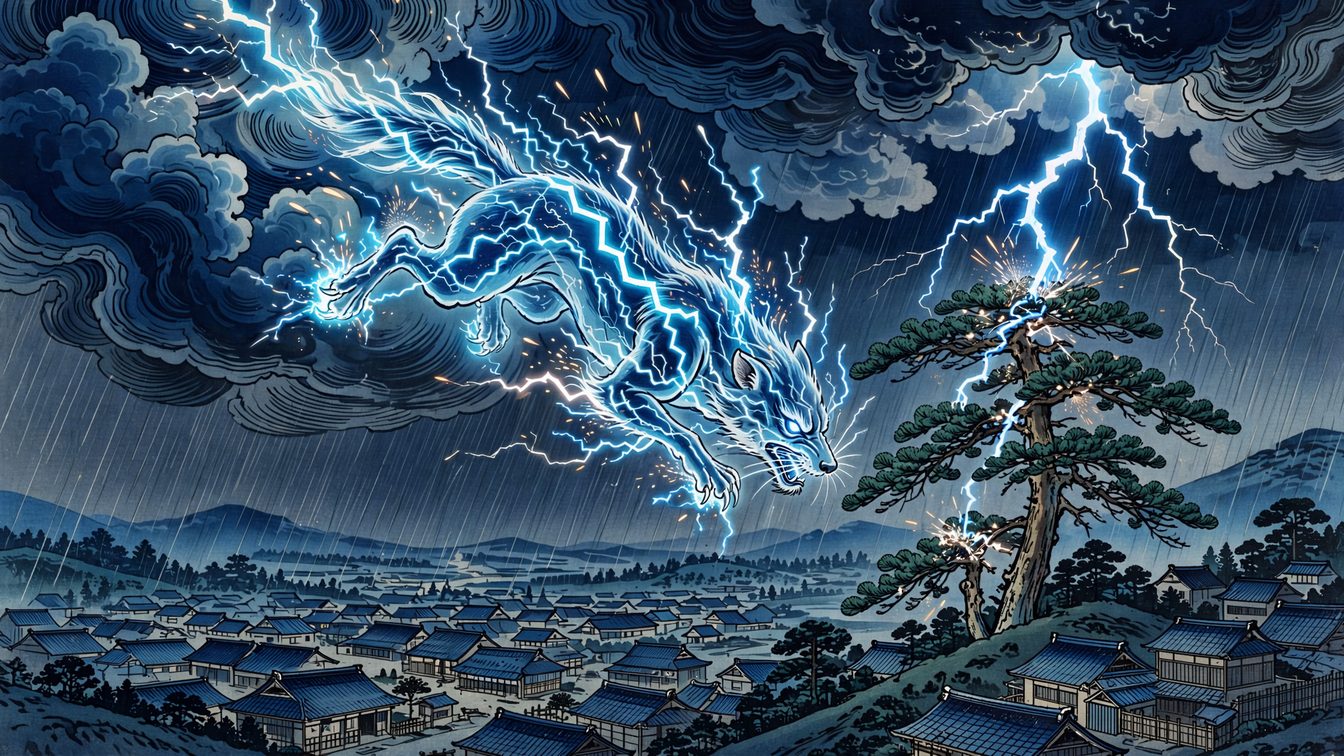
Illustration — Raiju, the Japanese thunder beast: a wolf-like creature of crackling blue lightning leaps from storm clouds toward a pine above a village. About our pictures
Animal yokaiThe 'thunder beast', a small, fierce animal said to fall from the sky with lightning bolts and leave claw marks on trees and buildings. Descriptions vary widely - a wolf-like creature crackling with electricity, a cat, a weasel - and Edo-period writers recorded live 'raijū' shown in cages and even stuffed specimens.
At a glance
What is a raijū?
Raijū (雷獣) means "thunder beast." It is a small, fierce animal that people in Edo-period Japan believed came down to earth with a bolt of lightning. Japanese dictionaries describe it as an imaginary creature that drops from the sky during a thunderstorm, tears trees apart and injures people and livestock, and sometimes cries out with a voice like thunder. Where lightning had split a tree or scored its bark, people said the raijū's claws had done it.
The raijū is often confused with Raijin, the thunder god. They are different. Raijin is a kami, drawn as a drum-beating, oni-like figure. The raijū is an animal, closer to a marten or a cat than to a god. Old writers were not sure how the two were related. A 1921 survey of thunder beliefs, summarised in the International Research Center for Japanese Studies (Nichibunken) yokai database, found three answers in circulation: the beast helped the thunder god, it simply loved thunder, or it was terrified of it.
What did it look like?
No two descriptions agree, and that is part of what makes the raijū interesting. The Sekai Daihyakka encyclopedia sums up the old accounts as a four-legged animal with a long tail and sharp claws, compared variously to a dog, a cat or an otter. The individual reports are more specific and contradict one another:
- An Edo-period essay set near Karasuyama in Shimotsuke (today's Tochigi Prefecture) describes a creature shaped like a rat but larger than a weasel.
- A record of Mount Tateshina in Shinano (Nagano) describes it as a puppy-like animal with badger-like fur, dark rings around its eyes, a thin nose and a short tail, which lived in a rock cave, dug itself into the ground for winter, and was gentle until the rain came, when it turned savage.
- A folk report from Wakayama divides thunder into "water thunder" and "fire thunder," and says both are cat-like beasts with sharp claws. When fire thunder falls, a fire follows.
- An essay in the collection Okinagusa tells of two dead animals washed down from a mountain in Shinano after a storm. They were grey, with long heads, half-black muzzles, fox-like tails and claws like an eagle's.
The Sekai Daihyakka suggests that the real animal behind many of these stories was probably a marten (ten), and that the idea of a thunder beast likely came to Japan from China. One reasonable guess runs like this. A frightened animal sheltering in a hollow tree is found dead or stunned after the tree is struck, and it looks as if it fell with the lightning. The encyclopedia notes that the raijū was thought to hide in hollow trees, stone walls and the corners of buildings, exactly where a small wild animal would shelter.
Edo naturalists and captured "specimens"
The raijū belongs above all to the Edo period (1603–1868), when educated men filled essays and notebooks with strange reports and tried to sort fact from rumour. The earliest dictionary example of the word comes from a 1795 work, Oranda tensetsu ("Dutch theory of the heavens"). It mentions "what is commonly called a raijū," a beast that rides the energy of thunder, and notes that wherever lightning strikes, the marks of its claws are always found.
Many essayists claimed that someone had actually caught one. Nichibunken's database records several cases from these writings:
- In the domain of Iwatsuki, near modern Saitama, a raijū is said to have fallen and run around a field until people caught it. It refused food and died. The writer later saw it stuffed and preserved: like a puppy overall, with claws as sharp as a bear's.
- The essayist Ban Kōkei repeated a report of a raijū that fell into a salt kettle at Hatsukaichi in Aki Province (Hiroshima) in 1801 and died there. He reproduced a drawing of it, though he admitted he could not tell whether the story was true. In the same passage he dismissed another captured "raijū" as probably just a kind of tanuki.
- Another writer said that raijū lived on Mount Haku in Kaga and Mount Asama in Shinano. They looked like foxes and were sometimes caught and shown to the public in Kyoto and Osaka, in iron-mesh cages. They would neither eat nor drink, and when a storm was coming their fur stood on end so violently that the cage had to be covered with a straw mat.
- A 1922 article on Awa (Tokushima) records that in the Bunka era (1804–1818), lightning struck a ship at sea, and an otter-like animal found on board afterwards was put on show as a raijū.
These records support the idea that raijū were exhibited, but they describe live animals in cages and a stuffed specimen. We have not found a reliable source for the claim, common online, that Edo showmen toured "raijū mummies," so we leave that out.
Raijū in village belief
Outside the essays, the raijū was a practical worry for farmers and a way of explaining what lightning did. In Kuji District, Ibaraki, people believed that heavy thunder while the rice seedlings were growing meant a raijū had come down to ruin the seedbeds. Villagers would march into the hills beating split bamboo to drive it off. They also stood bamboo poles in the seedbeds so the beast could climb back up to the sky. A record from Fukushima tells of a temple priest who, in the Kyōhō era (1716–1736), helped a stranded raijū home by planting a pole in the ground for it to climb.
Other reports explain lightning damage directly. In Shimane people said that when lightning struck, a raijū clawed its way down the tree, and some claimed to have watched it run up a trunk. In Akita, the column of fire from a lightning strike was described as a raijū racing up a tree. Some places had charms against it. One Edo writer recorded that the raijū feared camels, so lightning would not strike where camels lived, or where a picture of a camel was pasted up.
In modern culture
Today the raijū is best known from games, anime and manga, where it is often drawn as a large wolf, tiger or dog wreathed in lightning. These designs borrow the name and the electric theme. The animal of the Edo reports was something smaller and stranger: a cat-, rat- or marten-sized creature, caught in a field, kept in a cage or found dead after a storm.
Frequently asked questions
What is the difference between Raiju and Raijin?
Raijin is the thunder god, a kami drawn with drums. The raijū is a small animal said to fall to earth with lightning. Old sources disagreed on whether the beast served the thunder god, loved thunder or feared it.
What does a raiju look like?
Edo-period accounts disagree. It was compared to a dog, cat, otter, weasel, fox or rat, and most reports gave it sharp claws and a long tail. Scholars suggest a real animal such as the marten lies behind many sightings.
Does the raiju sleep in people's belly buttons?
This idea is common on English-language websites, but we could not find it in Japanese folklore records. The traditional Japanese warning is that the thunder god, Kaminari-sama, takes the navels of children who leave their bellies uncovered.
Were raiju real animals?
People did catch and display animals they called raijū. Edo writers describe caged ones shown in Kyoto and Osaka and a stuffed specimen. These were most likely ordinary wild animals, perhaps martens or tanuki, found near lightning strikes.
How old is the raiju legend?
The raijū belongs mainly to the Edo period. Dictionaries cite the word from a work of 1795, and many reports in Edo essays date from the 1700s and early 1800s. Folklorists were still collecting village beliefs about it in the twentieth century.
Sources & further reading
- Raijū entries (Kotobank: Daijisen, Nihon Kokugo Daijiten, Sekai Daihyakka)
- Nichibunken yokai database: all "raijū" records
- Nichibunken: raijū as helper, lover or fearer of thunder (1921)
- Nichibunken: raijū near Karasuyama, Shimotsuke (*北窻瑣談*)
- Nichibunken: raijū on Mount Tateshina, Shinano
- Nichibunken: water thunder and fire thunder, Wakayama
- Nichibunken: two beasts washed down in Shinano (*Okinagusa*)
- Nichibunken: stuffed raijū from Iwatsuki (*Toryūkō zuihitsu*)
- Nichibunken: Ban Kōkei's *Kanden jihitsu*, likely a tanuki
- Nichibunken: Ban Kōkei's *Kanden jihitsu*, the 1801 drawing from Aki
- Nichibunken: caged raijū shown in Kyoto and Osaka (*Nenjū koji*)
- Nichibunken: otter-like beast shown as a raijū, Awa
- Nichibunken: driving the raijū from the seedbeds, Ibaraki
- Nichibunken: a priest helps a raijū back to the sky, Fukushima
- Nichibunken: claw marks on struck trees, Shimane
- Nichibunken: raijū running up a tree, Akita
- Nichibunken: the raijū fears camels (*Hōreki genraishū*)
- Raijū (Wikipedia, used as a pointer for the navel claim)
- abookofcreatures.com — raiju