Zashiki-warashi
座敷童子
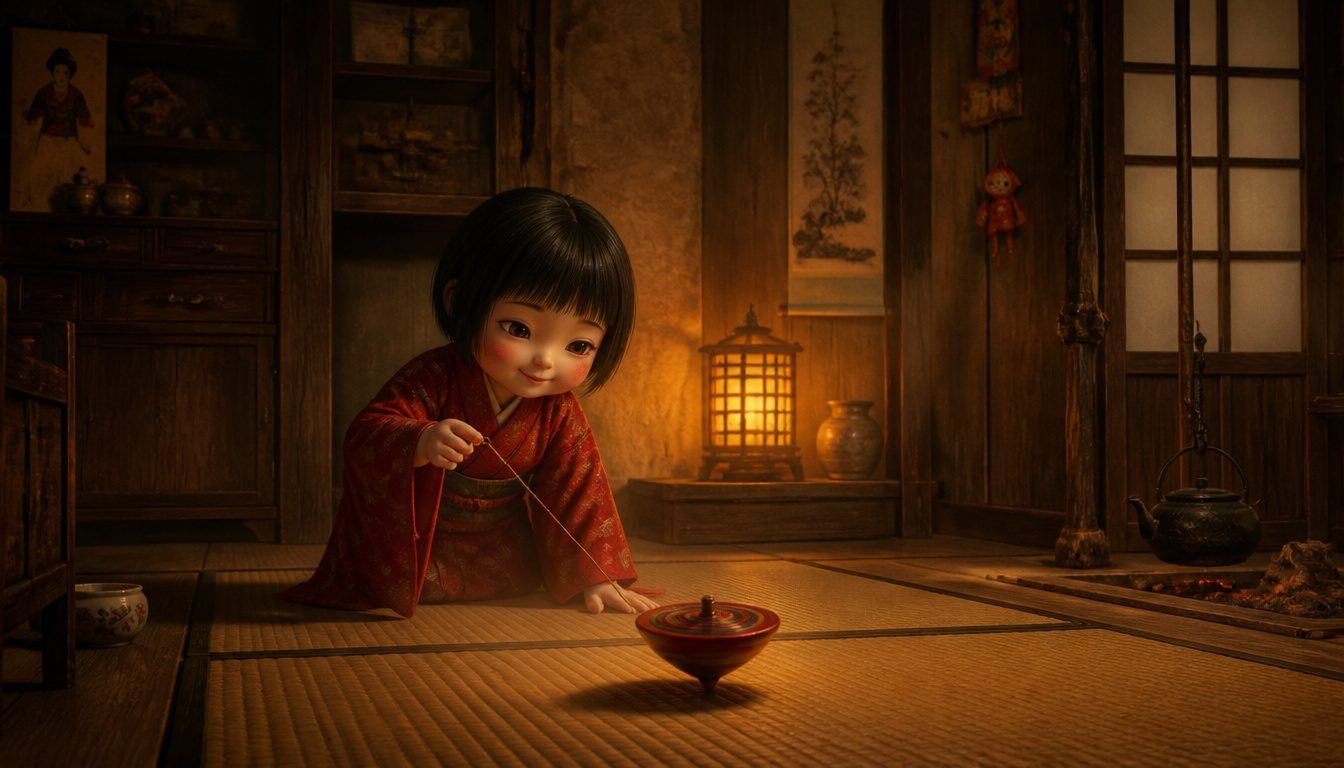
Illustration — Zashiki-warashi, the Japanese house spirit child: a smiling girl in a red kimono spins a top on tatami in a lamplit room. About our pictures
Household yokaiA child spirit, often with a bobbed haircut and a red face, who lives in the inner rooms of an old house. It plays small pranks - footsteps at night, a pillow moved - and as long as it stays, the household prospers. When it leaves, ruin follows.
At a glance
What is a zashiki-warashi?
A zashiki-warashi is a child spirit that lives in the formal rooms of an old house. The name joins zashiki, the formal tatami room of a traditional house, with warashi, a word for a child. It belongs to the Tōhoku region of northern Japan, and above all to Iwate Prefecture. It is one of the rare yokai that people actually hope to meet, because a house with a zashiki-warashi is said to prosper, and a house it abandons is said to fall into ruin.
Japanese reference works describe it in a few consistent strokes. The Nihon Kokugo Daijiten dictionary gives it a red face and a bobbed haircut and places it in the inner rooms of old families' houses. The folklorist Komatsu Kazuhiko, writing in Heibonsha's Sekai Daihyakka Jiten, lists its usual features: a small child with bobbed hair, a red face or red hair, a home in the back room, and a habit of playing tricks on guests who sleep there. In his view, though, the feature that matters most is that the spirit controls whether a household rises or falls.
In Tōno Monogatari
The zashiki-warashi reached a national readership through Tōno Monogatari (The Legends of Tōno), published by Yanagita Kunio in June 1910. In his preface, Yanagita explains that every story in the book came from Sasaki Kizen (pen name Kyōseki), a young man from Tōno who visited him at night from February 1909 and told him the tales of his home district. The dictionary entry cited above still uses this book as the earliest example of the word in print.
Three short sections deal with the spirit. Section 17 says that many old houses in Tōno are home to a god called the zashiki-warashi, usually a child of about twelve or thirteen, who sometimes lets itself be seen. A daughter of one family, home from girls' high school for the holidays, met it in a corridor and recognised it clearly as a boy. In the Sasaki family's own house, Kizen's mother was sewing alone when she heard paper rustling in the next room, which belonged to the master of the house, who was away in Tokyo at the time. She opened the door and found the room empty. Later she heard someone sniffling in there, and concluded it was the zashiki-warashi, which the house had long been said to have. The section ends by stating that a house where this god lives enjoys wealth and freedom.
Section 18 adds that the spirit can also be a girl. The old Yamaguchi Magozaemon household was said to have two girl spirits. One day a villager coming home from town met two unfamiliar, pretty girls by a bridge, looking troubled. He asked where they had come from, and they named Magozaemon's house. He asked where they were going, and they named a wealthy farming family in another village. The man took it as a sign that Magozaemon's line was finished. Section 19 tells what followed. Soon afterwards, more than twenty people in that house died in a single day from poisonous mushrooms. Only a seven-year-old girl survived, because she had been out playing and forgot to come home for lunch. Relatives then carried off the family's goods, and one of the founding families of the village disappeared.
Yanagita's own note on section 17 points readers to his Ishigami Mondō, which also discusses the spirit.
Appearance, names and habits
Away from Tōno, local surveys collected in Nichibunken's database of strange phenomena and yokai lore show how much the figure varies. A 1956 entry in the Miyagi prefectural history records other names for the spirit: zashiki-bokko, kura-warashi and kura-bokko for those living in storehouses, and further names such as usutsuki-ko, hosode and nagate. It also notes that a very similar red-haired figure called aka-shaguma was known in Ehime and Tokushima, far to the south-west.
The spirit's tricks are mostly harmless. The best known is makura-gaeshi, turning a sleeper's pillow around in the night, and some reports say it presses down on guests in bed. A 1939 report from present-day Ōshū says that ash scattered in a corner of the earthen floor would show small footprints in the morning. A 1952 report from Jōbōji in Ninohe says that when an old woman found such footprints by the hearth, the family believed money would come to the house as long as the marks were left alone.
A 1982 survey from the coast of Miyagi gives one of the most detailed portraits. There the spirit, called zashiki-oboko, was a bobbed-haired girl in a kimono with a red under-robe showing at the hem. She was tidy and swept the room, turned rice cakes so they did not burn, and joined the children at play in the evening. In games of rock-paper-scissors she only ever played rock. Other records disagree on details. A 1924 collection of reports by Sasaki Kizen includes one from Hanamaki saying that zashiki-warashi may be boys or girls, and that married couples of them live in some houses. A 2001 report from Hachinohe describes a shadow on a paper screen of a child of three or four, which vanished whenever someone opened the screen to look.
Luck that can leave
The Magozaemon story shows the central belief at work. Komatsu explains that the idea runs in both directions. A rich house that declines must have lost its zashiki-warashi, and a poor house that suddenly prospers must have gained one. The spirit is therefore a guardian of old families and also a way of explaining why fortunes changed within a village.
Not every community welcomed it. In a 1977 survey of Takko in Aomori Prefecture, the spirit appears as a boy of six or seven who disturbs sleep, and misfortune is said to follow where it appears. A 1980 report from Hachinohe calls it a cat in disguise, whose appearance marks a house in decline. The lucky house spirit of the travel brochures is the best-known version, but it is not the only one.
Where did the belief come from?
There is no single answer, and the scholars are careful. The Nihon Kokugo Daijiten describes it as a household god that has come down in the world, or been misunderstood, and so turned into a yokai. Komatsu notes that some traditions say it came from rivers or pools, which suggests links with water spirits and the kappa. He also connects it with Tōhoku's Okunai-sama house deity, which also appears as a child, with the lucky-child figures of hearth-god legends, and with the gohō-dōji, child spirits said to serve mountain ascetics.
Some local traditions were darker. Sasaki Kizen's 1924 reports include one from Miyagi in which zashiki-warashi are the souls of very young children, and another from Aomori that treats the spirit as the lingering attachment of the dead, so that families who saw one held memorial rites for spirits with no one to care for them. Modern writers sometimes link the belief to infant deaths in poor farming communities. That is a reading of a few such reports, not the general tradition.
In literature and at the inn
The poet and children's writer Miyazawa Kenji, himself from Iwate, published Zashiki-bokko no hanashi ("Tales of the Zashiki-bokko") in the magazine Getsuyō in February 1926. In one of its short episodes, ten children holding hands in a circle find there are suddenly eleven of them. Every face is familiar and none is repeated, yet no one can say who the extra child is.
The spirit's modern home is Kindaichi Onsen in Ninohe, Iwate, where the inn Ryokufūsō became famous for guests who said they had glimpsed a zashiki-warashi in its Enju no ma room. According to the Ninohe tourism association, the inn burned down in 2009 and reopened on 14 May 2016.
Frequently asked questions
Is a zashiki-warashi good or bad?
In most of the tradition it is lucky: the house it lives in prospers, and it is ruined when it leaves. Its pranks, such as turning pillows around, are seldom harmful. A few local records, from Aomori in particular, treat its appearance as a bad omen.
What does a zashiki-warashi look like?
Usually it is a small child with bobbed hair and a red face, or sometimes red hair, who lives in the back rooms of an old house. In Tōno Monogatari it is often about twelve or thirteen and can be a boy or a girl. Other regional reports describe younger children, and some say it is seldom seen at all and is known only by its sounds.
Where can you see a zashiki-warashi?
The tradition belongs to old houses in Tōhoku, especially Iwate. The best-known place associated with it today is the Ryokufūsō inn at Kindaichi Onsen in Ninohe, which reopened in 2016 after a fire.
What happens if a zashiki-warashi leaves a house?
Tradition says the family's fortunes decline. In Tōno Monogatari, two girl spirits are seen leaving the Yamaguchi Magozaemon house shortly before almost the whole household dies of mushroom poisoning.
Is a zashiki-warashi a ghost?
Not in the usual sense. Tōno Monogatari calls it a god (kami), and most sources treat it as a household spirit. A few local traditions do link it with the souls of dead children, but that is a minority view.
Sources & further reading
- Yanagita Kunio, *Tōno Monogatari* (1910), full Japanese text, sections 17–19 (Aozora Bunko)
- Zashiki-warashi entries in the *Nihon Kokugo Daijiten* and Heibonsha *Sekai Daihyakka Jiten* (Komatsu Kazuhiko) (Kotobank)
- Nichibunken Kaii/Yōkai Densho Database: all *zashiki-warashi* records
- Nichibunken record C0411050-000: Miyagi prefectural history, alternative names (1956)
- Nichibunken record 1230870: footprints in ash, Ōshū (1939)
- Nichibunken record 2180289: footprints by the hearth, Jōbōji (1952)
- Nichibunken record 1461277: *zashiki-oboko*, Motoyoshi, Miyagi (1982)
- Nichibunken record 0690191: Sasaki Kizen, boys, girls and couples, Hanamaki (1924)
- Nichibunken record 0690193: Sasaki Kizen, souls of young children, Miyagi (1924)
- Nichibunken record 0690192: Sasaki Kizen, lingering attachment of the dead, Aomori (1924)
- Nichibunken record 1460317: misfortune where it appears, Takko, Aomori (1977)
- Nichibunken record 1070242: a cat in disguise, Hachinohe (1980)
- Nichibunken record C0220114-000: shadow on a screen, Hachinohe (2001)
- Miyazawa Kenji, *Zashiki-bokko no hanashi* (1926) (Aozora Bunko)
- Kindaichi Onsen and Ryokufūsō (Ninohe Tourism Association)
- Wikipedia: Zashiki-warashi (pointer to further reading)
- en.wikipedia.org — Kindaichi Onsen
- web-japan.org — zashiki03