Fujin
風神
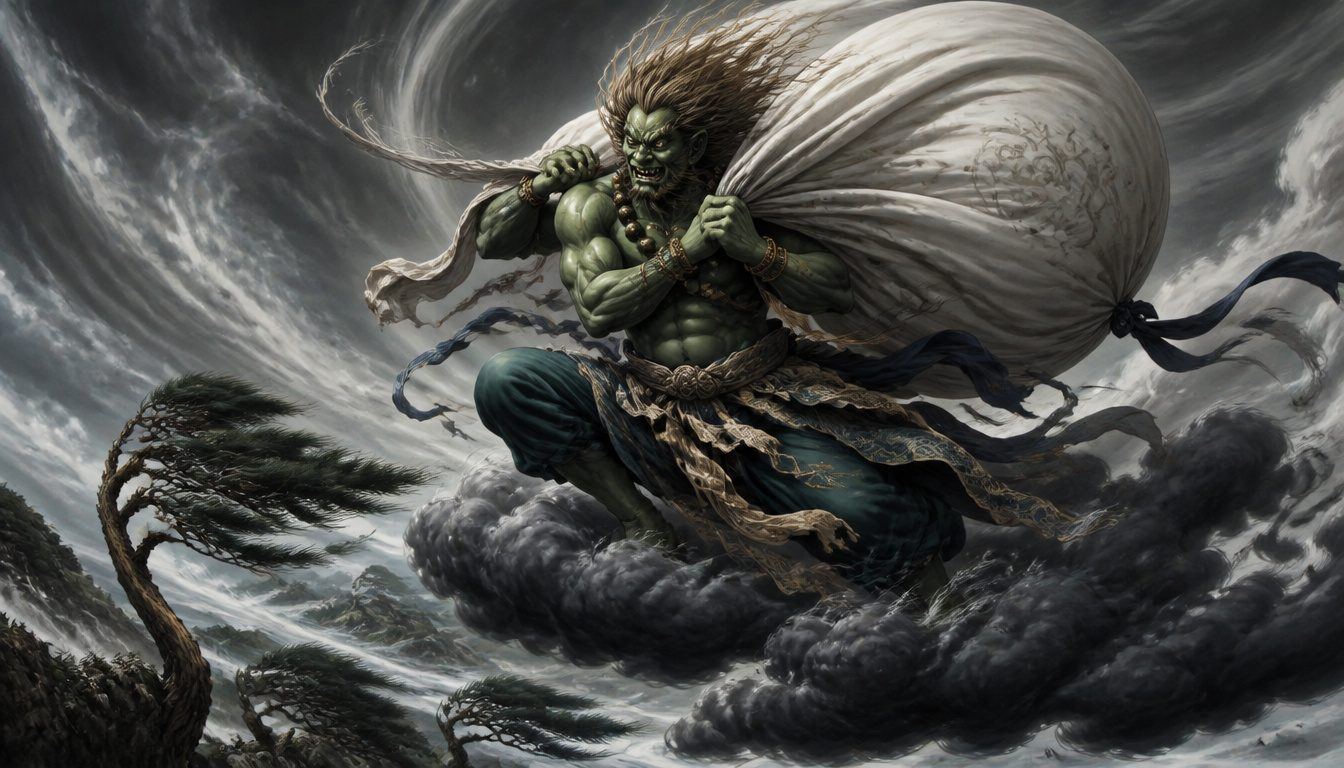
Illustration — Fujin, the Japanese wind god: a fierce green-skinned deity clutches a billowing white wind bag, riding dark storm clouds over pines. About our pictures
Deity (kami)The god of wind, a wild green figure who carries a great bag of air over his shoulders and lets the gales loose across the sky. He is almost always shown alongside his partner Raijin, the thunder god.
At a glance
What is Fūjin?
Fūjin (風神) means "wind god," and in Japan the name calls up one picture above all: a wild, grimacing figure who runs across the clouds holding a great bag of wind over his head. Japanese dictionaries describe him in almost the same words. He is a naked figure carrying a wind bag, kazebukuro (風袋), who races through the sky. In temples he is set beside the twenty-eight attendants of the thousand-armed Kannon, and nearly always he is paired with Raijin, the thunder god.
Like Raijin, Fūjin is a god and not a yokai in the strict sense. He is included in yokai collections because his demon-like body looks like an oni, and because the wind he carries could ruin a harvest or sink a fleet. You can read about his partner on our Raijin page.
A god who came along the Silk Road
The bag-carrying Fūjin is an imported image, not a native Japanese one. The Shogakukan encyclopedia Nipponica traces the image of a wind god running with his wind bag held up in both hands back to Central Asia. That figure appears on copper coins of the Kushan king Kanishka, and his gold coins show the Greek wind god Anemos in the same posture. In Cave 249 at Dunhuang in western China, a wall painting shows a wind god of this type next to a thunder god ringed with drums. That is the same pairing Japan later made famous.
Columbia University's JAANUS dictionary of Japanese art terms adds that the two gods have no basis in early Buddhist scripture. Their figures draw on Indian deities and on the Chinese wind and thunder gods Fengshen and Leigong. In esoteric Buddhism the wind god also appears as Fūten, one of the Twelve Devas, and as the guardian of the northwest. Japan's earliest picture of the pair is in the eighth-century illustrated Sutra of Cause and Effect (Kako genzai ingakyō). There they are among the demons who try to frighten the Buddha. Sanjūsangendō, the temple that owns the most famous statues, says both gods go back to the ancient Indian Rig Veda. There the wind god is Vāyu, who drives a chariot across the sky, chases off evil gods and grants wealth and success.
Fūjin and the native wind kami
Japan had wind gods long before Buddhist art arrived, but it did not make statues of them. The Heibonsha World Encyclopedia notes that shrines across the country honoured the male and female wind kami Shinatsuhiko and Shinatobe, but no images of them were made. The Kokugakuin University Encyclopedia of Shinto explains that in an alternate account in the Nihon shoki, Shinatsuhiko was born from Izanagi's breath as he blew away the mist covering the newly made land. His name has been read as "man of long breath" or "man of the place where wind arises."
The great centre of the wind cult was Tatsuta Shrine in Nara, which holds a Fūjinsai, a wind-god festival. The tenth-century Engishiki records its rites and preserves the full text of its prayer. At Ise, the detached shrine Kazahinomi-no-miya honours the wind kami. According to legend, the "divine wind," or kamikaze, that wrecked the Mongol invasion fleets in the thirteenth century blew from there. A folk version recorded in the Nara Prefectural History gives Tatsuta the credit instead. In this version, when the Mongols came, a great bag rose from behind Tatsuta Shrine and flew to the Genkai Sea, where it raised a storm that sank the enemy ships. The bag was the Tatsuta deity himself, the god of wind.
Wind festivals and the 210th day
For farmers, the wind god was mostly a threat to be calmed. The Encyclopedia of Shinto describes wind festivals (kaze matsuri), all-night vigils for the wind and lion dances. Most of these were held around the "210th day," counted from the start of spring in the old calendar, which was believed to mark the start of the typhoon season. Typhoons around that date really did cause great crop damage. In some places, people put up sickles or scythe-like objects on poles as charms against the wind.
There was also a medical side. Kaze means "wind," but a word pronounced the same way means "a cold." Many villages held rites to send away the wind god, kaze no kami okuri, which were also meant to drive out the spirits that spread colds and influenza. The Nihon Kokugo Daijiten records that in the Edo period, when colds were going around, beggars in masks went door to door beating drums and offering to "drive out the wind god" in return for money. People also made dolls representing the wind god so that it could be ceremonially sent away.
The wind could even carry a blade. An Edo-period essay, the Fūken gūki, notes that people in Shimōsa and Kai pasted calendars on their windows and paper screens to keep out a wind that cut people. There, it said, the wind god carried a sword. This is the same fear behind the sudden, unexplained wounds blamed on the Kamaitachi.
Sanjūsangendō: the statues that fixed the image
The best-known sculptures of Fūjin and Raijin stand at either end of the front row of statues in Sanjūsangendō in Kyoto, in front of its 1,001 standing images of Kannon. The temple lists both as Kamakura-period National Treasures. Fūjin is 123 cm tall and Raijin 105 cm. According to the temple, Tankei, the sculptor who directed the work when the hall was rebuilt, was closely involved in making them. The temple says that although the gods began in ancient India, these images were made entirely Japanese, and they decided how later generations would picture the pair. Japan's tourism agency describes Fūjin here kneeling on a cloud with the wind bag over his shoulders.
Sōtatsu's screens and their copies
The most famous painting of Fūjin is Tawaraya Sōtatsu's Wind God and Thunder God Screens. It is a pair of two-fold screens in ink and colour on gold-foiled paper from the seventeenth century, and it is a National Treasure owned by Kenninji temple in Kyoto. The Kyoto National Museum says that although the screens carry no signature or seal, there is no doubt that Sōtatsu painted them. The gold foil makes the gods seem to float in an endless space.
The Smithsonian's National Museum of Asian Art points out that the Sanjūsangendō statues stood near where Sōtatsu worked and were probably known to him. Later painters honoured his screens by copying them. Ogata Kōrin made a version that is now in the Tokyo National Museum, and Sakai Hōitsu made one after that. JAANUS describes the usual colouring of the pair. Fūjin is green, with two horns, a grimacing mouth and claw-like hands and feet, and he sometimes holds a spear with a red pennant. Raijin is typically red.
Fūjin at the Thunder Gate
Tokyo's best-known pair stands in the Kaminarimon, the great outer gate of Sensōji in Asakusa. Its formal name is Fūraijinmon, the Gate of the Wind and Thunder Gods. Sensōji says the two gods guard the temple against storm and flood damage and are also prayed to for good weather and good harvests. The statues lost their bodies in a fire in 1865, when only the heads were saved. The bodies were recarved in 1874, and the statues were repaired and repainted in 1960.
Frequently asked questions
Who is Fūjin in Japanese mythology?
Fūjin is the Japanese god of wind, shown as a demon-like figure carrying a large bag of wind. His image comes from Buddhist art rather than the old chronicles, which name other wind kami such as Shinatsuhiko and Shinatobe.
Are Fūjin and Raijin brothers?
No classical Japanese text makes them brothers. They are a pair in art and in temples, at Sanjūsangendō, in Sōtatsu's screens and at Sensōji's Kaminarimon. The idea that they are brothers or twins seems to be a modern embellishment.
What is in Fūjin's bag?
The wind. The bag, called kazebukuro, holds the winds he lets loose over the world. The same image of a wind god holding his bag up over his head appears much earlier in Central Asia, on Kushan coins and in the Dunhuang cave paintings.
Why is Fūjin green?
Painters fixed his colours over time. In standard depictions such as those described by the JAANUS art dictionary, Fūjin is green and Raijin is red. No early text explains why. It is a convention of the pictures, strengthened by Sōtatsu's screens and their many copies.
Where can I see Fūjin in Japan?
The Kamakura-period statue at Sanjūsangendō in Kyoto, Sōtatsu's screens (owned by Kenninji and kept at the Kyoto National Museum) and the statues in Sensōji's Kaminarimon in Tokyo are the most famous. Tatsuta Shrine in Nara is the historic centre of wind-god worship.
Sources & further reading
- Kotobank: 風神 (Daijisen; Nihon Kokugo Daijiten; Nipponica; Heibonsha World Encyclopedia; MyPedia)
- Kotobank: 風神雷神 (Heibonsha World Encyclopedia; Nipponica; Britannica Japan)
- Fūjin Raijin, JAANUS (Japanese Architecture and Art Net Users System), Columbia University
- Kazenokami, Encyclopedia of Shinto, Kokugakuin University
- Shinatsuhiko, Encyclopedia of Shinto, Kokugakuin University
- Fūjin and Raijin statues, Sanjūsangendō (official site, Japanese)
- The Wind God and Thunder God, and the Twenty-Eight Attendants (Japan Tourism Agency multilingual commentary)
- Wind God and Thunder God Screens, Kyoto National Museum
- The Gods of Wind and Thunder, Smithsonian National Museum of Asian Art
- Kaminarimon (Fūraijinmon), Sensōji (official site, Japanese)
- Nichibunken Kaii/Yōkai Densho Database, record 5390020: *Fūken gūki*, the wind god's sword
- Nichibunken Kaii/Yōkai Densho Database, record C2910091-000: the Tatsuta wind bag and the Mongol fleet
- Wikipedia: Fūjin (pointer)
- global.canon — fujinraijinzu-sotatsu
- worldhistory.org — Sanjusangendo