Nure-onna
濡女
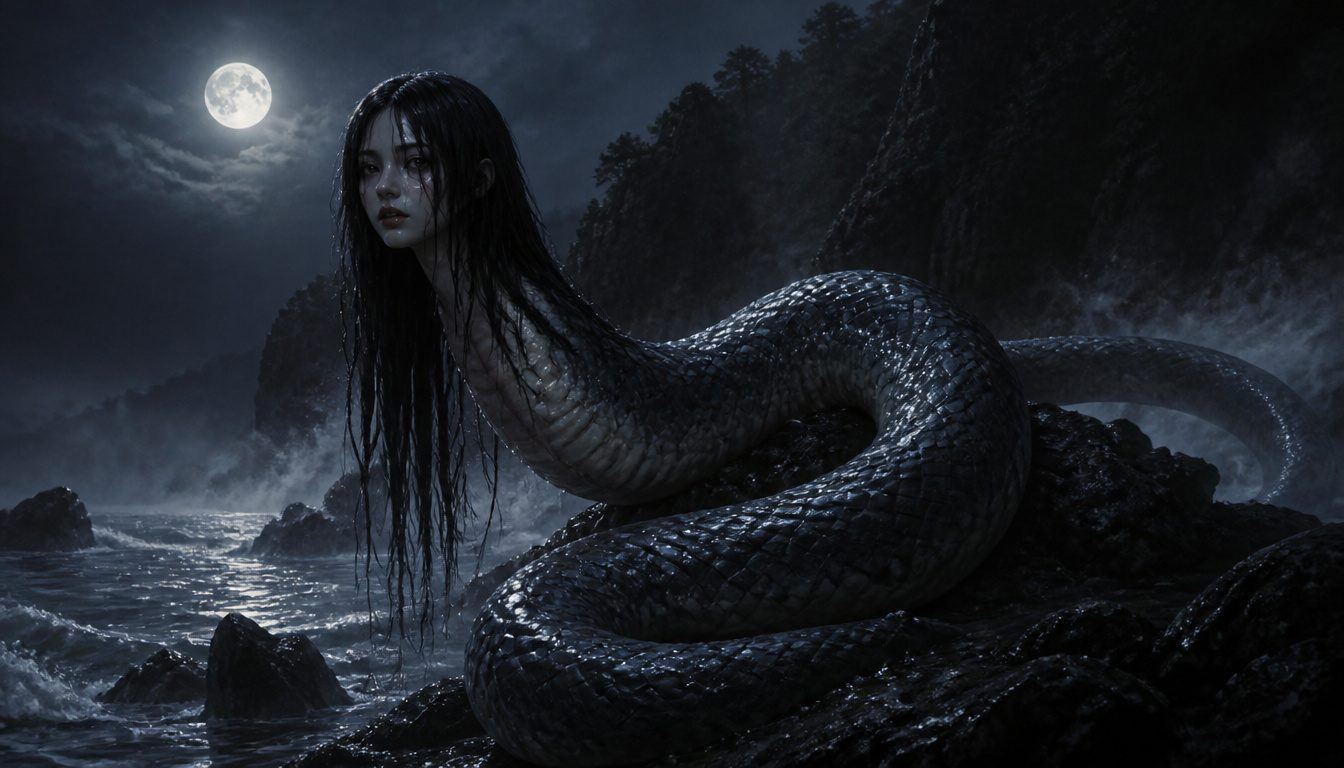
Illustration — Nure-onna, the wet woman: a pale woman with long dripping black hair and a huge serpent body coils on moonlit seaside rocks. About our pictures
Animal yokaiA creature with a woman's head and the long body of a great snake, her hair always streaming wet. She appears by the sea and rivers; in western Japan she is paired with the ox-demon ushi-oni.
At a glance
What is Nure-onna?
Nure-onna (濡女 or ぬれ女) means "wet woman." In Edo-period art she has a woman's head, with long black hair hanging soaked and loose, on the body of a huge snake. Japanese dictionaries describe her as a monster said to appear in the sea or in rivers, usually drawn as a serpent with a woman's face. She is also known by the name Nure-yomejo, "wet bride."
Two quite different things go by her name. One is the snake-woman of the picture scrolls, a striking image with very little story attached. The other is a cluster of village legends, mostly from western Japan, about a wet-haired woman met at night by the water, who often works hand in hand with the ox-headed monster Ushi-oni. The two traditions overlap but do not match perfectly, and it helps to keep them apart.
The snake-woman of the picture scrolls
Nure-onna was a picture before she was a story. She is one of the creatures in the bakemono-zukushi scrolls, painted catalogues of monsters that were popular from the seventeenth century on. Each figure carries a name label, with little or no explanation.
Brigham Young University's Harold B. Lee Library holds one such scroll, Bakemono no e, which a 1952 dealer's catalogue dated to around 1660. The library considers it perhaps the oldest surviving example of the type. Among its thirty-five figures is one labelled ぬれ女. The best-known dated version of the format is Sawaki Sūshi's Hyakkai zukan of 1737, now in the Fukuoka City Museum, and reference lists of its thirty figures include both nure-onna and ushi-oni.
Toriyama Sekien then drew her for his printed yokai catalogue, Gazu Hyakki Yagyō, in 1776. His Nure-onna rises out of churning water in slanting rain, beside a fence of stakes, with branches trailing above her. Her coiled body is spotted like a snake's, and her black hair streams back from a pale, gaunt face. Sekien gave her a name and nothing more, with no caption to explain who she was or what she did. That silence is typical. Many yokai in these scrolls and books were known only as names and images, and later writers filled in the gaps.
The Nihon Kokugo Daijiten, Japan's largest historical dictionary, cites the name from Kitamura Intei's essay collection Kiyū shōran (1830). It suggests, cautiously, that she may belong with other monsters of the shore, such as the iso-hime (磯姫) and umi-nyōbō (海女房).
Village legends: the baby and the ox-demon
The fullest stories come from the coast of Iwami, in what is now western Shimane Prefecture. A 1933 article on Ushi-oni legends there, summarised in Nichibunken's yokai database, records two versions.
In one, from Ōda, a man walking home from fishing at night meets a nure-onna. She hands him a baby to hold and vanishes. When he throws the baby down and runs, an ushi-oni comes after him. He escapes only by reaching a farmhouse.
In the other, from Gōtsu, a Shinto priest out night-fishing is given a baby by a nure-onna in the same way. When he tries to throw it away, it has turned as heavy as stone and will not leave his hands. The ushi-oni then chases him. As he runs, a shining object flies out of the darkness and strikes the monster on the head, and it gives up the chase. The shining object turns out to be a sword that flew to him from his own house.
A burden that grows impossibly heavy also turns up in another nure-onna report, from Ehime, described below. In the Iwami tales the baby makes the nure-onna a decoy, holding the victim in place while the real killer comes out of the sea.
Nure-onna across Japan
Other regional reports show how loosely the name was used.
- In Aso, Kumamoto Prefecture, a 1952 report says nure-onna appeared in many places by the water: a wet-haired, middle-aged woman with a snake's body who possessed people and sucked their blood.
- In Ōtsuki, Kōchi Prefecture, a 1965 student survey recorded that a nure-onna stood where water seeped from the mouth of a mountain path, her hair dripping. She shook her hair at passers-by, and anyone the water touched was in danger of their life.
- In Ainan, Ehime Prefecture, a 1985 report describes a "wet woman" in a white robe with tangled hair at a dangerous, always-wet ravine. She asks travellers to hold something for her. If they agree, the object grows so heavy that they faint. You must never speak to her.
In none of these is she the giant serpent of the scrolls. The Aso version comes closest, combining the snake body with blood-drinking. Elsewhere she is simply a woman soaked to the skin, and her wetness marks her as something that has come out of the water, or out of death.
A modern ghost
The name has carried on into twentieth-century ghost stories. The Shizuoka prefectural history, published in 1991, records a nure-onna tale set on National Route 150: a driver at night sees a soaking-wet woman standing by the road and gives her a lift. When he looks again she has vanished, and the seat where she sat is wet. The story has the shape of the familiar "vanishing hitchhiker" tale, and it shows how an old name can be borrowed for a new legend.
The long-tailed hair-washer
Many English-language accounts say that Nure-onna washes her hair by the water, that her tail is hundreds of metres long, and that anyone she spots cannot escape. According to English Wikipedia's summary of the Japanese reference books, these details come mainly from a single story set in 1819, on a river on the border of Echigo and Aizu (today's Niigata and Fukushima). In it, a boat crew comes upon a woman washing her hair, and the tail is implied to be at least three chō, roughly 300 metres, long. The story is traced to a 1929 collection of strange tales by the folklorist Fujisawa Morihiko, which, the article notes, gives no earlier source. We have not been able to check it against an Edo-period text, so it is best read as a late and lightly attested version, not the core of the legend.
The same caution applies to any single, fixed "biography" of Nure-onna. The older evidence is a handful of pictures and a scattering of local tales, and they do not all describe the same creature.
Frequently asked questions
What does Nure-onna mean?
Nure-onna means "wet woman." She is named for her soaking hair, which is the one feature shared by nearly every picture and legend of her.
Is Nure-onna a snake?
In Edo-period art she has a woman's head on a snake's body, and one 1952 report from Aso in Kumamoto describes her the same way. In many village legends, though, she appears simply as a woman who is soaking wet.
What is the connection between Nure-onna and Ushi-oni?
In legends from the Iwami coast of Shimane, Nure-onna hands a passer-by a baby that grows impossibly heavy, and Ushi-oni, an ox-headed monster, then comes out of the sea to chase the victim. The two also appear side by side in early picture scrolls.
Is Nure-onna dangerous?
Very. In different regions she drinks blood, endangers anyone touched by water from her hair, or traps people with a baby or bundle that becomes too heavy to put down.
Where does Nure-onna appear?
By water: rivers, the sea shore and wet mountain ravines. Folklore records come mostly from western Japan, including Shimane, Kumamoto, Kōchi and Ehime. A modern roadside version comes from Shizuoka, and a much-repeated story places her on a river between Niigata and Fukushima.
Sources & further reading
- Nure-onna entries (Kotobank: Daijisen Plus, Nihon Kokugo Daijiten)
- Nure-onna, BYU Library *Bakemono no e* scroll
- About *Bakemono no e* and the c. 1660 dating, BYU Library
- Toriyama Sekien, *Gazu Hyakki Yagyō*, Library of Congress
- Toriyama Sekien's Nure-onna (Wikimedia Commons image)
- Nichibunken yokai database: Nure-onna and Ushi-oni, Ōda, Shimane (1933)
- Nichibunken: Nure-onna, Ushi-oni and the flying sword, Gōtsu, Shimane (1933)
- Nichibunken: blood-drinking Nure-onna of Aso, Kumamoto (1952)
- Nichibunken: Nure-onna of Ōtsuki, Kōchi (1965)
- Nichibunken: the "wet woman" of Ainan, Ehime (1985)
- Nichibunken: the wet hitchhiker of Route 150, Shizuoka (1991)
- *Hyakkai zukan* (Japanese Wikipedia, used as a pointer for the figure list)
- Nure-onna (Wikipedia, used as a pointer)
- yokai.jp — hyakkai-zukan