Nurarihyon
滑瓢
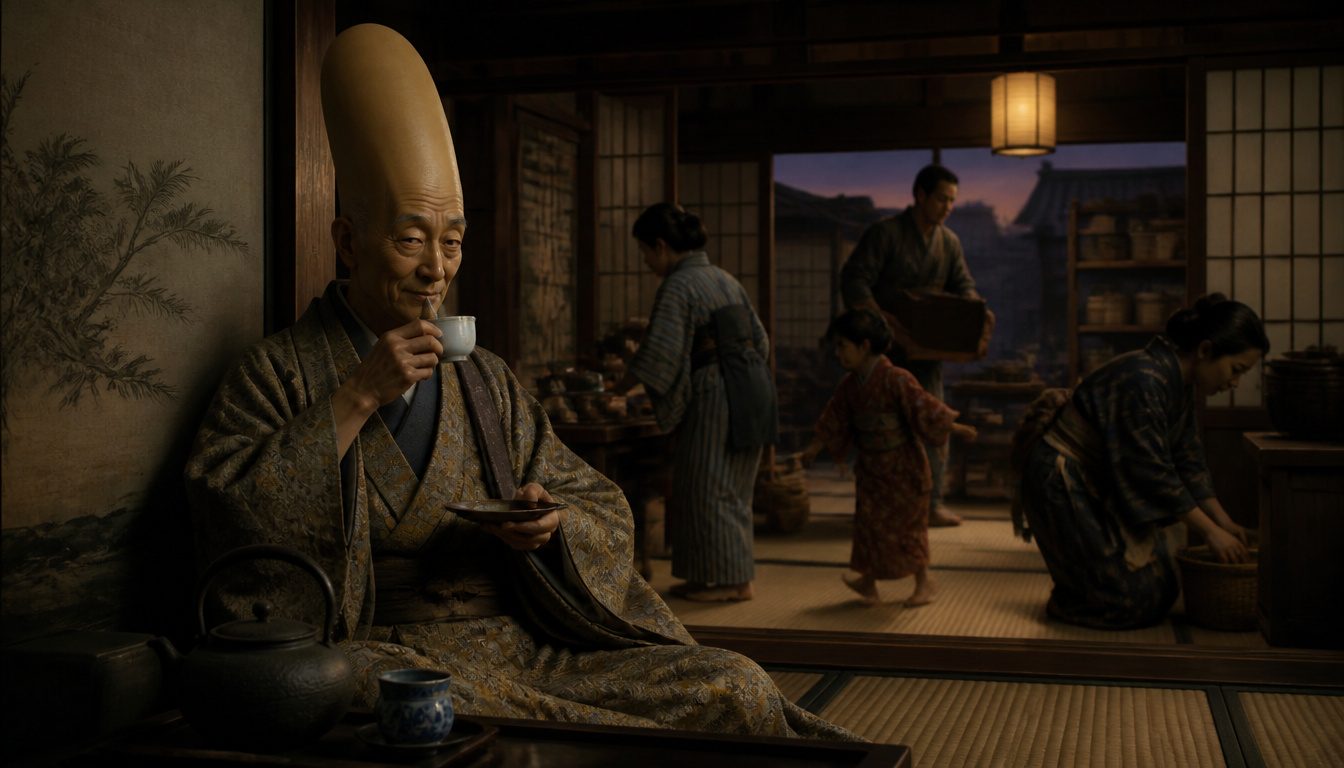
Illustration — Nurarihyon, the Japanese yokai who slips into homes: an old man with a huge elongated head sips tea as the household works. About our pictures
Household yokaiAn elderly gentleman with a strangely long, bald head, dressed in fine robes. In modern accounts he walks into other people's homes uninvited and helps himself to their tea as if he owned the place. Nobody quite notices him - and nobody can catch him.
At a glance
What is the nurarihyon?
The nurarihyon (ぬらりひょん, sometimes written 滑瓢) is a yokai drawn as a bald old man with a huge, bulging head, usually in good clothes. Today he is famous as the "supreme commander" of the yokai, the boss who leads the night parade of monsters in manga and anime. That role is modern. For most of his history the nurarihyon was a picture with a name attached and very little story.
The name itself is a description. The Digital Daijisen dictionary defines nurarihyon as a slimy, slippery monster that is impossible to pin down. The Nihon Kokugo Daijiten lists nurarihyon as another form of nurari-kurari, an everyday word for something soft and slick that slips through your fingers. The same word is used for a person who is vague and evasive. One of the dictionary's early examples, from the book Sugiyōji of 1680, compares the passing years to a gourd thrown into water, drifting along nurari-kurari. The characters 滑瓢 used for the yokai mean "slippery" and "gourd". So from the start, the nurarihyon was something you cannot get hold of.
Pictures without a story
The nurarihyon first appears in Edo-period picture scrolls and books that line up yokai one by one, each with a name label.
- Sawaki Sūshi, Hyakkai zukan (1737). This handscroll of a hundred monsters includes a nurarihyon. A reproduction on Wikimedia Commons, scanned from a modern published edition, gives the date and the artist.
- Toriyama Sekien, Gazu Hyakki Yagyō (1776). Sekien's first illustrated yokai catalogue includes the nurarihyon. The National Diet Library dates the book to An'ei 5 (1776). It was followed by sequels in 1779, 1781 and 1784, but the nurarihyon belongs to the first book, not the 1779 sequel.
- An undated scroll at Brigham Young University. The Bakemono no e ("Pictures of Monsters") in BYU's Harold B. Lee Library has an entry for the nurarihyon. The library notes that the scroll has no signature, seal or colophon. Its suggested date of about 1660 comes only from a 1952 dealer's catalogue, so it should be treated with caution.
Later artists kept drawing him. The Nichibunken yokai image database describes a nurarihyon on a yokai board game, Shinpan yōkai tobimawari sugoroku. He has a large head with a broad, bald forehead, an old man's face and a beard on his chin, and he is stepping down from a palanquin. The same database lists a nūrihyon by the Meiji painter Kawanabe Kyōsai in his book Kyōsai gadan.
The trouble is what these pictures leave out. They give the figure's name and shape, but no tale of what he does. The folklorist Michael Dylan Foster, quoted by National Geographic, puts it plainly: the nurarihyon's origins are murky. Foster argues that this "folkloric indeterminacy" is exactly why the figure has been so easy to reinvent.
A slippery word in Edo fiction
The word turns up in Edo popular fiction as well as in pictures. The translator Zack Davisson, also quoted by National Geographic, points to a story in Kōshoku haidokusen. Heibonsha's encyclopedia describes this as an ukiyo-zōshi collection of fifteen comic tales of the pleasure quarters, published in 1703. In the tale, a married man is infatuated with a courtesan, and a nurarihyon appears as a faceless, catfish-like creature, the spirit of deception. Davisson suggests that tales like this helped give the figure its later reputation for slyness.
The catfish turns up beside the word elsewhere too. The Nihon Kokugo Daijiten's earliest example of nurari-kurari, from a book of 1698, uses it right after a catfish image in a passage about a visitor to the Yoshiwara pleasure quarter. Slimy and hard to hold, the catfish (see the namazu) was an obvious picture of evasiveness.
How he became the supreme commander
The idea that the nurarihyon rules the yokai can be traced to the twentieth century. In 1929 the folklorist Fujisawa Morihiko published the first volume of the Japan series of his Yōkai gadan zenshū ("Complete Illustrated Talks on Yokai"). The National Diet Library records it as published by Chūō Bijutsusha. Foster explains that Fujisawa put a label on a picture of the nurarihyon calling him the oyadama of the yokai. The word can be translated as "leader", "boss" or "chief". No Edo source we have found gives him that rank. Fujisawa's caption, not any older tale, is the earliest known source for the idea. It may simply be his reading of the old pictures of a dignified, well-dressed elder.
The label stuck because of Mizuki Shigeru and his GeGeGe no Kitarō. Davisson says that Mizuki's version of the character played a crucial part in creating the nurarihyon of modern pop culture. The Tōei Animation series show how the role grew.
- In the third TV series (1985–1988), the fourth episode, "Yōkai Nurarihyon", makes him a criminal businessman. He brings down buildings so that his own construction company can profit, helped by his henchman Shu no Bon.
- In the fourth series (1996–1998), episode 96 is titled "Yōkai-ō Nurarihyon", "Nurarihyon, King of the Yokai". In it he finds a sealed mirror and appears before Kitarō as king of the yokai.
- In the sixth series, Tōei's character page describes him as a well-dressed old yokai in Japanese clothes, highly cunning, with influence even in human politics.
From there the boss figure spread. National Geographic lists later appearances, including the manga Nurarihyon no Mago, whose title means "Nurarihyon's Grandson".
The uninvited guest
The best-known description today is gentler. Foster describes the usual folk image as harmless: a visitor who slips into a house and helps himself to tea while the family is busy or away. It fits the slippery name and the pictures of a polite old man well. However, we have not found an Edo-period text that tells this story, and it should be read as part of the figure's modern description rather than a documented old belief.
The sea nurarihyon of Okayama
There is also a quite different nurarihyon, with nothing to do with old men. Foster, again quoted by National Geographic, notes theories linking the name to a sea creature of the Seto Inland Sea off Okayama Prefecture. It is a round thing about the size of a human head, related to the umibōzu or sea monk. When fishermen try to catch it, it sinks out of reach and then bobs up again to tease them. Here the name means exactly what it says: something slippery that cannot be held. It may well be closer to the word's everyday sense than the yokai boss is.
Frequently asked questions
Is the nurarihyon really the leader of the yokai?
Not in any Edo-period source we have found. The leader idea comes from a 1929 caption by Fujisawa Morihiko calling him the "boss" of the yokai. It was then made famous by Mizuki Shigeru's GeGeGe no Kitarō, where he becomes the main villain and, in one 1990s episode, the "King of the Yokai".
What does nurarihyon mean?
It comes from nurari, "slippery", and is listed in the Nihon Kokugo Daijiten as a form of nurari-kurari, meaning slick, hard to catch or evasive. The kanji spelling 滑瓢 means "slippery gourd".
What does the nurarihyon do?
The Edo pictures do not say. In modern descriptions he walks into other people's homes uninvited and makes himself comfortable, drinking their tea. In Okayama the name belonged to a head-sized ball in the sea that dodged anyone trying to grab it.
Where does the nurarihyon first appear?
In Edo-period yokai pictures. These include Sawaki Sūshi's Hyakkai zukan (1737) and Toriyama Sekien's Gazu Hyakki Yagyō (1776). An undated scroll at Brigham Young University may be older, but its date is uncertain.
Is the nurarihyon dangerous?
In folklore he is more rude than harmful. The villainous, scheming nurarihyon belongs to twentieth-century manga and anime.
Sources & further reading
- Nurarihyon (Kotobank: Digital Daijisen)
- *Nurari-kurari*, with *nurarihyon* as a variant and examples of 1680 and 1698 (Kotobank: Nihon Kokugo Daijiten)
- Sawaki Sūshi's nurarihyon from the *Hyakkai zukan*, 1737 (Wikimedia Commons)
- Toriyama Sekien's nurarihyon from the *Gazu Hyakki Yagyō*, 1776 (Wikimedia Commons)
- National Diet Library Image Bank: dates of Toriyama Sekien's yokai books
- *Bakemono no e* scroll and its dating (Brigham Young University Library)
- Nurarihyon in the *Bakemono no e* scroll (Brigham Young University Library)
- Nichibunken yokai image database: nurarihyon on a yokai sugoroku board game
- Nichibunken yokai image database: Kawanabe Kyōsai's *nūrihyon*
- *Kōshoku haidokusen*, 1703 (Kotobank: Heibonsha)
- Fujisawa Morihiko, *Yōkai gadan zenshū*, Japan volumes, 1929–30 (National Diet Library Search)
- How the nurarihyon became a yokai boss, with Michael Dylan Foster and Zack Davisson (National Geographic)
- *GeGeGe no Kitarō* (3rd series, 1985–88), episode 4, "Yōkai Nurarihyon" (Tōei Animation)
- *GeGeGe no Kitarō* (4th series, 1996–98), episode 96, "Yōkai-ō Nurarihyon" (Tōei Animation)
- Nurarihyon character page, *GeGeGe no Kitarō* 6th series (Tōei Animation)
- Nurarihyon (Wikipedia, used as a pointer)