Ningyo
人魚
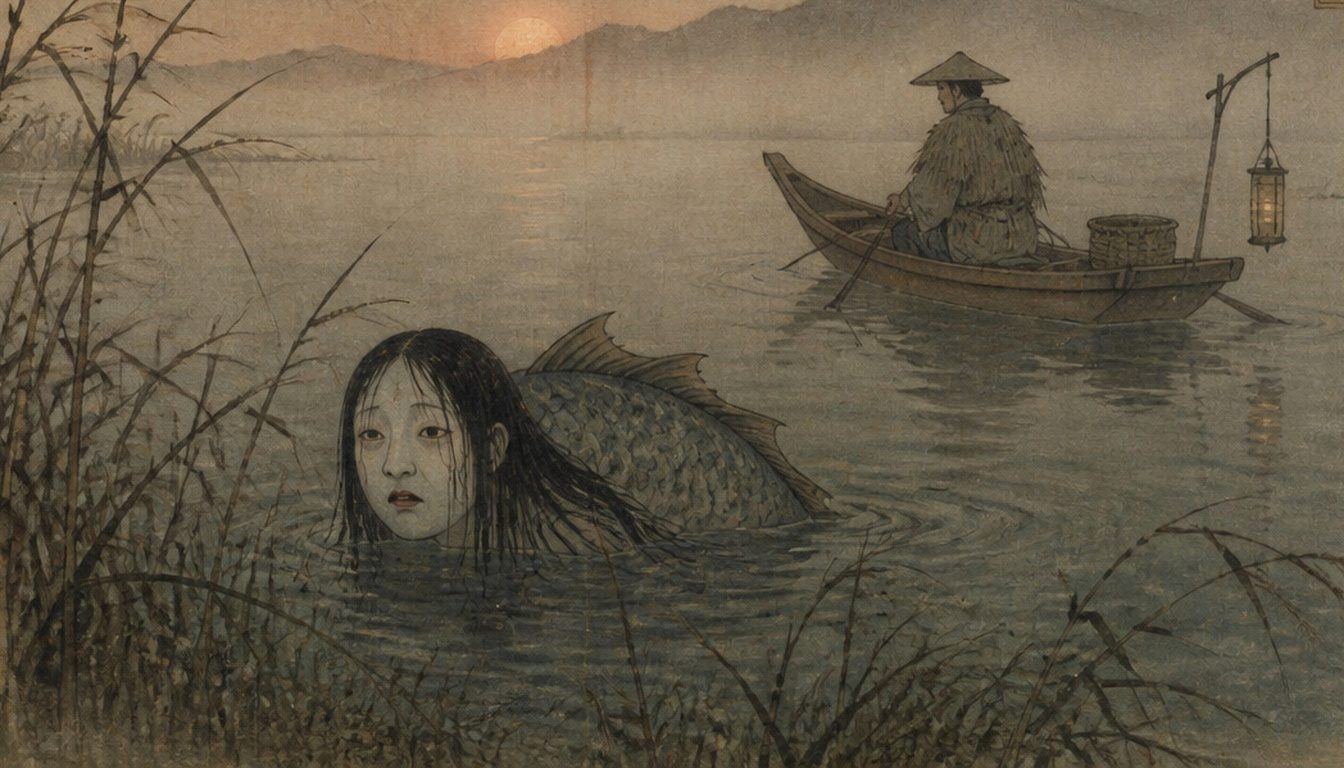
Illustration — Ningyo, the Japanese mermaid: a pale long-haired woman with a scaly fish body surfaces near a fisherman's boat at dusk. About our pictures
Animal yokaiJapan's 'human-fish' is no glamorous mermaid: older accounts describe a fish with a human or monkey-like face, sometimes with a child's cry. Catching one could bring storms or disaster, but eating its flesh was said to grant extraordinary long life.
At a glance
What is a ningyo?
Ningyo (人魚) is written with the characters for "person" and "fish." Today it is the ordinary Japanese word for a mermaid, but the older Japanese ningyo was not the beautiful singer of European tales. Medieval Japanese records describe something closer to a fish with a human face, sometimes with a face like a monkey's or a cry like a child's. Seeing or catching one could be a terrible omen. Eating its flesh, people said, could give extraordinary long life.
The Heibonsha World Encyclopedia makes the point plainly. Before the modern era, Japanese ningyo were closely tied to real sea creatures and seemed much more ordinary than the legendary mermaid. The familiar picture of a woman above the waist and a fish below probably came from the West. It spread in the Edo period through books such as the encyclopedia Wakan sansai zue.
The first records
The earliest Japanese account usually cited is in the Nihon shoki, the court chronicle finished in 720. In the reign of Empress Suiko, in the year that corresponds to 619, two strange reports reached the court. In W. G. Aston's translation, in the fourth month the province of Ōmi reported "a creature in the shape of a man" in the river Gamō. In the seventh month a fisherman in Settsu cast his net at Horie and caught something "formed like a child, which was neither a fish nor a man. Its name was unknown." The chronicle does not use the word ningyo. Nippon.com notes that the naturalist Minakata Kumagusu later guessed the creatures were giant salamanders.
The word itself first appears in the Wamyō ruijushō, a dictionary compiled around 937, which defines a ningyo as a fish with a human face. That idea came from China. The Classic of Mountains and Seas (Shan hai jing) describes a ningyo with four legs and a voice like a baby's. By the time of the Shōtoku Taishi denryaku (around 917), writers were already treating the appearance of a ningyo as a sign about the fortunes of the whole country.
Ningyo in medieval chronicles
The most detailed medieval account is in the Kokon chomonjū (1254), a collection of tales. Fishermen in Ise province pulled in three large fish whose heads looked human. According to the Nipponica encyclopedia, their teeth were small like a fish's and their faces were like a monkey's, and they wept and cried with human voices. The fishermen ate one and found it delicious.
The chronicle Azuma kagami records that in 1247 a large fish shaped like a human corpse was seen off Tsugaru, in the far north. That was the year of the Hōji conflict, a violent struggle for power in Kamakura. Nippon.com explains that the later Hōjō godai ki identified this as a ningyo and linked such sightings with times of upheaval. An Edo-period essay, Shokoku rijin dan, tells of a fisherman in Wakasa who killed a creature with a human head, a red, frill-like collar and a fish's body. The sea raged for seventeen days, and an earthquake later destroyed his village.
Yao Bikuni, the nun who lived 800 years
The most famous ningyo story is about the person who ate one. The nun known as Yao Bikuni or Happyaku Bikuni, "the 800-year nun," is described by Japanese encyclopedias as a legendary woman. She kept the face of a girl of fifteen or sixteen for centuries because she had eaten forbidden flesh, usually a ningyo's, though some versions say a "nine-holed" abalone.
The details change from place to place. A version from Wakasa recorded in the Edo essay Ume no chiri runs like this. A fisherman caught a fish with a human face and invited people to a feast, but one guest saw it being cooked and warned the others. They wrapped their portions in paper and threw them away on the way home. One man forgot, and his daughter ate the flesh. She married and lived normally. But each time a husband died she grew young again, and in her shame she became a nun and lived for 800 years. In other versions, such as one collected in Sado, a group of men meet on a Kōshin night, when people stayed awake together in a religious vigil. Someone takes home the strange meat served there, and a daughter eats it. The Nipponica encyclopedia notes that the story, with small differences, is found almost all over Japan. It is attached to cedars and camellias she is said to have planted, to the sites of her houses and to caves.
Her strongest home is Obama in Wakasa (Fukui Prefecture). At Kūin-ji temple there, a cave in the grounds is pointed out as the place where she lived. Other regions claim her too. On Sado it is said she was born there and lived to 1,000 years. She gave 200 of them to the provincial lord and crossed to Wakasa to die at 800. A 1935 tale from Asakuchi in Okayama makes her a "thousand-year nun" who wandered the provinces and finally went to Zenkōji temple. A record from Kamitakara in Gifu says she was born in a local family and went on to Wakasa, or perhaps to Mount Kōya.
There is also a historical record. The Heibonsha encyclopedia notes that diaries from 1449, the Yasutomi ki and the Gaun nikken roku, record that a "white nun" (Shira Bikuni) said to be 800 years old came to Kyoto from Wakasa. Crowds gathered to see her, although she stayed hidden behind a blind. Scholars have suggested that wandering female preachers spread the story, using the name of the 800-year nun as they travelled.
Mermaid mummies and Edo shows
In the Edo period, ningyo became something you could pay to see. Nippon.com describes "mermaid mummies" shown at misemono, the popular curiosity shows. Visitors were told that seeing one, or even its picture, protected them from disease and gave long life. Many were later given to temples and shrines. Most were made by joining the upper body of a monkey to the tail of a fish. Japanese-made examples went abroad as well. The Heibonsha encyclopedia notes that many Japanese mermaids were in circulation in the nineteenth century, and Nippon.com points to one taken back to the Netherlands by a Dutch trader from Nagasaki. The "Fiji mermaid" that P. T. Barnum showed in 1842 was probably made in Japan too.
The artist Toriyama Sekien included the creature in his 1781 yokai catalogue Konjaku hyakki shūi. His caption, drawing on Chinese geography, describes it as human above the chest and fish below. His drawing shows a shaggy-haired head on a scaly fish body thrashing in the waves.
One of these mummies was tested in modern times. In February 2022, a research team based at Kurashiki University of Science and the Arts began examining a roughly 30-centimetre mummy kept at Enjuin, a temple in Asakuchi, Okayama Prefecture. A note in its box claimed that it had been caught off Tosa in the Genbun era (1736–41). After about a year of X-ray CT scans and other analysis, the team gave its final report on February 7, 2023. KSB Setonaikai Broadcasting reported that the upper body was made of cotton and cloth with pufferfish skin and animal hair attached. The lower body was paper and other material covered in fish skin. It was a man-made object, probably from the late 1800s, and the temple continues to keep it.
Frequently asked questions
What is the difference between a ningyo and a Western mermaid?
Older Japanese ningyo were usually described as fish with human or monkey-like faces, sometimes crying like a child. Their appearance could be a bad omen. The half-woman, half-fish image probably came from the West and spread in the Edo period.
What happens if you eat ningyo flesh?
In Japanese legend, eating it can grant very long life. The best-known story is that of Yao Bikuni, a girl who ate the flesh and lived 800 years as a nun. In some versions she lives to 1,000.
Where is the Yao Bikuni legend from?
It is told in many parts of Japan, but it is most closely tied to Obama in Wakasa, Fukui Prefecture. Kūin-ji temple there has a cave said to have been her home. Sado, Gifu, Okayama and other regions have their own versions.
When was the first ningyo recorded in Japan?
The Nihon shoki records that in 619 strange creatures, one "neither a fish nor a man," were found in Ōmi and Settsu. It does not use the word ningyo, which first appears in a dictionary of around 937.
Are Japanese mermaid mummies real?
No. Those that have been studied turned out to be made objects. A Kurashiki University of Science and the Arts team found in 2023 that the Enjuin mummy in Okayama was made of cloth, paper, pufferfish skin, fish skin and animal hair, probably in the late 1800s.
Sources & further reading
- Nihongi, tr. W. G. Aston (1896), Book XXII, Suiko 27th year (Wikisource)
- Kotobank: 人魚 (Nihon Kokugo Daijiten; Heibonsha World Encyclopedia, entry by Aramata Hiroshi; Nipponica, entry by Nomura Jun'ichi)
- Kotobank: 八百比丘尼 (Heibonsha World Encyclopedia, entry by Miyata Noboru; Nipponica; Nihon Jinmei Daijiten)
- Itakura Kimie, "Ningyo: Japanese Merfolk and Auspicious Mummies," Nippon.com (2022)
- KSB Setonaikai Broadcasting: final report on the Enjuin "mermaid mummy" (7 February 2023, Japanese)
- KSB Setonaikai Broadcasting: research team begins study of the mummy (2022, Japanese)
- Nichibunken record 3400003: *Ume no chiri*, the daughter who ate the fish
- Nichibunken record 3420017: *Teisei kidan*, the white nun's cave at Obama
- Nichibunken record 2460012: Okayama, the thousand-year nun (1935)
- Nichibunken record 2363767: Gifu, Yao Bikuni's birthplace
- Nichibunken record 3880001: *Shokoku rijin dan*, the ningyo and the earthquake
- Nichibunken record 3200037: *Seikai zokudan*, the Horie catch of 619
- NDL Digital Collections: Toriyama Sekien, 百鬼夜行拾遺 (1805 edition), the ningyo page
- NDL Image Bank column: Toriyama Sekien's yokai catalogues and their dates
- Wikipedia: Ningyo (pointer)
- yokai.jp — ningyo-fushi
- unseen-japan.com — mermaid-mummy-japan-true-identity