Hannya
般若
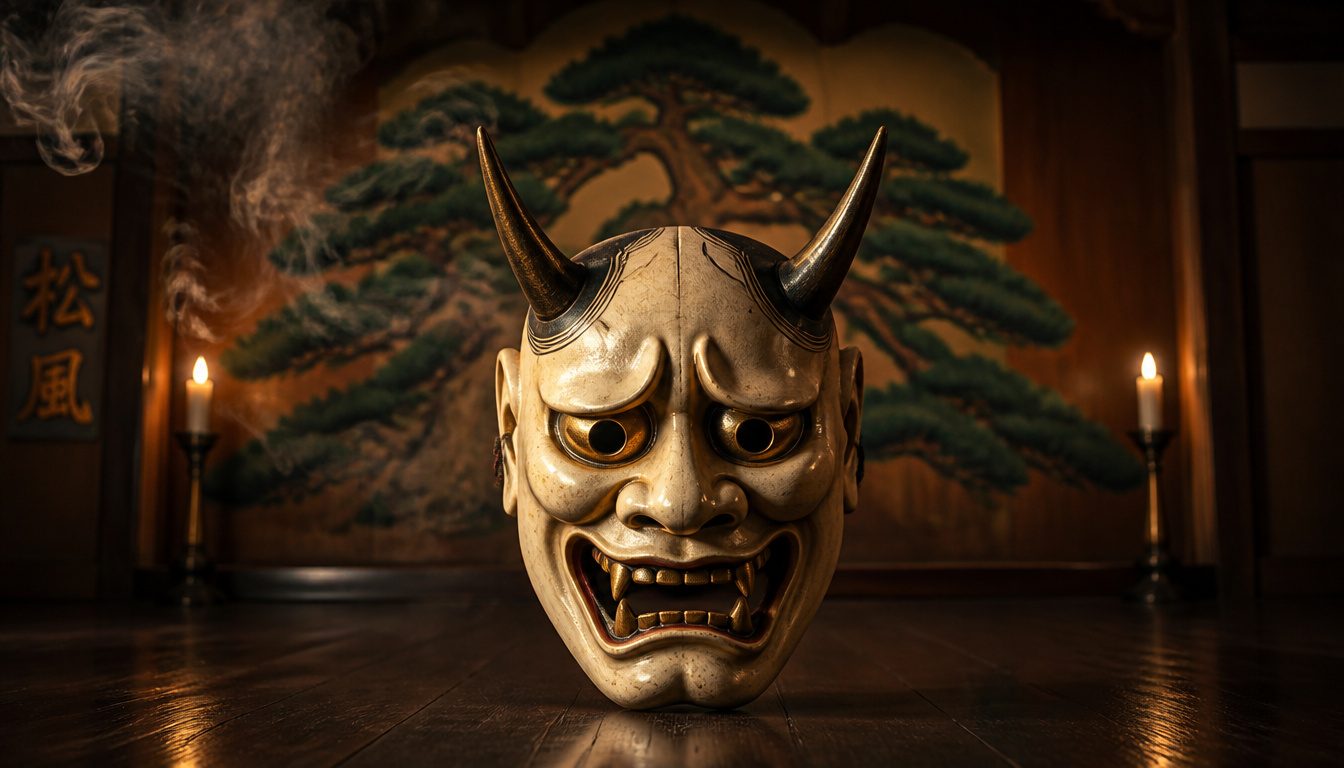
Illustration — Hannya, the Japanese jealous demon mask: a horned Noh mask with gold eyes and fangs on a stage before a painted pine. About our pictures
DemonThe horned, grimacing face of a woman consumed by jealousy, best known as a Noh theatre mask. Gold-rimmed eyes glare with fury while the brow seems to grieve, so that rage and sorrow share a single face. On stage the mask marks the moment a wronged woman becomes a demon.
At a glance
What is a hannya?
The hannya is a woman whose jealousy or resentment has grown so strong that it has turned her into a demon. Unlike most figures in this encyclopedia, it is known above all as an object: a carved and painted mask from the Noh theatre. Japanese dictionaries define hannya first as that mask, a demon-woman's face with two horns and a mouth split wide. From there the word came to mean the demon-woman herself. Long before the mask became a souvenir and a tattoo design, it served one precise dramatic purpose. In the second half of a play, it showed the audience that a woman had crossed the line from human anguish into something no longer human.
The word itself has a surprising origin. Hannya is the Japanese reading of the Sanskrit Buddhist term prajñā, "wisdom", familiar from the Hannya Shingyō, or Heart Sutra. How a word for enlightened wisdom came to name a jealous demon is one of the mask's small mysteries, discussed below.
Appearance: a face in two halves
A hannya mask has two sharp horns at the temples, round eyes inlaid with gilded metal, and a gaping mouth with gold teeth and fangs. Fine, dishevelled strands of hair fall across the forehead. The Victoria and Albert Museum, which holds a red hannya carved in 2000 by the Kobe mask-maker Suzuki Nohjin, describes the subject as a female serpent-demon consumed by jealousy and hatred. Its description also notes that the shade of the face signals the woman's rank, with a paler face meaning higher status.
What makes the mask more than a monster face is its brow. The Tokyo National Museum's description of a hannya in its collection draws attention to the eyebrows, drawn in the shape of the character for "eight" (八). Beneath the fury they suggest the deep loneliness, sorrow and suffering of a noble, beautiful woman. The result is a face that rages in its lower half and grieves in its upper half. The-noh.com's mask database calls the expression a fusion of jealousy, grudge, sorrow and grief, and the Tamagawa University museum describes it as women's inner resentment, passion, jealousy, anger and sadness distilled to the limit.
Origins of the mask and its name
Noh took shape in the fourteenth century under the actor-playwrights Kan'ami and Zeami. Mask types multiplied over the following centuries. The-noh.com describes an older, flatter and cruder type called hiragata-hannya, said to date from the Kamakura period and to be the ancestor of the classic form. The refined, triangular hannya is traditionally credited to Hannya-bō, a monk-carver from Nara active in the Muromachi period. Japanese reference works generally date him to the late fifteenth or early sixteenth century. That attribution has never been firmly documented, and museum catalogues call it a tradition rather than a fact.
There are several explanations for the name. The first is simply that the type was named after Hannya-bō. A second, recorded by the Tamagawa University Museum of Education, traces it to a line in the play Aoi no Ue, where the possessing spirit cries out in fear at the hannya-goe, the voice of a priest chanting the Hannya (Wisdom) sutra. A third, offered by the-noh.com, says that carving such a demon called for real wisdom, hannya, from the mask-maker.
Like other Noh masks, hannya were copied from celebrated originals over generations, and the copies are valued in their own right. One hannya in the Tokyo National Museum has two notches carved between the nostrils on its back. That mark identifies it as the work of Kawachi, a leading carver who died in 1645, and its features suggest he copied it from a mask owned by the Konparu school of Noh.
Stages of transformation
Noh has a whole family of masks for women overcome by resentment, and they are often read as stages along a single path. Namanari, "half-formed", has only small horns and painted human eyebrows. The-noh.com describes it as the living apparition of a deserted wife and calls it a preliminary stage of becoming the demon shown by the hannya. It is used in Kanawa. The hannya is the middle stage. Beyond it lies the ja, or "serpent", mask. It is darker red, more brutal, and has almost no trace of the woman left. The-noh.com credits its tradition to the heads of the Kongō school and lists its use in Dōjōji.
The hannya also comes in colours, though these mark the kind of character more than the stage of change. The Tamagawa University museum explains that the shiro-hannya, the white hannya, keeps a sense of refinement even at its most terrible. It is the mask for the aristocratic Lady Rokujō in Aoi no Ue. The aka-hannya, the red hannya, is used for more bestial roles, such as the girl turned serpent in Dōjōji and the man-eating hag of Kurozuka.
The plays
The hannya is worn by the shite, or lead actor, in the second half of several plays. The best known are Aoi no Ue, Dōjōji, Kurozuka (called Adachigahara in the Kanze school) and Momijigari. The-noh.com counts the first three as Noh's great female-demon plays.
Aoi no Ue ("Lady Aoi") is drawn from The Tale of Genji. Genji's wife Aoi lies gravely ill, represented on stage only by a folded robe. A shrine medium summons the spirit that is tormenting her. It turns out to be the living spirit of Lady Rokujō, a former crown prince's widow whom Genji has neglected, and who was humiliated when her carriage was shoved aside at the Kamo Festival. When a mountain ascetic begins his prayers, her jealousy takes visible form as a demon-woman. She attacks the priest, is subdued, and at last finds peace.
Dōjōji is set at a temple in Kii Province, today's Wakayama, on the day a new bell is to be hung. A dancer slips past the ban on women, leaps into the bell as it falls, and reappears as a serpent. The priests explain that years earlier a girl who believed a monk had betrayed her turned into a snake and burned him alive beneath the temple's old bell. Kurozuka is different. It shows a woman who is a demon from the start, a solitary old woman on the plain of Adachigahara who hides a room piled with corpses. Here the mask shows not jealousy but a terrible secret exposed.
Beyond the Noh stage
The Dōjōji story passed into kabuki as the dance Kyōganoko Musume Dōjōji. It was first performed at Edo's Nakamura-za theatre in 1753 and ends with the dancer reappearing from the bell as a serpent-demon. The Nihon Kokugo Daijiten dictionary records that the word came to mean the demon-woman herself, not only her mask. Today the hannya face appears far beyond the stage, on festival masks, souvenirs and tattoos. Its double expression, rage below and grief above, is what has kept it compelling for five centuries.
Frequently asked questions
What does a hannya mask mean?
It shows a woman transformed into a demon by jealousy, resentment or betrayal. The mask is meant to hold rage and sorrow at once. The mouth and horns show fury, while the brow conveys grief and loneliness. On the Noh stage it marks the moment when a woman's suffering becomes something inhuman.
Is the hannya a demon?
Yes and no. The hannya is a woman who has become a demon, an oni or demon-woman, through her own emotions. She is not a separate species of monster. She stays human enough to suffer, which is why many Noh plays end with her spirit pacified by prayer rather than simply destroyed.
Why is it called hannya?
Hannya means Buddhist "wisdom" (Sanskrit prajñā). The mask is traditionally said to be named after Hannya-bō, a monk-carver of the Muromachi period. Other explanations link it to a line about sutra chanting in Aoi no Ue, or to the wisdom needed to carve it. None is proven.
What is the difference between a white and a red hannya?
The white hannya is the more refined form, used for the noble Lady Rokujō in Aoi no Ue. The red hannya is used for more savage roles such as those in Dōjōji and Kurozuka. The colour signals the character's rank and nature rather than a fixed stage of transformation.
Is the hannya mask male or female?
Female. The hannya always represents a woman, even when, as is traditional in Noh, a man plays the role. Male demons and demon-gods wear masks from other families, which the-noh.com groups under kishin.
Sources & further reading
- the-noh.com Noh Masks Database: Hannya
- the-noh.com: Hiragata-hannya
- the-noh.com: Namanari
- the-noh.com: Ja
- the-noh.com Plays Database: Aoi no Ue
- the-noh.com Plays Database: Dōjōji
- the-noh.com Plays Database: Kurozuka
- Tamagawa University Museum of Education: Noh mask "Hannya (white)"
- Tokyo National Museum via ColBase/Japan Search: Noh mask Hannya (C-1554)
- Tokyo National Museum via ColBase/Japan Search: Noh mask Hannya by Kawachi (C-1555)
- Victoria and Albert Museum: Aka-Hannya mask by Suzuki Nohjin, FE.3-2004
- JAANUS (Japanese Architecture and Art Net Users System): hannya
- Kotobank: 般若 (Nihon Kokugo Daijiten, Nipponica)
- Kotobank: 京鹿子娘道成寺 (Kyōganoko Musume Dōjōji)
- Wikipedia: Hannya (pointer)
- yokai.jp — hannya