Ushi-oni
牛鬼
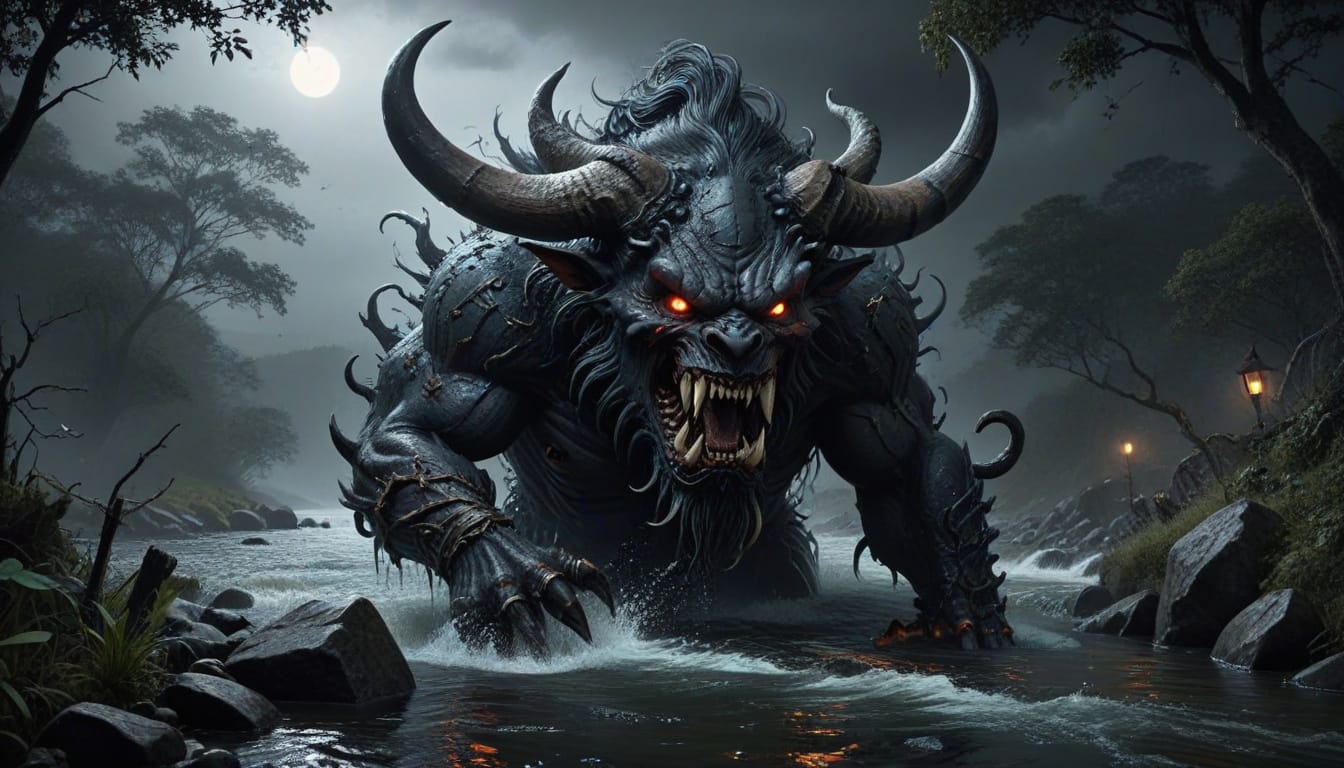
Illustration — Ushi-oni, the Japanese ox demon: a huge horned black beast with glowing red eyes and fangs charges through a river at night. About our pictures
DemonAn ox-demon of western Japan's coasts, river pools and waterfalls. Descriptions vary: an ox's head on a demon's body in old texts, a demon's head on an ox's body in many local legends. Most tales make it a killer of fishermen and travellers.
At a glance
What is the ushi-oni?
The ushi-oni (牛鬼), "ox demon", is a monster of western Japan's coasts, rivers and deep pools. The name covers several quite different things. The Nihon Kokugo Daijiten, Japan's largest historical dictionary, gives three main senses. One is a general ox-shaped demon, close to the ox-headed jailers of the Buddhist hells. The second is a regional monster: a sea creature in Shimane, and a creature of river pools in places such as Nishimuro in Wakayama and Tosa in Kōchi. The third is not a monster at all. It is the huge red ox-demon float carried in autumn festivals around Uwajima in Ehime Prefecture.
No single description holds for all of them. Some tellings give the creature an ox's head on a demon's body. Others give it a demon's head on an ox's body. Some say nobody has ever seen it clearly. Most stories make it a killer, but a few end with it being worshipped.
An old name
The word is older than most yokai names. The Nihon Kokugo Daijiten gives as its earliest example a list in Sei Shōnagon's Makura no Sōshi (The Pillow Book, late tenth century). There ushioni appears in a run of things with frightening names, between ikisudama (a living person's wandering spirit) and ikari (an anchor). Nothing in that passage says what the ushi-oni looked like.
The dictionary's own note on the word suggests where the early image came from. The Buddhist hells, as described in texts such as Genshin's Ōjōyōshū, are guarded by gozu, demons with an ox's head on a human body. The dictionary thinks the ushi-oni of classical literature followed that model. The late-Heian tale collection Konjaku Monogatarishū has "a demon with an ox's head". The dictionary points out that the local legends recorded later usually turn this around. In them the creature has a demon's head, with one or two horns, on an ox's body.
The Nihon Kokugo Daijiten also cites the guidebook Tōkaidō meishoki (around 1659) for a place where "long ago an ushi-oni came out and ran about". A more detailed early account appears in the essay collection Isetsu machimachi (1748). Its author says the ushi-oni is found in Izumo Province. When rain goes on and the air is damp, people meet it at night by a certain bridge. Nichibunken's yokai database summarises the anecdote. A man crossing the bridge found many glowing white things fluttering around him and clinging to him. When he asked at a nearby house, he was told that he must have met the ushi-oni.
Sekien's ushi-oni
Toriyama Sekien put the ushi-oni in his illustrated catalogue of monsters, Gazu Hyakki Yagyō (1776). The National Diet Library's digitised copy, an 1805 printing, shows it on its own page. A heavy, shaggy beast crouches in tall, wind-blown grass at the water's edge. Its head is half hidden in the grasses, and a clawed foot reaches forward. Sekien gave only the name, with no caption to explain it.
The ushi-oni had been painted before Sekien, in the illustrated monster scrolls known as bakemono-zukushi. Sawaki Sūshi's Hyakkai zukan (1737), now in the Fukuoka City Museum, includes a figure labelled うし鬼, ushi-oni. The museum showed that section in its 2026 exhibition of ghost and yokai paintings. The same kind of scroll also includes the nure-onna, as our article on Nure-onna describes.
On the coast: Shimane and the wet woman
The richest coastal stories come from Iwami, on the Sea of Japan coast of present-day Shimane Prefecture. Nichibunken's database holds several from local-history articles of 1933.
In one, from Ōda, four men fishing for mackerel at night hear a voice from the shore calling "Shall I come? Shall I come?" One of them answers "Come if you like." An ushi-oni leaps into the sea and chases them. They escape into the house nearest the water, and the monster flees from a charm of Izumo Taisha pasted on a pillar. In another, an old fisherman catches an ushi-oni, carries it home and throws it down in front of his boat shed. When a young man strikes its head with an oar, it turns out to be an old camellia root.
The best-known Iwami stories pair the ushi-oni with the nure-onna, the "wet woman". She appears by the water at night and hands a passer-by a baby. In a version from Gōtsu, the baby turns as heavy as stone and cannot be dropped. Then the ushi-oni comes out of the sea to catch the victim who is stuck holding it. The full stories are told in our Nure-onna article. A 1991 study, "Ushi-oni kō", collected more Iwami tales. In one, from Hamada, an ushi-oni lives in a sea cave and quarrels with a great spider. In another, a man chanting the nenbutsu drives one off, but his hair falls out afterwards.
Further east along the same sea, at Kumihama on Kyoto's Tango coast, fishermen spoke of the ushi-oni less as a beast than as a kind of spell. A 1974 collection explains that when even a skilled fisherman, on a rainy night, rowed all night and still could not reach the spot he was making for, he was said to have been "caught by the ushi-oni".
In the hills and pools
Away from the sea, the ushi-oni lives in waterfalls and deep pools, and many places are named after it. Collectors in Hongū, in the Kumano mountains of Wakayama, recorded in 1985 that the ushi-oni had once been the most feared thing of all. One informant described it as having a demon's head and, below the neck, the body of an ox. Others said that nobody had ever seen it properly. It was said to come down from the mountains on the night of Setsubun or on New Year's Eve, and to slip into cattle sheds without a sound. People who were seen by it would die.
Several legends end with a hero killing it, usually an archer or a hunter. A 1915 report from Hikari in Yamaguchi says that in the Tenbun era (1532–1555) an ushi-oni drove the people off an island, until a man from Iyo and a local archer shot it. A rock where it sharpened its tusks is still pointed out. In Tokushima a hunter named Heishirō is said to have killed one living on a mountain. Its blood flowed for seven days and nights.
Not every ushi-oni stays an enemy. In Toyoura, near Shimonoseki in Yamaguchi, one story collected in 1992 tells of a young man who visited a woman every night and was shot by her husband. The young man fled and was found dead at the foot of a mountain. When the village suffered misfortune afterwards, people enshrined him as an ushi-oni-gami (an ushi-oni deity), and the misfortune stopped.
The Heibonsha encyclopedia suggests one down-to-earth source for the name. The Japanese serow, a wild goat-antelope that keeps to remote mountains, was seldom seen in western Japan. Many farmers who did see one feared it as an ox-like monster and called it ushi-oni.
The Uwajima floats
In the south of Ehime the ushi-oni became a festival guardian. The Nipponica encyclopedia describes it as a procession figure in autumn festivals of the Uwa district. A long neck carries a demon's head with ox-like horns. The body, five or six metres long, is woven from split bamboo and covered in palm fibre or red cloth, and it ends in a tail shaped like a sword. Dozens of young men carry it. Children follow behind, blowing bamboo trumpets. To drive out evil, the float pushes its head into each house in turn, and Nipponica notes that it may get rough with households that have a bad local reputation. A popular story says the figure was first used by Katō Kiyomasa in the invasion of Korea in 1592. Nipponica treats this only as something "it is said" and considers the float part of the same family as the lion figures that lead other festival processions.
The best-known appearance is in Uwajima city in late July. The Britannica Japan encyclopedia notes that on 23–24 July, while the Warei Shrine holds its summer festival, ushi-oni floats entered by neighbourhood associations, companies and groups parade through the city. It stresses that these floats are organised separately from the shrine festival itself.
Smaller communities have their own reasons. A 1959 report from Kikuma, in Mikame on the Uwa Sea, says that in a year when the ushi-oni was not brought out an epidemic broke out, so it has been brought out every year since. A 1973 report from Ehime gives two origin stories: the float was built to drive out the gods of an epidemic, or it was made to calm the vengeful spirit of an ox-like monster that had ruined the crops.
Frequently asked questions
What does an ushi-oni look like?
It depends on the region. Classical texts seem to follow the ox-headed demons of Buddhist hell. Many local legends describe a demon's head on an ox's body. Sekien drew a shaggy, clawed beast in the reeds at the water's edge. Some villages said no one had ever seen it clearly.
Where do ushi-oni legends come from?
Mostly from western Japan: the Iwami coast of Shimane, Wakayama and the Kumano mountains, Kyoto's Tango coast, Yamaguchi, and Shikoku, especially Ehime and Tokushima. They are tied to the seashore, river pools and waterfalls.
What is the connection between the ushi-oni and the nure-onna?
In 1933 accounts from Iwami in Shimane, the nure-onna hands a passer-by a baby. The ushi-oni then comes out of the sea to chase the victim, who cannot get rid of the baby. Both also appear in the same eighteenth-century monster scroll, Sawaki Sūshi's Hyakkai zukan (1737).
Is the ushi-oni always evil?
No. Most tales make it a deadly menace that hunters or archers kill. But near Shimonoseki one was enshrined as a deity to end its curse, and in southern Ehime the ushi-oni float is paraded to drive away disease and bad luck.
When is the Uwajima ushi-oni festival?
Ushi-oni floats parade through Uwajima in late July, at the same time as the summer festival of Warei Shrine. Britannica Japan gives the parade days as 23–24 July. Many other communities in southern Ehime bring out ushi-oni at their autumn festivals.
Sources & further reading
- 牛鬼: *Nihon Kokugo Daijiten*, *Daijisen*, Nipponica and Heibonsha entries (Kotobank)
- 和霊大祭: Britannica Japan entry (Kotobank)
- 東海道名所記: dating of the *Tōkaidō meishoki* (Kotobank)
- Toriyama Sekien, *Gazu Hyakki Yagyō*, 1805 printing, ushi-oni page (National Diet Library Digital Collections)
- NDL Image Bank: Toriyama Sekien's yokai books (publication dates)
- Fukuoka City Museum exhibition release: Sawaki Sūshi, *Hyakkai zukan* (1737), うし鬼 section (PR Times)
- Nichibunken yokai database: *Isetsu machimachi*, the ushi-oni at the bridge in Izumo
- Nichibunken: four fishermen and the Izumo Taisha charm, Ōda (1933)
- Nichibunken: the ushi-oni that was a camellia root, Ōda (1933)
- Nichibunken: Nure-onna and Ushi-oni, Gōtsu (1933)
- Nichibunken: the ushi-oni and the great spider, Hamada (1991)
- Nichibunken: the nenbutsu and the falling hair, Gōtsu (1991)
- Nichibunken: "caught by the ushi-oni" at sea, Kumihama, Kyoto (1974)
- Nichibunken: demon's head and ox's body, Hongū, Wakayama (1985)
- Nichibunken: the ushi-oni at Setsubun, Hongū (1985)
- Nichibunken: the silent visitor to the cattle shed, Hongū (1985)
- Nichibunken: no one has seen its true form, Hongū (1985)
- Nichibunken: the island ushi-oni of the Tenbun era, Hikari, Yamaguchi (1915)
- Nichibunken: the hunter Heishirō, Tokushima (1962)
- Nichibunken: the enshrined ushi-oni of Toyoura, Yamaguchi (1992)
- Nichibunken: the Kikuma ushi-oni and the epidemic, Ehime (1959)
- Nichibunken: two origins of the festival ushi-oni, Ehime (1973)
- Ushi-oni (Wikipedia, pointer to further reading)