Kiyohime
清姫
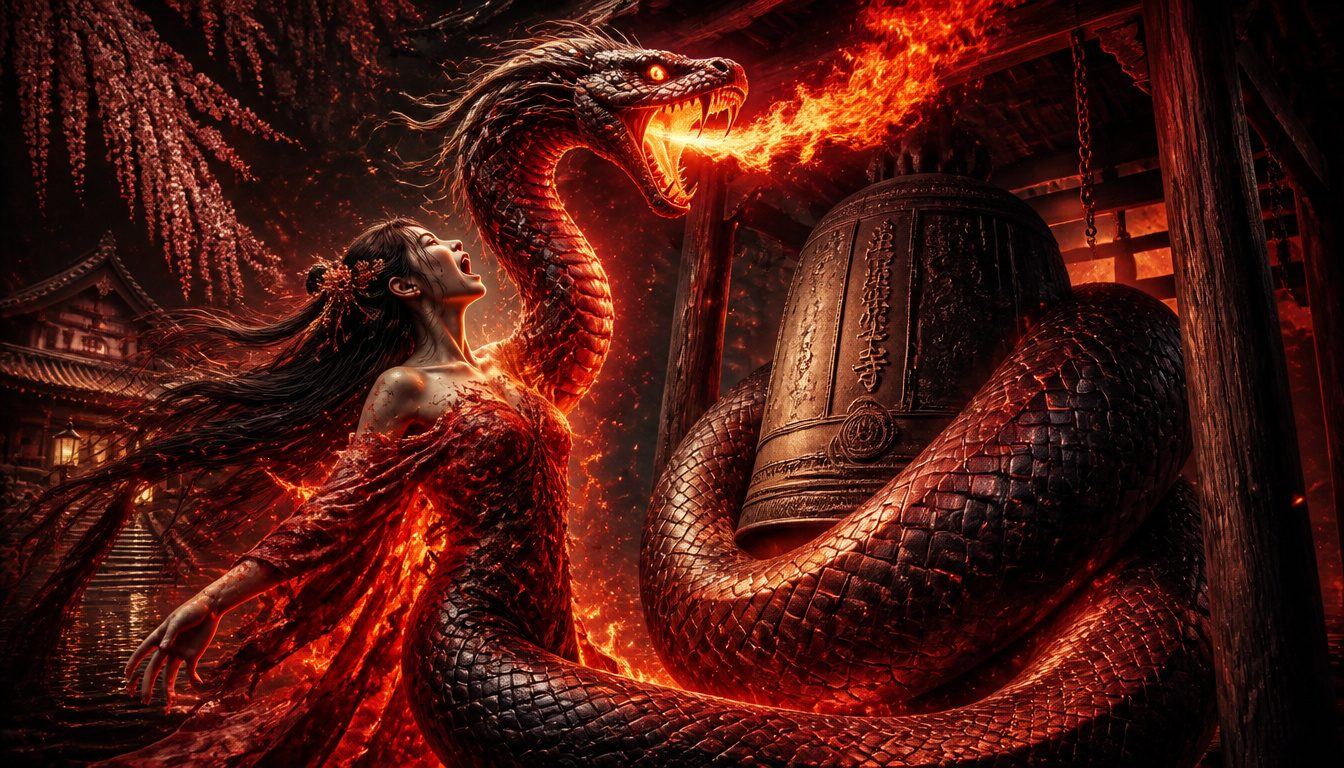
Illustration — Kiyohime, the woman who became a serpent: a screaming woman turns into a fire-breathing red serpent coiled around a temple bell. About our pictures
DragonA woman (a widow in the earliest version) whose love for a travelling monk turned to fury when he broke his promise and fled. She became a great serpent - in later versions breathing fire and swimming the Hidaka River - and coiled around the temple bell in which he hid until he burned to death inside.
At a glance
Who is Kiyohime?
Kiyohime (清姫) is the woman in the legend of Dōjōji, a temple in Wakayama Prefecture. A young monk on pilgrimage to Kumano stays at her house. She falls in love with him, and he promises to come back to her, but he takes another road home. She chases him, turns into a great serpent, and finds him hidden under the temple bell at Dōjōji. She coils around the bell and burns him to death inside it.
The story is one of the most retold in Japan. Heibonsha's Sekai Daihyakka Jiten says it inspired a huge body of literature and drama. Dōjōji itself counts well over a hundred stage works on the theme. But the name Kiyohime is a late addition. In the oldest versions the woman has no name at all, and her story looks quite different.
The earliest version: a Buddhist miracle tale
The first written form of the legend is in the Dainihonkoku Hokke-kyō Kenki, a collection of miracle tales about the Lotus Sutra. The priest Chingen compiled it in the Chōkyū era (1040–1044). Its tale is titled "An Evil Woman of Muro District, Kii Province". Heibonsha notes that almost the same story appears in the Konjaku Monogatari-shū, the great tale collection of about 1120 (volume 14, tale 3).
In this telling, two monks, an old one and a young one, are travelling to Kumano. They stop at a roadside house kept by a widow. She tries to seduce the younger monk. He puts her off by promising to return after his pilgrimage, then goes home by another road. When she learns she has been tricked, she shuts herself in her room, and a huge poisonous snake comes out of it. In one English translation it is eighteen feet long. The snake follows the monks along the road to Dōjōji. The temple's monks lower the great bell and hide the young man inside it. The snake smashes the door of the bell tower with its tail, coils around the bell and beats on it. The bell grows so hot that the monks have to cool it with water. When they lift it, the young monk has burned to ashes.
That is not the end. An old monk of the temple dreams that the young man has come back as a snake himself, forced to be the woman's husband. He asks for the Lotus Sutra to be copied for them both. The old monk copies a chapter and holds a service. In a second dream the two appear free of their snake bodies. The man is reborn in the Tōri heaven, the woman in the Tosotsu heaven. The point of the story is the power of the sutra. Heibonsha sums it up: the tale teaches that a woman's desire and resentment block the path to salvation, and that the Lotus Sutra can save her all the same.
Heibonsha also notes who the monk is: a wandering Kumano pilgrim. It suggests the story was carried around the country by yamabushi, mountain ascetics who preached the miracles of Kumano.
When did she become Kiyohime?
The names arrived slowly. Heibonsha traces them through the texts:
- The Noh play Dōjōji and its older source play Kanemaki give no personal names. The woman is the daughter of the manor steward of Manago, and the man a mountain priest from the north on his way to Kumano.
- The Buddhist history Genkō Shakusho by Kokan Shiren (1322) is the first to name the man, as Anchin of Kurama-dera. The woman is still only a widow of Muro District.
- The Dōjōji engi picture scroll, owned by the temple, calls her only the daughter-in-law of the steward Kiyoji of Masago. As Heibonsha notes, the temple's own scroll gives neither lead character a personal name.
- A variant scroll, the Kengaku sōshi in the Nezu Museum, gives both characters names, but different ones: the monk Kengaku of Mii-dera and Hanahime, daughter of a rich man of Tōtōmi.
Heibonsha concludes that the pair Anchin and Kiyohime cannot be found in any text from before the early modern period. It points to the puppet play Dōjōji Genzai Uroko as an early example. Nipponica dates that play to 1742. The Nihon Kokugo Daijiten agrees: the two names appear only from early-modern jōruri puppet plays onward. From then on the story became fixed as the tale of Anchin and Kiyohime. A printed booklet of it, made in the Bunka era (1804–1818), came to be treated as the temple's own legend.
One reference disagrees. Nipponica's entry on the temple retells the Hokke Kenki tale using the names Anchin and Kiyohime. That is a later gloss. The other entries, including Heibonsha's, say clearly that the early text names neither of them.
The Dōjōji picture scroll
The Dōjōji engi is a two-scroll handscroll kept at the temple. In it the monk visits in the reign of Emperor Daigo. The woman turns gradually into a fire-breathing serpent, swims across the Hidaka River and coils around the bell. At the end the temple monks copy the Lotus Sutra and the two are reborn as heavenly beings. Heibonsha notes that the characters' speech is written into the pictures, in the manner of popular otogizōshi scrolls. A colophon says the shogun Ashikaga Yoshiaki viewed the scroll in 1573.
Its date is disputed. Heibonsha calls it a mid-Muromachi work. Nipponica's entry on the scroll places it in the late Muromachi period, the sixteenth century. Nipponica's entry on the temple says Kamakura. The temple's own timeline gives about 1394. The temple also dates the events to 928.
The scroll is still in use. Dōjōji says that its priests and staff unroll a copy of the scroll and tell the story to visitors every day, more than two thousand times a year. Heibonsha calls it the only surviving example of etoki, preaching from pictures, that still uses a handscroll. In an interview with Wakayama Prefecture's magazine, the temple's head priest explains a detail of the scroll's meaning. It says that the Kumano god took the form of Anchin and the bodhisattva Kannon took the form of Kiyohime, so the telling is also a prayer for the listeners.
On stage: Noh and kabuki
The Noh play Dōjōji is set many years after the burning. Nipponica attributes it to Kanze Kojirō Nobumitsu, while the Nihon Kokugo Daijiten lists the author as unknown. Both call it a shortened version of the older Kanemaki. That play still survives in the Kurokawa Noh of Yamagata Prefecture. A new bell is being dedicated at the temple, and women are banned from the ceremony. A shirabyōshi dancer talks her way in. The-noh.com describes the ranbyōshi, a dance of about fifteen minutes in which the lead actor and the small-drum player keep time only by each other's breathing. The dancer then leaps up as the bell drops over her. The priest tells the old story of the steward's daughter and the mountain priest. The monks pray, the bell rises, and the woman comes out as a serpent wearing the hannya mask. She is beaten back and throws herself into the Hidaka River. Nipponica calls the play a test piece that actors must master to show they have completed their training.
Kabuki took up the theme early. Nipponica says the earliest record is a Dōjōji dance by Tamagawa Sennojō II in the Enpō era (1673–1681). The form reached its classic version in Kyōganoko Musume Dōjōji, first danced by Nakamura Tomijūrō I at Edo's Nakamura-za in 1753. It turns the Noh dance into a long series of dances showing a town girl in love. It ends with the dancer reappearing from the bell as a serpent-demon. Variants followed, among them Ninin Dōjōji, with two dancers, and Yakko Dōjōji. Puppet theatre produced Hidakagawa Iriai Zakura (1759), based on the 1742 play. Dōjōji notes that in this play, unlike the Noh and kabuki dances, Kiyohime herself appears. Its scene at the Hidaka River crossing is still staged. The temple's timeline adds the Ryukyuan kumiodori drama Shūshin Kaneiri, first performed in 1719.
Dōjōji temple
Dōjōji stands at Kanemaki in Hidakagawa town, Wakayama Prefecture. It belongs to the Tendai school. Temple tradition says it was founded in 701 at the wish of Fujiwara no Miyako, the consort of Emperor Monmu. Heibonsha notes that excavations have found remains of a hall, a lecture hall and a pagoda, with roof tiles that confirm a founding in the early eighth century. The temple lay on the pilgrim road to Kumano, at the ferry over the Hidaka River. Heibonsha suggests this is how its legend spread.
The bell in the story is not the bell the temple had later. Its second bell was cast in 1359. In the late sixteenth century Toyotomi Hideyoshi's forces dug it up and took it to Kyoto. Nipponica says it is now at the Hokke-school temple Myōman-ji in Kyoto. Nipponica also records an annual memorial service for the lost bell on 27 April. The temple's main image, a thousand-armed Kannon, and its two attendant figures were designated National Treasures in 1994.
Frequently asked questions
Is Kiyohime's name in the original legend?
No. In the Hokke Kenki (1040s) and the Konjaku Monogatari-shū, the woman is an unnamed widow and the man an unnamed young monk. The man is first called Anchin in 1322. The name Kiyohime appears in early-modern puppet plays. Dictionaries point to Dōjōji Genzai Uroko (1742).
Was Kiyohime a dragon or a snake?
The early texts make her a poisonous snake. Later the creature is described as a great serpent that breathes fire. Japanese writers did not always separate the two. Heibonsha, writing about temple-bell legends, files the Dōjōji story among bell legends linked to dragon gods and snakes.
What happens in the Noh play Dōjōji?
It is a sequel. Years after the burning, a dancer slips into the dedication of a new bell, dances and leaps into the bell as it falls. She is the woman's vengeful spirit and reappears as a serpent. The monks' prayers drive her into the Hidaka River.
Can you visit Dōjōji?
Yes. The temple is in Hidakagawa, Wakayama Prefecture. Its website says that every day between 9 am and 4 pm, priests or staff tell the story of Anchin and Kiyohime from a copy of the picture scroll. Individual visitors need no booking.
Is the story true?
Dōjōji gives the year 928 for the events, but the earliest written version comes more than a century later. It is a Buddhist teaching tale, not a record. Scholars think wandering preachers carried it along the Kumano pilgrim road.
Sources & further reading
- 安珍・清姫: Heibonsha *Sekai Daihyakka Jiten*, *Nihon Kokugo Daijiten*, Nipponica and other entries (Kotobank)
- 道成寺縁起: Heibonsha *Sekai Daihyakka Jiten* and Nipponica entries (Kotobank)
- 道成寺 (the temple, the Noh play and *Dōjōji-mono*): Nipponica, Heibonsha and *Nihon Kokugo Daijiten* entries (Kotobank)
- 京鹿子娘道成寺: *Digital Daijisen*, *Nihon Kokugo Daijiten* and Nipponica entries (Kotobank)
- 鐘巻: *Nihon Kokugo Daijiten* and Heibonsha entries (Kotobank)
- 今昔物語集: *Nihon Kokugo Daijiten* entry (Kotobank)
- 元亨釈書: *Digital Daijisen* and *Nihon Kokugo Daijiten* entries (Kotobank)
- 竜神: Heibonsha entry citing bell legends linked to dragon gods (Kotobank)
- "An Evil Woman of the Muro District of Kii Province", English translation from *Miraculous Tales of the Lotus Sutra from Ancient Japan* (500 Yojanas)
- Dōjōji temple: history and timeline
- Dōjōji temple: the stories of the temple
- Dōjōji temple: the world of *Dōjōji-mono*
- Dōjōji temple: *etoki* picture-scroll preaching
- Wakayama Prefecture, *Nagomi* vol. 55: *etoki* preaching with the *Dōjōji engi* scroll
- the-noh.com Plays Database: Dōjō-ji
- the-noh.com Noh Masks Database: Hannya (used in *Dōjō-ji*)
- JAANUS: Doujouji
- Wikipedia: Kiyohime (pointer to further reading)