Bakeneko
化け猫
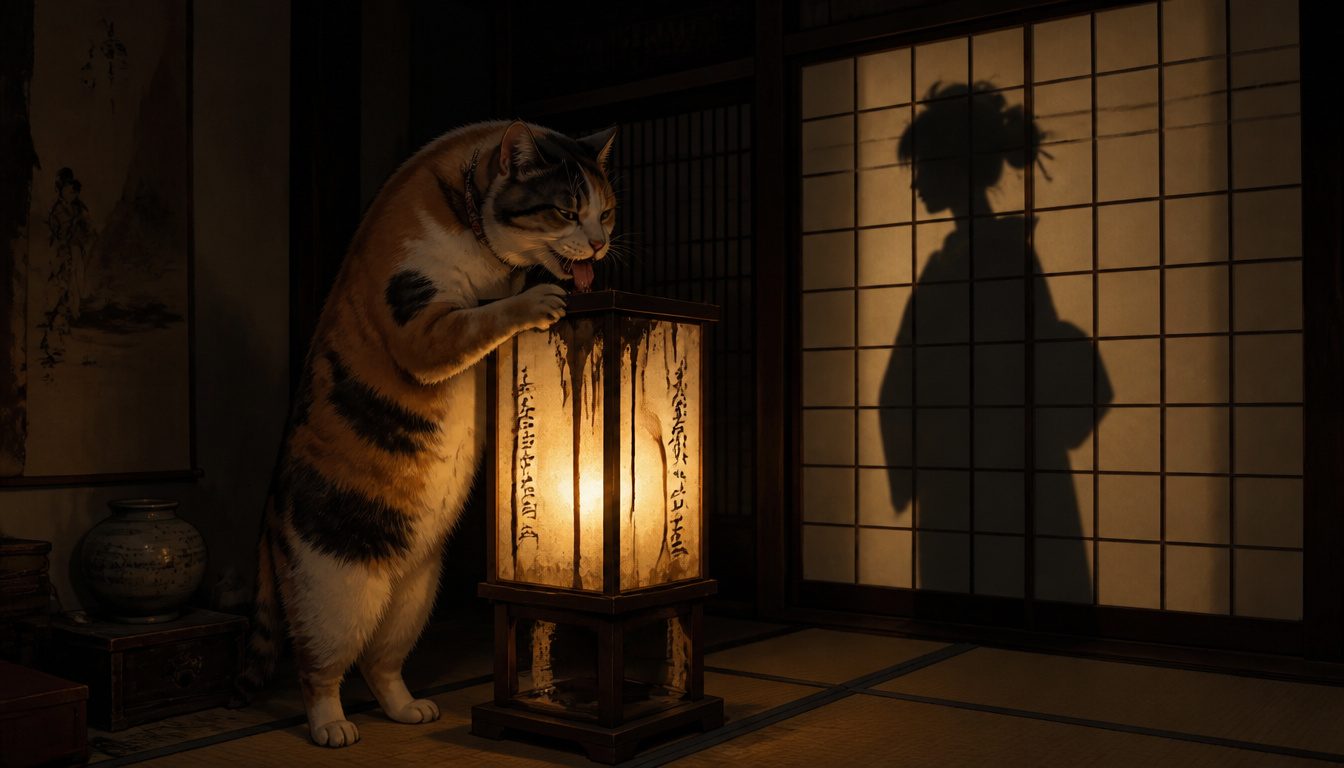
Illustration — Bakeneko, the Japanese monster cat: a huge calico cat stands upright licking a paper lantern, a woman's shadow on the shoji. About our pictures
Animal yokaiAn ordinary house cat that has lived too long or tasted something it shouldn't, and quietly become a monster. Bakeneko can walk on their hind legs, speak, take human form, and are said to lick lamp oil in the night. Some simply play tricks; others devour their owners and take their place.
At a glance
What is a bakeneko?
Bakeneko literally means "changed cat" or "transforming cat". It is the general Japanese name for a cat with uncanny powers. The standard dictionary definition is simply a cat that changes into people, or a cat that has that kind of magical power. Most bakeneko start out as ordinary animals, often a family's own pet. They change because they have grown old, grown unusually large, or been wronged. Then they begin to do things no cat should: talking, walking upright, dancing, taking human shape, and in the darker stories killing a member of the household and quietly taking that person's place.
Bakeneko belong to the same family of shape-shifting animals as the fox and the tanuki, with one difference: foxes and tanuki live out in the fields, but the cat lives inside the house. Much of the bakeneko's power to frighten comes from that closeness.
Appearance and powers
In the oldest and most widespread belief, a cat becomes uncanny by living too long or growing too big. A 1930 report from the island of Iki by the folklorist Orikuchi Shinobu records the belief that a tomcat turns into a bakeneko once it reaches seven kin, a little over four kilograms. Once transformed, the bakeneko's commonest trick is disguise. Folk records from all over Japan describe cats taking the shape of a woman, an old woman or a husband. In Sendai, people said an old cat once sat up in a cherry tree dressed as an old woman, with a hand towel on her head, turning a spinning wheel.
Other powers recur across the stories. A bakeneko can speak. It can bewitch people and lead them astray, and it can survive arrows and bullets that would kill an ordinary animal. Edo-period writers loved anecdotes of cats that gave themselves away by talking. The essay collection Shin Chomonjū tells of a red cat kept at a sub-temple of Zōjōji in Edo during the Genroku era (1688–1704). It fell from a beam while chasing a mouse and cried out the Buddhist invocation "Namu sanbō!" When people said it must be a nekomata, it vanished.
The most famous image is the cat licking lamp oil at night. Edo households often burned cheap fish oil, such as sardine oil, in their paper-shaded andon lamps, so a cat at the lamp dish had an ordinary explanation. Seen as a shadow on a paper screen, though, it became the best-known sign of a cat turning monstrous.
Bakeneko and nekomata
The two words overlap so much that Japanese sources often use them for the same creature. Broadly, bakeneko is the general term for any transforming cat. Nekomata names a particular kind, usually pictured with a tail forked in two, a feature often connected with the mata ("fork") in its name. A common rule of thumb in modern yokai books is that a bakeneko has one tail and a nekomata has two.
The nekomata is the older idea. It appears in the essay collection Tsurezuregusa, written around 1330 by Yoshida Kenkō. In episode 89, people report a creature called a nekomata that lives deep in the mountains and eats people. Someone else adds that even outside the mountains, a cat that grows old can become a nekomata and attack people. A linked-verse poet walking home alone at night hears this, panics when something leaps at him by a stream, and falls into the water shouting for help. Neighbours with torches find that the "nekomata" was his own dog, which had recognised its master in the dark. The joke works because the belief was already familiar. It also contains the key idea behind every bakeneko story, that a house cat can turn into a monster with age.
The Nabeshima cat disturbance
The most famous bakeneko of all is the cat of the Nabeshima family of Saga. The tale grew out of a real political transition in Hizen Province, today's Saga Prefecture. After the warlord Ryūzōji Takanobu died in 1584, real power passed to his retainer Nabeshima Naoshige. In 1607 Takanobu's grandson Takafusa died at the age of 22 after trying to take his own life. The Nabeshima were confirmed as rulers of the domain, and Ryūzōji descendants went on petitioning for their house to be restored. Japanese encyclopedias explain that later storytellers recast this succession dispute as a tale of a vengeful cat. It took shape in kōdan storytelling, in popular "true record" books and on the kabuki stage.
The kabuki version, Hana no Saga Nekomata Zōshi, was written by Segawa Jokō III and is dated to 1853. The details of its first production differ between sources. One kabuki title dictionary lists a first performance at Edo's Nakamura-za in the ninth month of 1853. Heibonsha's encyclopedia says the planned production was stopped after protests from Saga domain. In the play's plot, the lord of a thinly disguised domain kills a blind musician over a game of go. The musician's cat takes the form of the dowager lady and torments the lord night after night, until the loyal retainer Itō Sōta sees through the disguise and drives it off.
Regional traditions
Bakeneko lore was never limited to Saga: the Nichibunken database lists dozens of local reports, from Okinawa to Niigata. In Aso, Kumamoto, a pet cat was said to have eaten its old mistress and taken her shape. It was found out only when a hunter wounded it with a special bullet that never misses, and the old woman's bones were discovered under the floor. In Hitoyoshi, also in Kumamoto, a disturbance at the castle led to the founding of Shōzen-in temple in 1625. The temple is nicknamed the "cat temple", and it is said to have a room that no one can sleep in.
Hunters' tales from Tanba in Hyōgo tell of a cat in the form of a woman that dodged twelve arrows with a pot lid before falling to a thirteenth arrow its owner had kept hidden. On Sado Island, an old woman who rolled in the sand like a cat was said to have gained a cat's uncanny power and become a feared mountain spirit. She was later enshrined as Nekotara Tennyo.
In Miyazaki in Kyushu and in Gunma, cat-monsters were blamed for snatching corpses from funeral processions. In Miyazaki this creature was called kasha. A 1978 report from the Mera mountains says this is why a coffin must never be set down on the way to the grave.
In art, theatre and pop culture
Cat-disturbance plays (neko-sōdō-mono) formed a recognised genre of late Edo kabuki. One play from 1827, staged at Edo's Kawarazaki-za, came to be known simply as Bakeneko. Utagawa Kuniyoshi's triptych Scene from a Ghost Story: The Okazaki Cat Demon is now in the Metropolitan Museum of Art. It shows a monstrous cat tearing through bamboo blinds above a calm nobleman, while the women beside it are revealed as the cat in disguise. Tsukioka Yoshitoshi's 1867 print shows Itō Sōta catching the Saga cat at the moment it reveals its true form.
The tradition moved easily into film. Kaibyō (monster-cat) films followed. The actress Irie Takako, for example, appeared in two released in 1953, Kaidan Saga Yashiki and Kaibyō Arima Goten. Bakeneko still turn up throughout manga, anime and games.
Protection and folk practice
Much bakeneko belief is really about death and the household. In Kanagawa, people believed that if a cat stepped over a corpse, the dead body could rise. They said that if such a corpse drank from the kitchen water bucket with a ladle, it would gain the strength of a thousand men and become a nekomata. That is why a broom or a blade was laid beside the dead. The practical message of these stories is that cats belong to the household, but they need to be watched.
Frequently asked questions
What is the difference between bakeneko and nekomata?
Bakeneko is the broad term for any cat that transforms or has magical powers. Nekomata is a particular kind, usually pictured with a forked tail and often described as more dangerous. Japanese sources often blur the two. A common modern rule of thumb is one tail for a bakeneko and two for a nekomata.
What powers does a bakeneko have?
In folklore, bakeneko can take human form, often by killing and impersonating a member of the household. They can also speak, walk on their hind legs, bewitch people and shrug off ordinary weapons. Some stories also blame them for stealing corpses or making the dead move.
What is the Nabeshima bakeneko story?
It is the story of a cat that avenges its murdered master by haunting the lord of Saga in the guise of a noblewoman, until a loyal retainer exposes it. The story dramatises the real seventeenth-century transfer of power in Saga from the Ryūzōji family to the Nabeshima. It became famous through storytelling, kabuki and woodblock prints.
Why do bakeneko lick lamp oil?
Edo-period lamps often burned cheap fish oil, which a hungry cat would understandably lick. Lit from behind a paper screen, the shadow of a cat at the lamp looked uncanny, and it became the classic sign of a cat turning into a monster.
Are bakeneko evil?
Not always. Many bakeneko stories are about revenge for a real wrong, such as a murdered owner, and some cats are simply mischievous. The most frightening are the cats that replace people.
Sources & further reading
- Yoshida Kenkō, *Tsurezuregusa*, episode 89 (Japanese text, Wikisource)
- Kotobank: 化猫 (Nihon Kokugo Daijiten; kabuki title dictionary)
- Kotobank: 鍋島騒動 (Heibonsha World Encyclopedia, Nipponica, Daijisen)
- Nichibunken Kaii/Yōkai Densho Database: bakeneko records
- Nichibunken record 2260097: Iki, a tomcat of seven kin (Orikuchi, 1930)
- Nichibunken record C0410603-000: Sendai, cat as old woman spinning
- Nichibunken record 1040006: Hitoyoshi "cat temple"
- Nichibunken record 1230203: Aso, cat replaces its mistress
- Nichibunken record 1230565: Tanba, the hunter and the pot lid
- Nichibunken record 3760007: Sado, Nekotara Tennyo
- Nichibunken record 1850012: Miyazaki, kasha and the coffin
- Nichibunken record 3490095: *Shin Chomonjū*, the talking temple cat
- Nichibunken record 1232370: Kanagawa, cats, corpses and the broom
- Waraku (Shogakukan): fish oil in Edo andon lamps
- Metropolitan Museum of Art: Kuniyoshi, *Scene from a Ghost Story: The Okazaki Cat Demon*, JP1563
- Egenolf Gallery: Yoshitoshi, *Itō Sōta and the Cat Demon of Saga* (1867)
- allcinema: Irie Takako filmography
- Wikipedia: Bakeneko (pointer)