Nekomata
猫又
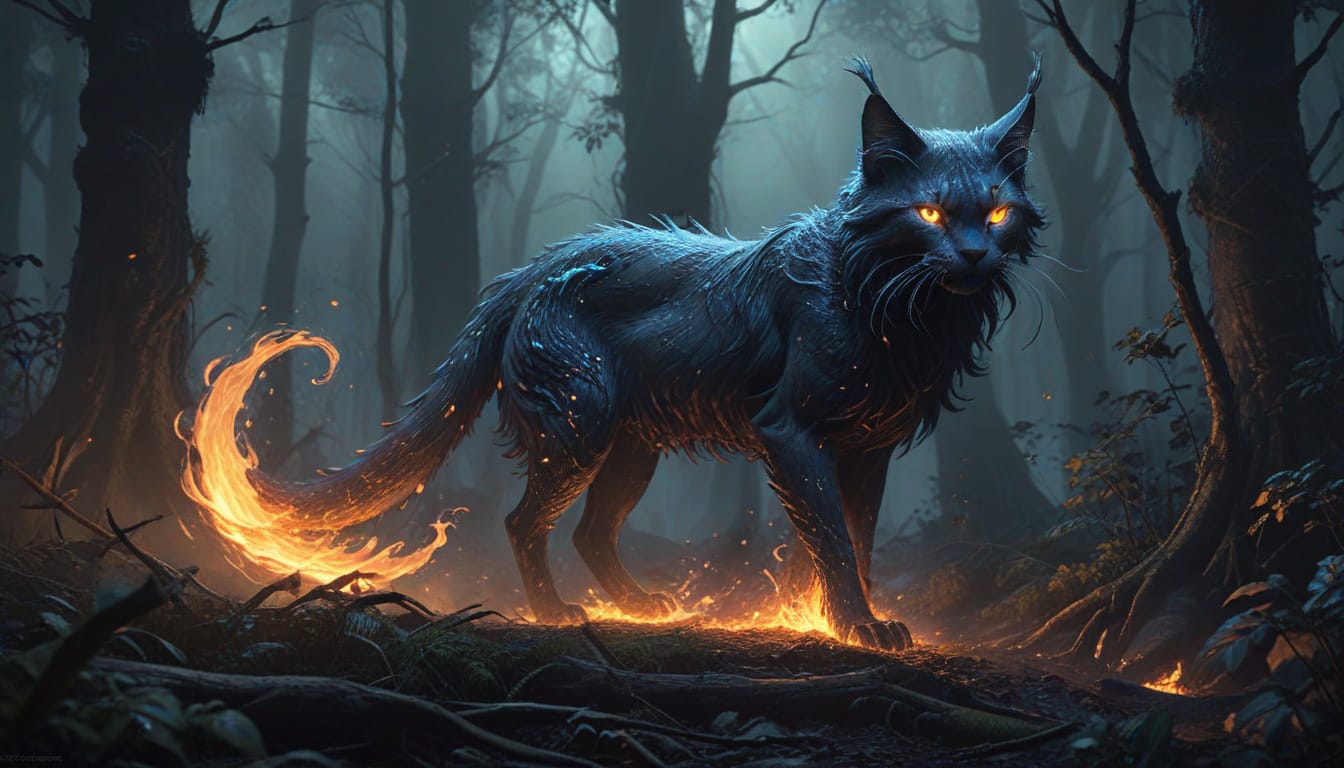
Illustration — Nekomata, the Japanese cat yokai: a dark shaggy cat with glowing orange eyes and a flaming tail prowls a misty forest. About our pictures
Animal yokaiCat yokai with forked tails that have lived so long they gained supernatural powers. They can shapeshift into humans and speak, and folk belief held that a cat passing over a corpse could make the body move. Often depicted as vengeful.
At a glance
What is a nekomata?
A nekomata is a monster cat, best known for a tail split in two. Standard Japanese dictionaries define it as an aged cat whose tail has forked, and which transforms and does people harm. Heibonsha's encyclopedia adds that nekomata were said to change shape and speak human language.
In fact, the name covers two rather different creatures. The older nekomata is a man-eating beast of the mountains, closer to a wild animal than to a pet. The later and more familiar nekomata is a household cat that has lived too long. The second kind overlaps so much with the transforming cat known as the bakeneko that the two words are often used for the same thing. This page concentrates on what is particular to the nekomata: its mountain origins, the famous episode in Tsurezuregusa, and the forked tail.
The mountain nekomata
The earliest record comes from the diary Meigetsuki of the poet and courtier Fujiwara no Teika. In an entry for the second day of the eighth month of Tenpuku 1 (1233), Teika noted a rumour from Nara. A beast called a nekomata had appeared there and eaten several people in a single night, and many had died. The entry also mentions the beast being beaten to death. It had eyes like a cat's, and a body as long as a dog's. It is a wild animal, not anyone's pet.
Mountain nekomata never disappeared from local legend. In Fukushima, north of Mount Nekoma, lies a rock called Nekoishi ("cat stone"), about the size of a tatami mat. A nekomata that lived there was said to eat people, and the ground around the rock was said to be bare of grass and dust, as if swept. In Toyama, a peak above the Kurobe Gorge is called Nekomata-yama. Its legend says an old cat once lived on Mount Fuji, was rounded up with other animals in a great hunt, killed and ate some of the soldiers, and was banished. It then settled in Kurobe as a nekomata and terrorised the villages until the hunters sent against it were frozen with fear and it simply left. A tale from Niigata also begins with a nekomata expelled by the god of Fuji. It settles in the village of Nakanomata and kills one villager after another. Neither the authorities nor guns can stop it, until the strongest man in the village, though sick, wrestles it to the death and dies with it. In Yamagata, near Mount Haguro, a man named Hayasuke killed a nekomata on the eastern mountain with his family's heirloom sword. Its grudge then brought misfortune on his house, which ended only when he stood the sword on the ridge of his roof, pointing toward the mountain.
Tsurezuregusa, episode 89
The best-known nekomata in Japanese literature is a false alarm. Yoshida Kenkō's essay collection Tsurezuregusa, written around 1330, records some gossip in its episode 89. "Deep in the mountains," people say, "there is a thing called a nekomata, and it eats people." Someone replies that one need not go to the mountains. Even here, a cat that grows old can turn into a nekomata and carry people off.
A monk known for linked verse, who lived near the temple of Gyōganji in Kyoto, hears this and resolves to be careful when walking alone. One night he comes home late and alone from a linked-verse party. At the edge of a little stream, the nekomata he has heard about comes straight at his feet, leaps on him and goes for his throat. His strength leaves him, and he tumbles into the water shouting, "Help! A nekomata!" Neighbours run out with torches and pull a monk they all know out of the stream. The fan and small boxes he had won as prizes at the party are soaked. He crawls home, barely saved. It was his own dog, which had recognised its master in the dark and jumped up to greet him.
The passage is valuable because it shows both kinds of nekomata side by side in the fourteenth century. One is the beast of the deep mountains. The other is the house cat that turns into one with age. It is also worth noticing what the passage does not say. Kenkō never mentions a tail. The forked tail that defines the nekomata in modern dictionaries is supplied by commentators, not by the essay itself.
The house-cat nekomata and the forked tail
By the time folklorists began collecting stories in the twentieth century, the house-cat nekomata had become the usual kind. A 1913 note from Matsue in Shimane states simply that a pet cat becomes a nekomata when it grows old. A temple cat there was said to go out at night wearing a priest's surplice and singing in the streets.
The forked tail now appears in the folk accounts themselves. In Marugame in Kagawa, people said that a cat that grows old becomes a nekomata. Its tail splits in two, and it stands on its hind legs and dances. A detailed account from Miyazaki says that a cat over one kan (about 3.75 kg) leaves home to train in the mountains. It sleeps on pine stumps to coat itself in resin and rolls in sand to harden its fur, until no arrow or bullet can pierce it. After one, two or seven years it comes home as a nekomata, with the tip of its tail divided, and turns on the family. Red tomcats were thought especially likely to change.
Several stories have the nekomata eat an old woman and take her place. In one from Kagawa, the cat a bedridden grandmother had kept for years ate her. It slept in her shape by day and went to the shrine at night to wrestle. In one from Ishikawa, a samurai's arrow struck a nekomata in a tree. Soon afterwards an old woman named Okiku lay dying, and when her clothes were pulled back the arrow wound was found. The cat had eaten the real Okiku thirteen years before.
Nekomata were also tied to the dead. In Ehime, people said a cat passing over a corpse would make it a nekomata and set the body moving, so mourners kept cats away. For the related Kanagawa belief about the kitchen ladle and the broom laid beside the dead, and for the corpse-snatching kasha, see the bakeneko article.
Living with a nekomata
Folk tradition did not always call for a fight. In Kagawa, the advice for a cat that had become a nekomata was to give it a meal of red-bean rice with fish, put a red hand towel on its head and tell it that it was free to go. Then it would leave without harming the house. In Miyazaki, a newborn kitten might be placed in a wooden measuring box as a charm to stop it growing too big.
Some nekomata even repaid kindness. In another Kagawa tale, a priest saved a cat from fishermen who were about to kill it. About three years later it had become a nekomata, and it repaid him by ridding his temple of a huge rat.
In art and theatre
Edo writers enjoyed nekomata anecdotes. The Baiō zuihitsu tells of a teahouse in the spring of Kansei 8 (1796), where five or six regulars ate and drank and told the owner to collect payment at their lodgings as usual. When he went, he learned they had died seven years earlier. Remembering that they had eaten three flounder whole, head and bones included, he concluded they must have been nekomata.
In prints, Utagawa Kuniyoshi placed a comic nekomata at the centre of his graffiti-style picture Nitakaragura kabe no mudagaki. On the kabuki stage, the Saga cat-disturbance play bore the word in its title, Hana no Saga Nekomata Zōshi. Its story is told in the bakeneko article.
Frequently asked questions
What is the difference between a nekomata and a bakeneko?
Bakeneko is the broad word for any transforming cat. Nekomata is the older word and names a particular kind, usually defined by its forked tail. The nekomata also has a second, separate tradition as a man-eating mountain beast. In practice the two names overlap heavily.
Why does a nekomata have two tails?
Dictionaries define the nekomata as a cat whose tail has split with age, and folk accounts from Kagawa and Miyazaki describe the split. The earliest texts, from 1233 and around 1330, do not mention the tail at all, so the feature seems to have been attached to the name later.
What was the first record of a nekomata?
The courtier Fujiwara no Teika's diary Meigetsuki records, in 1233, a rumour that a nekomata in Nara had eaten several people in one night. He described it as having a cat's eyes and a body as long as a dog's.
What happens in Tsurezuregusa episode 89?
People gossip that nekomata live in the mountains and that old house cats can turn into them. A linked-verse monk walking home at night is jumped on beside a stream and falls in, screaming for help. It turns out to be his own dog welcoming him home.
Are nekomata dangerous?
In most folk tales, yes: they eat people, take the place of old women and disturb the dead. But some traditions show nekomata that leave peacefully if politely sent away, and even one that repays a priest who saved its life.
Sources & further reading
- Kotobank: 猫股 (Nihon Kokugo Daijiten, citing *Meigetsuki* 1233 and *Tsurezuregusa*; Daijisen; Heibonsha)
- Yoshida Kenkō, *Tsurezuregusa*, episode 89 (annotated Japanese text, Wikisource)
- Nichibunken Kaii/Yōkai Densho Database: nekomata records
- Nichibunken record C0730350-000: Fukushima, Nekoishi below Mount Nekoma
- Nichibunken record 0030050: Niigata, the nekomata of Nakanomata
- Nichibunken record 1231302: Yamagata, Hayasuke's sword
- Nichibunken record 0640028: Matsue, the singing temple cat (1913)
- Nichibunken record 0640390: Marugame, forked tail and the farewell meal
- Nichibunken record C0411105-000: Kagawa, red-bean rice and red towel
- Nichibunken record C4510104-000: Miyazaki, the cat's mountain training
- Nichibunken record 0470056: Kagawa, the cat that replaced a grandmother
- Nichibunken record 2460015: Ishikawa, the arrow and Okiku
- Nichibunken record 0200080: Ehime, cats kept from the dead
- Nichibunken record 0470122: Kagawa, the grateful nekomata
- Nichibunken record 3610007: *Baiō zuihitsu*, the dead regulars (1796)
- Waraku (Shogakukan): nekomata legends, Nekomata-yama and Kuniyoshi
- japan.je: Bakeneko
- Wikipedia: Nekomata (pointer)
- en.wikipedia.org — Pet culture in Japan
- web-japan.org — animal01