Chapter One
The Two Gifts
Two princes, grandsons of the heavenly line, were born with opposite gifts — one for the sea, one for the mountains. When the younger lost his brother's fishhook beneath the waves, his search carried him to the palace of the sea god, to a marriage between land and ocean, and to a birth that would found Japan's imperial house.
Long after the heavenly prince Ninigi came down to rule the land, he and his bride Konohanasakuya-hime had three sons, born in the flames of a burning birthing hut. The eldest, Hoderi (火照命, "Fire-Shine"), took his luck from the sea: he was Umisachihiko, the Prince of the Sea's Bounty, who drew in fish "broad of fin and narrow of fin". The youngest, Hoori (火遠理命, "Fire-Subside"), took his luck from the mountains: he was Yamasachihiko, the Prince of the Mountain's Bounty, who hunted beasts rough-haired and soft-haired.
The Japanese word sachi meant both luck and the tools that carried it — the fishhook was the sea-luck, the bow and arrows the mountain-luck. One day Hoori proposed that they trade. Three times his brother refused. At last, reluctantly, Hoderi handed over his fishhook and took the bow.
Chapter Two
The Lost Fishhook
The trade went badly for both of them. Hoori sat on the shore with his brother's line and caught nothing at all — and then the hook was gone, lost somewhere in the sea. When Hoderi came to take back his own luck, saying that each gift belonged to its owner, Hoori had to confess that he had neither fish nor hook to return.
Hoderi would not forgive it. Hoori broke his own long sword and forged its metal into five hundred fishhooks; his brother refused them. He made a thousand; his brother refused those too. Only the original hook would do.
Chapter Three
The Old Man of the Tides
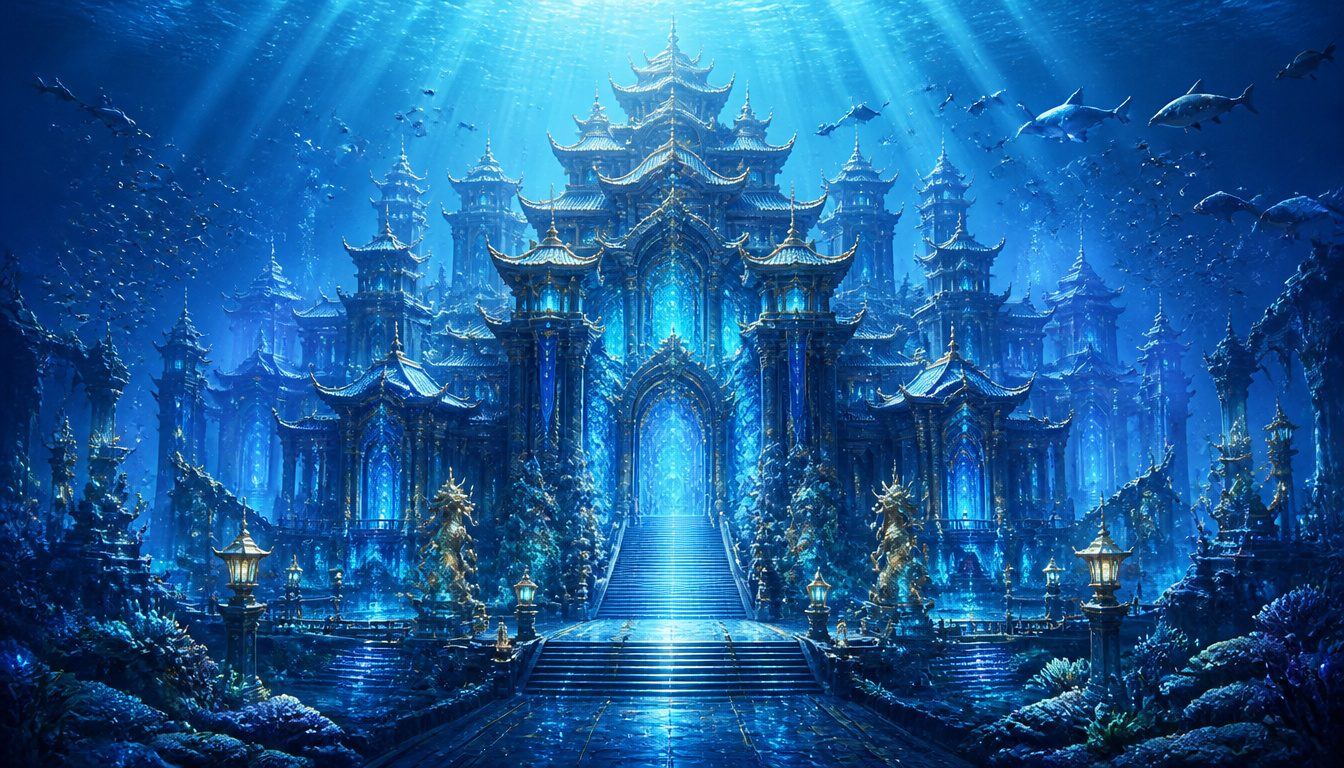
Hoori wandered weeping along the shore until an old god of the sea-currents found him: Shiotsuchi no Kami (塩椎神), the "Salt-Possessor". Hearing the story, the old god built a small boat woven so tightly it had no gaps, set the prince inside, and pushed him out onto the sea. Follow the current, he said, and a pleasant sea-road would open; at its end stood a palace built like the scales of a fish — the palace of Watatsumi (綿津見神), god of the sea.
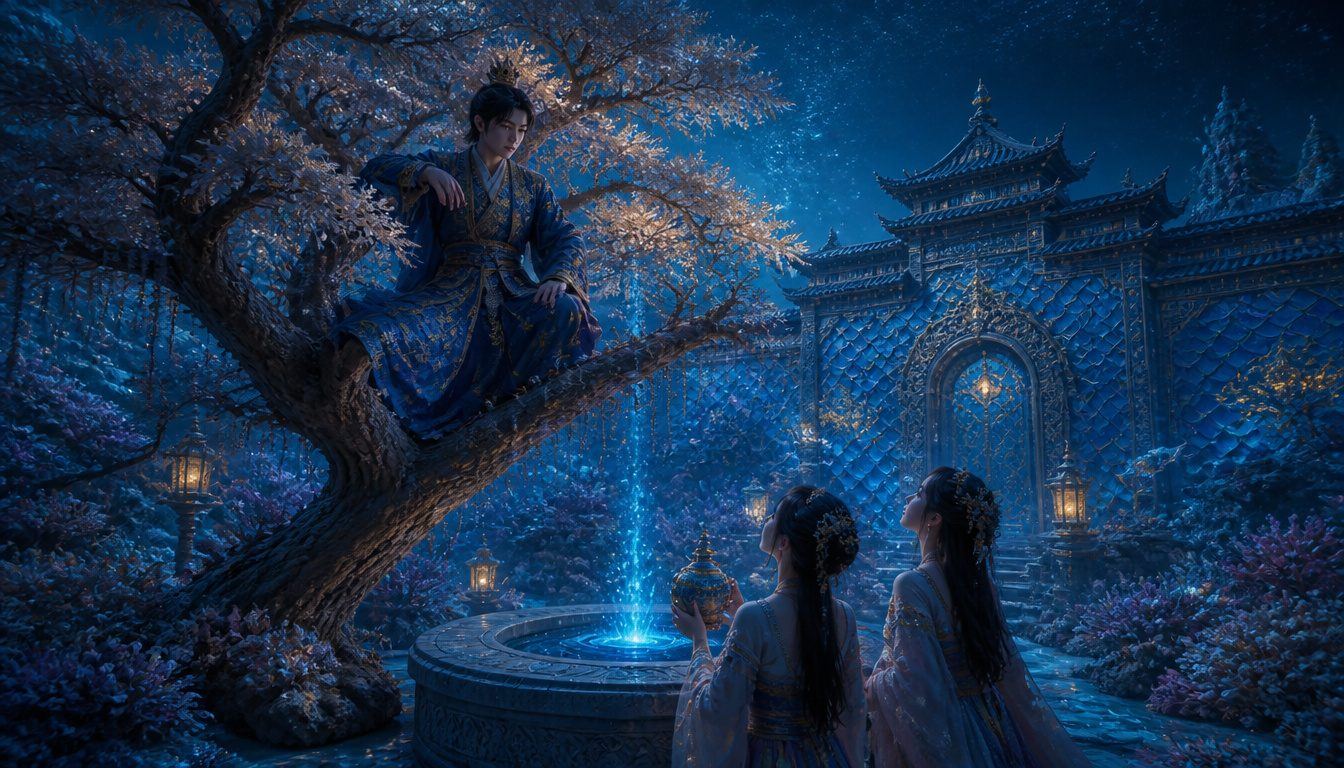
By the palace gate, Shiotsuchi told him, there was a well, and above it a great many-branched katsura tree. If Hoori climbed it and waited, the sea god's daughter would see him and know what to do. (In the Nihon Shoki the old man sinks him into the sea in a basket instead — the versions differ, the destination does not.)
Chapter Four
The Light in the Well
Everything happened as the old god had said. Hoori climbed the tree and waited. Presently the handmaidens of the sea god's daughter, Toyotama-hime (豊玉毘売, "Abundant-Jewel Princess"), came with jewelled vessels to draw water — and saw a light shining up from the well. Looking up, they found a beautiful young man sitting in the branches.
He asked them for water. When they offered it, he did not drink; instead he took a jewel from the cord at his neck, held it in his mouth, and let it fall into the vessel. The jewel fixed itself to the bowl so that no one could pull it free. The maidens carried it, jewel and all, to their mistress.
Toyotama-hime went out to look, and the moment their eyes met, the matter was settled. She told her father there was a beautiful stranger at the gate. The sea god came out himself, recognised the young man as a child of the heavenly line, and led him inside — onto eight layers of sealskin rugs with eight layers of silk spread over them — and held a great feast. He gave Hoori his daughter in marriage.
Chapter Five
Three Years Beneath the Waves
Hoori lived in the sea palace for three years. Then one night he remembered why he had come, and let out a single deep sigh. Toyotama-hime heard it — in three years he had never sighed — and told her father. The sea god asked his son-in-law gently what troubled him, and why he had come to the sea at all, and Hoori told him everything.
Watatsumi summoned every fish of the sea, great and small, and asked whether any of them had taken a hook. They answered that the tai, the sea bream, had lately complained of something lodged in its throat, so that it could not eat. They looked — and there was the hook. It was washed clean and placed in Hoori's hands.
Chapter Six
The Jewels of the Tides
The sea god did not send Hoori home with only the hook. He taught him words to say as he handed it back — a spell naming it a gloomy, fretful, poor and foolish hook — and told him to give it with his hand turned behind him. He told him to plant his rice fields high when his brother planted low, and low when his brother planted high: because the sea god ruled the waters, Hoderi's fields would fail.
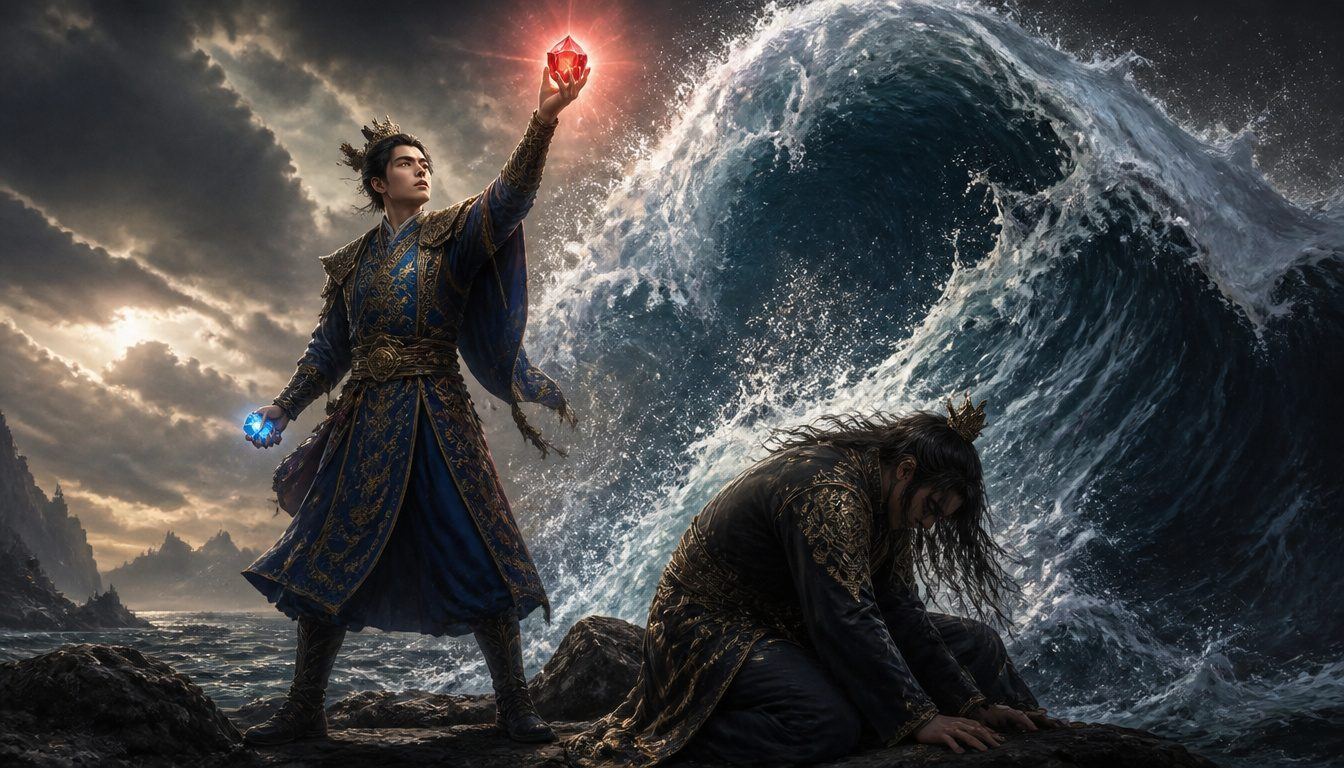
Then he gave Hoori two jewels: the shiomitsu-tama (塩盈珠), the tide-flowing jewel, and the shiofuru-tama (塩乾珠), the tide-ebbing jewel. If his brother attacked him, he should raise the flood tide with the first; if his brother begged for mercy, he should draw the waters back with the second.
To carry him home, Watatsumi called together the wani — the great sea creatures, "crocodiles" in the oldest English translation and usually understood today as sharks — and asked which could make the journey fastest. A wani one fathom long promised to do it in a single day, and did. Hoori tied his small sword around its neck in thanks, and it has been honoured as a god ever since.
Chapter Seven
The Brother Yields
Everything followed the sea god's instructions. Hoderi received his hook with the words of the spell, and from that day he grew poorer and poorer. In his anger he came to attack his younger brother. Hoori raised the tide-flowing jewel and the sea rose to drown him; when Hoderi cried out in distress, Hoori raised the tide-ebbing jewel and the waters drew back.
Humbled, Hoderi bowed his head and swore that from then on he would guard his younger brother day and night. The Kojiki records that his descendants — the Hayato people of southern Kyushu — still performed, in the chronicler's own day, the gestures of a man struggling in the water, in memory of that submission.
Chapter Eight
The Birth on the Shore
Some time later, Toyotama-hime rose from the sea to find her husband. She was carrying his child, she said, and a child of heaven should not be born in the ocean. On the edge of the waves she began building a birthing hut thatched with cormorant feathers — but her time came before the roof was finished.
Before she went in, she made one request. Those from other lands, she said, give birth in the form of their own country; she would take her true shape. Do not look at me. Hoori found the words strange — and looked. Inside the hut his wife had become a wani eight fathoms long, coiling and writhing on the floor. In the Nihon Shoki's main telling, she had become a dragon. He fled in terror.
Toyotama-hime knew she had been seen. Ashamed, she left the child on the shore, closed the path between the sea and the land, and returned to the depths. Her son was named Ugayafukiaezu (鵜葺草葺不合命) — "Cormorant-Thatch-Unfinished". Yet she could not stop loving her husband. She sent her younger sister Tamayori-hime to nurse the child, carrying a poem: red jewels shine, even to the cord that strings them, but her lord, like white jewels, shone more. Hoori answered that he would never, to the end of his life, forget the wife he had slept beside on the island where the wild ducks land.
The child grew up and married Tamayori-hime, his aunt and foster-mother. Their youngest son was Kamu-Yamato-Iwarebiko — remembered as Jimmu, the first emperor of Japan. Through Toyotama-hime, the imperial line traced its ancestry not only to the sun in heaven but to the god of the sea.
Chapter Nine
Watatsumi, Ryūjin and Urashima Tarō
The Kojiki never calls the sea god a dragon. His name there is Watatsumi (綿津見神) — from old words meaning "holder of the sea" — a sea god born in the age when Izanagi and Izanami brought forth the gods of nature (three more Watatsumi arise when Izanagi purifies himself after returning from the underworld). The palace is simply the sea god's palace, "built like the scales of fish".
The name Ryūjin (龍神, "dragon god") and the idea of the Ryūgū (龍宮, "dragon palace") came later, as Chinese and Buddhist traditions of dragon kings who rule the waters blended with Japan's older reverence for serpent-shaped water spirits. In folk religion Ryūjin became the god whom fishermen asked for calm seas and full nets, and over time the sea god of the Kojiki and the dragon king of the sea came to be thought of as one. The Nihon Shoki's image of Toyotama-hime as a dragon helped the two pictures meet. That later name is the one this map uses — but the story it tells is Watatsumi's.
A different, later tale is often confused with this one: Urashima Tarō, the fisherman who rescues a turtle, is taken to the Dragon Palace, and returns home to find that centuries have passed. Its earliest form is a brief entry in the Nihon Shoki (Emperor Yūryaku, year 22), in which a fisherman of Tango catches a turtle that becomes a woman and travels with her to Hōrai, the land of immortals; fuller versions survive in the Tango Fudoki and the Man'yōshū. The familiar name Urashima Tarō, the Dragon Palace and the forbidden box come from medieval and later retellings. It is a separate story — but it swims in the same waters.
Sources
Sources & Versions
- Kojiki (712), Book One — Chamberlain's sections XXXVIII (birth of the three brothers), XXXIX "The August Exchange of Luck", XL "The Palace of the Ocean-Possessor", XLI "Submission of His Augustness Fire-Shine", XLII "The Parturition-House of Cormorants' Feathers", XLIII (the children of Ugayafukiaezu, including Jimmu). This telling follows the Kojiki.
- Nihon Shoki (720), Book II ("Age of the Gods", part 2) — main text and several variant accounts. Differences: the elder brother is named Ho-no-susori and the younger Hiko-hoho-demi; Shiotsuchi sinks the prince in a basket rather than a boat; the hook is found in the mouth of the "red-woman" (akame, a name for the sea bream); the sea god is in one variant called Toyotama-hiko; and in the main text Toyotama-hime turns into a dragon (tatsu), while variants say a wani.
- Nihon Shoki, Book XIV (Emperor Yūryaku, 22nd year) — the earliest Urashima entry.
- Kokugakuin University Encyclopedia of Shinto: entries "Watatsumi", "Umi no kami" and "Ryūjin shinkō" — for the distinction between the classical sea god and the later dragon god.
Source URLs:
- Chamberlain, Kojiki (1882), §XXXIX: https://en.wikisource.org/wiki/Kojiki_%28Chamberlain,_1882%29/Section_39
- §XL: https://en.wikisource.org/wiki/Kojiki_%28Chamberlain,_1882%29/Section_40
- §XLI: https://en.wikisource.org/wiki/Kojiki_%28Chamberlain,_1882%29/Section_41
- §XLII: https://en.wikisource.org/wiki/Kojiki_%28Chamberlain,_1882%29/Section_42
- (Also at sacred-texts.com: https://sacred-texts.com/shi/kj/index.htm)
- Aston, Nihongi (1896), Book II: https://en.wikisource.org/wiki/Nihongi/Book_II
- Aston, Nihongi, Book XIV (Urashima): https://en.wikisource.org/wiki/Nihongi/Book_XIV
- (Also at sacred-texts.com: https://sacred-texts.com/shi/nihon0.htm)
- Kokugakuin, "Watatsumi": https://d-museum.kokugakuin.ac.jp/eos/detail/?id=9733
- Kokugakuin, "Umi no kami": https://d-museum.kokugakuin.ac.jp/eos/detail/?id=9971
- Kokugakuin, "Ryūjin shinkō": https://d-museum.kokugakuin.ac.jp/eos/detail/?id=8979