Akaname
垢嘗
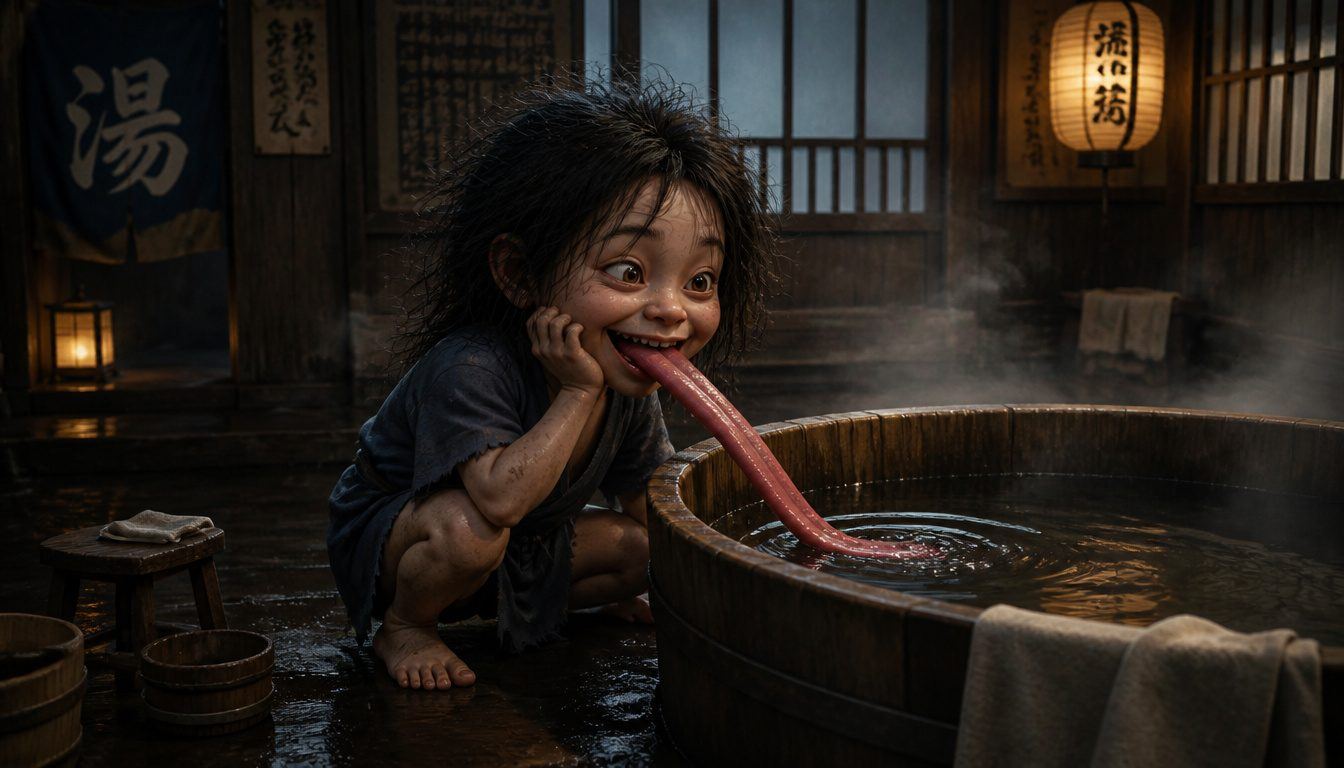
Illustration — Akaname, the Japanese bathhouse filth-licker yokai: a grinning wild-haired child in rags licks a wooden bathtub with a long red tongue. About our pictures
Household yokaiA wild-haired, clawed creature with a long tongue, pictured by Toriyama Sekien beside a bathhouse. An earlier text says it is born from built-up grime in old bathhouses and lives by licking it. It does no harm, but nobody wants to find it there.
At a glance
What is the akaname?
The akaname (垢嘗) is a small, grotesque figure said to lick the grime from bathtubs and bathhouses. Its name means "grime-licker." Aka is the dirt and dead skin that comes off the body when you wash, and name means "lick." A short entry in the Digital Daijisen Plus dictionary sums up the modern picture: a yokai that licks the grime and dust left in a bath.
The akaname is one of the most thinly documented yokai on this site. It has no regional folk tales behind it. A search of Nichibunken's database of folk-belief records, which collects field reports of strange beings from all over Japan, returns no cases under either akaname or its older name akaneburi. What exists is one picture, one short discussion in a seventeenth-century book of ghost talk, and a handful of later mentions in popular prints and dictionaries. This article sets out what those sources actually say.
Sekien's picture of 1776
The name akaname first appears in Toriyama Sekien's illustrated yokai catalogue Gazu Hyakki Yagyō, published in 1776. A later printing of the book, held by the National Diet Library, lists it among the book's spirits alongside the kodama, the mountain echo yamabiko, the kappa and the kamaitachi.
The picture shows the corner of a wooden bath building. Cloths hang over a rail, and two wooden pails stand on the ground. A wild-haired figure with clawed feet crouches beside the building with its long tongue out. The only writing on the page is the name, 垢嘗, with its reading in kana.
That is the whole of Sekien's entry. Sekien does not say what the akaname does, where it comes from, or whether it is dangerous. Everything said about its habits since then has been read into the picture or taken from other sources.
The akaneburi of 1686
There is an earlier text, under a different name. Kokon Hyakumonogatari Hyōban ("Critiques of a Hundred Tales, Old and New"), published in 1686, is a book of ghost talk with a twist. It is framed as a gathering at which guests raise strange stories and a teacher explains each one by reasoned argument. The teacher is the poet and scholar Yamaoka Genrin (1631–1672). The Britannica Japan encyclopedia notes that the book is said to be his work with additions by a later hand, which fits its publication fourteen years after his death.
The sixth section of the second volume is titled "On the akaneburi" (垢ねぶりの事). Neburu is an older verb for "to lick," so the name means the same as akaname. The full text is printed in the 1915 collection Tokugawa Bungei Ruijū, available from the National Diet Library. In rough translation:
"Someone said: 'They say the akaneburi is a monster that lives in old bathhouses. I can well believe there are such things in run-down mansions too, but I do not understand the name.' The teacher said: 'The name is quite reasonable. Every creature feeds on the thing from which it is born. A fish is born from water and drinks water. A louse is born from filth and feeds on filth. In the same way, the akaneburi arises by transformation from a place where the vapour of dust and grime has built up, and so it keeps itself alive by licking grime. It is a matter of necessity.'"
This is the earliest real description, and it is not a warning. It is a small lesson in natural philosophy. The teacher treats the creature as an example of spontaneous generation, the widely held idea that some living things arise from the matter around them. He does not say it harms anyone or that people should clean to keep it away.
The book is a useful neighbour for other yokai on this site. Its table of contents also includes the kamaitachi, the kappa (as kawatarō), the yuki-onna and the kodama. The very next section deals with another creature of dirty places, the "toilet monster" (setchin no bakemono). There the teacher concludes that whatever people meet in a privy is a spirit of the unclean vapour that has gathered there.
Bathhouses in Edo Japan
The akaneburi lived in an "old bathhouse," and that setting would have been familiar to readers. The Nipponica encyclopedia records the first public bath in Edo in 1591, when a man named Ise Yoichi opened one near Zenigame Bridge and charged a single coin. By the Bunka era (1804–1818) Edo is said to have had more than 600 public baths. Apart from samurai mansions and large households, homes had no bath of their own, so ordinary people all used the public baths.
The baths of the seventeenth century were not the bright rooms of later times. The Sekai Daihyakka encyclopedia explains that early furoya were mainly steam baths, while yuya had hot water to sit in. Later bathhouses placed the tub behind a low entrance called the zakuroguchi, which customers had to stoop under. The encyclopedia describes the space inside as cramped, dark and unhygienic, and says the Meiji government banned the design for those reasons. Nipponica adds that bathhouses closed on fixed days each month to scrub tubs, pails and floors.
Grime was also part of the trade. In the early Edo period some bathhouses employed women called yuna to scrub the dirt from customers' backs, until they were banned in 1657. A dim, steamy room where dirt was scraped off all day was a natural home for a creature born from grime.
After Sekien: prints, games and dictionaries
The name spread through popular publishing. In Ōjidai Morokoshi Bakemono, a comic illustrated book of 1816 by Shinratei with pictures by Katsukawa Shuntei, a bright-red boy crawls out and introduces himself as the "akaname kozō monster who lives in the bathhouse." A board game of 1858, Hyakushu Kaidan Yōbutsu Sugoroku by Ichijusai Yoshikazu, includes squares labelled akaname among its ghosts and monsters. By then the akaname was a recognisable comic monster.
The older word had a second life in dictionaries. Ōtsuki Fumihiko's dictionary Genkai defines akaneburi first as the name of an insect that breeds in bathrooms, and second as another word for the newt (imori). The ordinary word for a small bathroom pest and the name of the monster were the same.
The philosopher Inoue Enryō, who set out to explain away superstitions, discussed the akaneburi together with the toilet monster in his Lectures on Yokai Studies (Yōkaigaku Kōgi). In the 1923 edition he quotes the 1686 passage in full. He then suggests the belief was a delusion born from the eerie feel of such places at night and from the fact that insects breed in unclean things.
"It scares people into cleaning"
Today the akaname is usually explained as a lesson in housework. Parents supposedly told children that it would come if the bath was left dirty, so the bath was scrubbed. A popular online article on the akaname, for example, says the creature is repelled by clean homes and that keeping the bathroom clean prevents it from settling in.
No early source we have read says this. Sekien's page has no text. The 1686 book explains the creature as a product of grime, not as a punishment for it. Genkai treats the word as an insect, and Inoue treats it as a misunderstanding. The cleaning moral appears in popular yokai books and websites of recent times, and we could not trace it to any Edo or Meiji source. It is a reasonable reading of the picture, but it should be presented as a modern interpretation, not as old folk practice.
Frequently asked questions
What does akaname mean?
It means "grime-licker." Aka is the dirt and dead skin washed off the body, and name means "lick." The older form akaneburi has the same meaning.
Where does the akaname come from?
The name and the picture come from Toriyama Sekien's Gazu Hyakki Yagyō of 1776. An earlier book, Kokon Hyakumonogatari Hyōban of 1686, describes the akaneburi, a monster of old bathhouses born from built-up grime.
Is the akaname dangerous?
No source we have found says it harms people. The 1686 text says only that it is born from grime and lives by licking grime.
Did the akaname story really make people clean their baths?
That is a common modern explanation, but no Edo-period text we have read says so. Sekien gives no text at all, and the 1686 book explains the creature through natural philosophy, not as a warning.
Is the akaname a real folk belief?
Not in the usual sense. There are no regional folk tales about it in the Nichibunken database. It is mainly a creature of books, prints and later popular culture, though the word akaneburi was also an ordinary name for a small insect found in bathrooms.
Sources & further reading
- Akaname entry, *Digital Daijisen Plus* (Kotobank)
- Toriyama Sekien's akaname from *Gazu Hyakki Yagyō* (Wikimedia Commons image)
- Toriyama Sekien, *Hyakki Yagyō*, 1805 printing listing the akaname (National Diet Library Digital Collections)
- National Diet Library Image Bank: Toriyama Sekien's yokai books and the 1776 date
- *Kokon Hyakumonogatari Hyōban*, "On the akaneburi" and "The toilet monster," in *Tokugawa Bungei Ruijū* vol. 4, 1915 (National Diet Library Digital Collections)
- Yamaoka Genrin, entries in *Britannica Japan*, *Sekai Daihyakka* and others (Kotobank)
- Sentō, public bathhouses, entries in Nipponica and *Sekai Daihyakka* (Kotobank)
- Shinratei and Katsukawa Shuntei, *Ōjidai Morokoshi Bakemono*, 1816 (National Diet Library Digital Collections)
- Ichijusai Yoshikazu, *Hyakushu Kaidan Yōbutsu Sugoroku*, 1858 (National Diet Library Digital Collections)
- Ōtsuki Fumihiko, *Genkai*, 1907 printing, entry *akaneburi* (National Diet Library Digital Collections)
- Inoue Enryō, *Yōkaigaku Kōgi* vol. 4, 1923 edition (National Diet Library Digital Collections)
- Nichibunken Kaii-Yōkai Folklore Database (no folk records found under akaname or akaneburi)
- Example of the modern "keep the bath clean" explanation (Stories from Nihon)
- Akaname (Wikipedia, used as a pointer to further reading)