Inugami
犬神
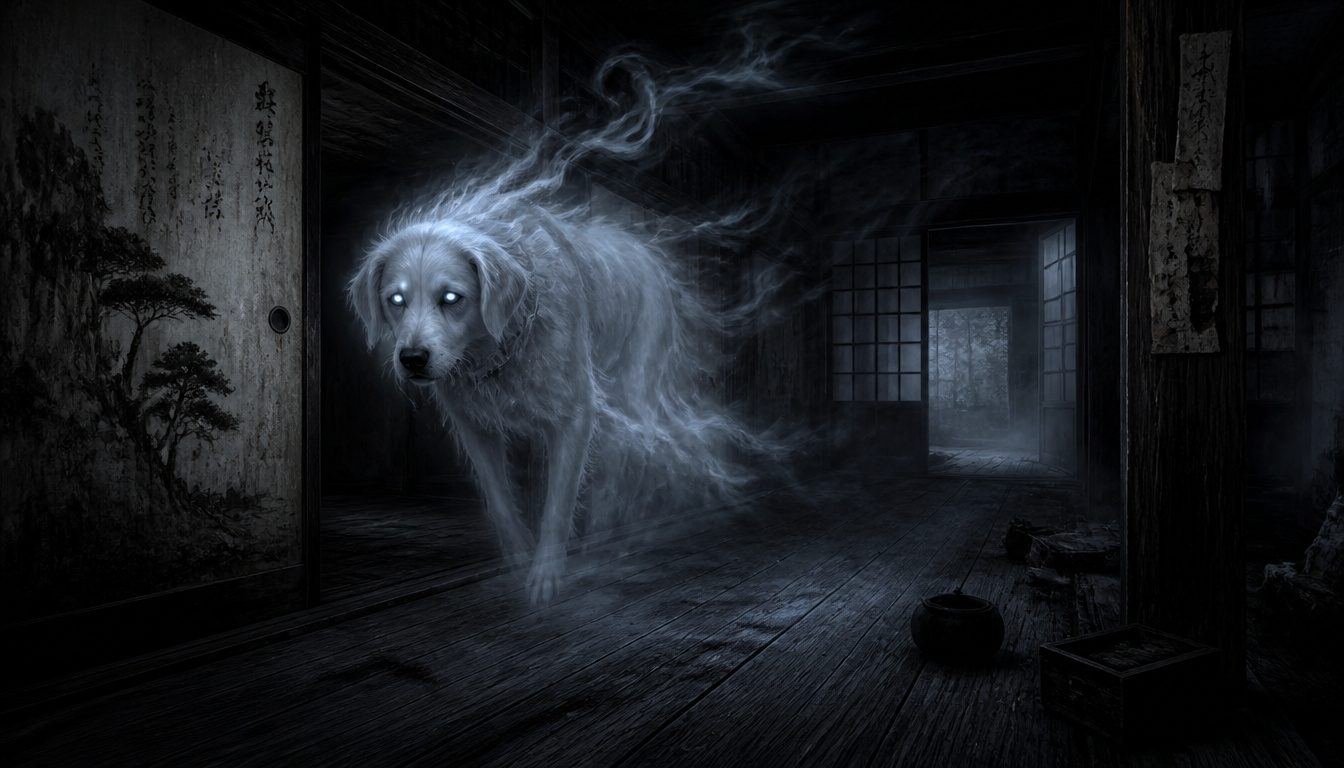
Illustration — Inugami, the Japanese dog spirit: a pale ghostly dog with glowing white eyes, trailing smoke, walks through a dark wooden house. About our pictures
Animal yokaiA dog spirit that can be sent to possess people and bring sickness, pain or madness. Inugami were believed to be held by certain families, passed down the generations, and to act on their owners' resentments even unbidden.
At a glance
What is the inugami?
The inugami (犬神), "dog god", is a dog spirit that was believed to possess people and make them ill. It belongs to a group of beliefs that folklorists call tsukimono, "possessing things", alongside possession by the fox, the kitsune. The Nipponica encyclopedia describes it as found widely across the Chūgoku region, Shikoku and Kyushu. In local speech its name becomes inugame, ingame or irigami.
Despite the name, the inugami was not imagined as an ordinary dog. Nipponica says it was often described as tiny, about the size of a mouse, and visible to some people but not to others. Reports in Nichibunken's yokai database describe it as a mouse with a vertically split mouth (Iwami, 1922) or a mouse with white and black spots (Hagi, 1922). Several sources say a family held seventy-five of them.
What mattered most was not the creature itself but who was thought to control it. In nearly every account the inugami did not act alone. It was kept by a particular household and sent out, deliberately or not, against people that household envied or resented. That belief had real consequences for real families, and they are the most important part of the story.
Possession and its cure
According to Nipponica, a person possessed by an inugami might fall into fits, or act like a dog. Pains moved around the body, and all kinds of illness of body and mind followed. Women were said to be possessed more often than men. Britannica Japan adds barking and running about like a dog. A 1914 report from Kuma in Kumamoto says the victim's body swelled as if insects were crawling under the skin.
Doctors could do nothing, the belief went. The inugami had to be driven out by a prayer specialist, a mountain ascetic or a shrine priest. Local cures varied. A 1922 report from Kagawa describes rubbing the sick person's body with three rice balls, then throwing them at the wall of the household believed responsible. The Kumamoto report suggests burying roasted beans in the ground and setting a stone Jizō on top, with a vow that the inugami must not come out until the beans sprout. Since roasted beans never sprout, the inugami could never come out.
Inugami lines: how the stigma worked
The Heibonsha encyclopedia, in an entry by the folklorist Komatsu Kazuhiko, describes the core belief. Certain households were said to worship a dog spirit as a god. They were called inugami-suji (inugami line), inugami-mochi (inugami holders) or inugami-tō. Their members were thought able to send the spirit against anyone they disliked, causing illness or death. Once a family took up an inugami it could never be rid of it, and the spirit was believed to spread through marriage. So, Komatsu writes, people avoided marrying into such families.
Nipponica adds detail. The power was thought to belong to the whole family and pass to its descendants. One story said that a bride from such a family carried the inugami to her new home in her chest of drawers. Treated well, worshipped as a household god, the inugami was believed to make the family rich. Neglected, it would bring ruin. Because the families were feared, Nipponica says, neighbours avoided dealing with them in all kinds of ways, and above all refused to intermarry.
The records in Nichibunken's database show how long this lasted, and who it hurt. The essayist Kitamura Intei noted in Kiyū shōran (1830) that descendants of inugami families in Shikoku still faced discrimination when they married. A 1954 article reports that the house rules of the Tanegashima clan in southern Kyushu included an article forbidding marriage with inugami-holding families. A 1936 study from Tokushima, where the belief was tied to women, found that women of inugami lines were held down both socially and psychologically, and often met discrimination over marriage.
Field reports from the 1930s to the 1970s describe the same pattern still at work in Kōchi, Ōita and Yamaguchi, with such families shunned when marriages were arranged. A 1964 study from Tsukumi in Ōita is especially clear. It found that inugami lines faced discrimination at weddings and at funerals. The funeral custom was dying out, but the marriage barrier remained strong. Almost nobody there still believed that an inugami could actually possess anyone. What kept the discrimination alive was that relatives would break off ties with anyone who married into such a family.
Why some families were labelled
The families labelled in this way had done nothing to earn it. Scholars have looked for the social reasons behind the label. Heibonsha's entry on tsukimono outlines two older theories. One links possessing-spirit lines to wandering religious specialists who settled in villages, since the people who drove out spirits often used similar spirits themselves. The other ties the label to the spread of a cash economy from the middle of the Edo period. Older village powers, this theory says, used the stigma to push down families that were newly growing rich. The entry adds that newer research has found inugami lines already existing at the start of the Edo period, which fits neither theory well, and that the question needs more study.
The belief was officially opposed at times. Nipponica states that the domains of Awa under the Hosokawa and Tosa under the Chōsokabe, between the medieval and early modern periods, were troubled enough by inugami beliefs to execute people involved, apparently without effect. Doubt was also voiced early. The physician Nakayama Sanryū (1614–1684), in his essay collection Daigo zuihitsu, passed on a Shikoku doctor's view. People fell ill because they lived in constant fear of the inugami and blamed every sickness on it.
How an inugami was made
The best-known story about the inugami is a cruel one. Komatsu, in the Heibonsha encyclopedia, gives it as the most widely known tradition. A dog is buried up to its neck in the ground and left to starve. When its hunger is at its height, its head is cut off. The head is then worshipped as a ritual object, and its spirit can be made to do the owner's will. Komatsu says this story is found often in Edo-period essays, and is still told in the regions concerned.
The earliest version this article could trace is shorter. Among the Edo-period essays summarised in Nichibunken's database is Enpekiken ki by the physician and Confucian scholar Kurokawa Dōyū (died 1691). It explains the inugami as the lingering resentment of a dog that someone's ancestor buried alive, chanting a spell over it. The essay says the dog's spirit then possesses people and makes them ill, that worshipping the dog cures them at once, and that such things still happened in the countryside of western Japan.
The full version, with the head left above ground, the food out of reach and the beheading, appears in Nichibunken's records from twentieth-century fieldwork onward. A 1922 report from Kagawa specifies a white dog and a bowl of rice set in front of it, with a vow that it will be fed and worshipped if it obeys, before its head is struck off with one blow. On Iki in 1936 a shrine priest described leaving the dog for a week, after which the severed head leapt at the food. Similar accounts were collected in Kōchi (1955) and Hiroshima (1959).
Other origin stories were told alongside it. In Ehime in 1913, people said that Kōbō Daishi once gave a household a sealed charm against wild boars. When they broke the seal, a picture of a dog jumped out and became the inugami. In Tokushima the inugami was said to come from the dismembered body of the nue: the dog-like part fell in Awa and became the inugami, while the monkey part became the sarugami of Sanuki. Nipponica also notes a theory that the belief came from China, where dog-spirit sorcery is recorded in Gan Bao's Soushen ji. The comparison is an old one. The Edo-period essayist Sakakibara Kōshū, in Sakaki kōdan'en, already likened Shikoku's inugami to Chinese dog sorcery.
The inugami in pictures and fiction
The inugami appears in the painted monster scrolls of the eighteenth century. Sawaki Sūshi's Hyakkai zukan (1737), in the Fukuoka City Museum, includes the inugami. The museum's 2026 exhibition showed a section of it with the inugami beside the nukekubi. Toriyama Sekien included it in Gazu Hyakki Yagyō (1776). In the National Diet Library's 1805 printing, the inugami is a dog-headed figure in court robes, sitting before a screen painted with waves and holding a ritual paper wand (gohei). It wears a tall black cap. Beside it, a small figure labelled shirachigo (白児) kneels and writes in a book. As usual, Sekien gives no explanation.
The name became widely known in modern Japan through Yokomizo Seishi's mystery novel Inugamike no ichizoku (The Inugami Clan, 1950–51), filmed in 1976 and again in 2006. In the novel, Inugami is a family's name, and the plot is a murder case over an inheritance.
Frequently asked questions
What is an inugami?
It is a dog spirit from the folk belief of western Japan, said to possess people and cause illness or madness. It was believed to be kept by certain families and sent against people they resented or envied.
Where was inugami belief found?
Mainly in Shikoku, and also in eastern Kyushu, the western Chūgoku region and islands further south such as Tanegashima. Reports in Nichibunken's database come from Tokushima, Kōchi, Ehime, Kagawa, Shimane, Yamaguchi, Ōita, Kumamoto and Kagoshima.
What does inugami-mochi mean?
It means "inugami holder", a household believed to keep an inugami. The label was thought to pass to descendants and to spread through marriage. Such families were widely avoided, especially as marriage partners, and the stigma lasted into the twentieth century.
Is the buried-dog ritual historical?
It is a tradition, not a documented practice. A late-seventeenth-century essay already explains the inugami as a dog buried alive with a spell. The fuller version, with the dog starved and beheaded, is described in Edo essays according to Heibonsha, and in many twentieth-century field reports.
Is The Inugami Clan about the inugami spirit?
Not directly. Yokomizo Seishi's novel (1950–51) is a detective story about a wealthy family whose surname is Inugami. It made the word familiar across Japan.
Sources & further reading
- 犬神: *Nihon Kokugo Daijiten*, Nipponica, Heibonsha (Komatsu Kazuhiko), Britannica Japan and other entries (Kotobank)
- 憑物: Heibonsha entry on possession beliefs and *tsukimono-suji* (Kotobank)
- 黒川道祐: dates of Kurokawa Dōyū (Kotobank)
- 中山三柳: dates of Nakayama Sanryū (Kotobank)
- 嬉遊笑覧: dating of *Kiyū shōran* (Kotobank)
- 犬神家の一族: *The Inugami Clan*, novel and films (Kotobank)
- Nichibunken yokai database: *Enpekiken ki*, the dog buried alive with a spell
- Nichibunken: *Daigo zuihitsu*, a Shikoku doctor's view of the inugami
- Nichibunken: *Kiyū shōran*, marriage discrimination in Shikoku
- Nichibunken: Tanegashima clan rule against marriage with inugami families (1954)
- Nichibunken: women of inugami lines in Tokushima (1936)
- Nichibunken: "Inugami lines and social structure", Tsukumi, Ōita (1964)
- Nichibunken: inugami lines avoided in marriage, Yamaguchi (1959)
- Nichibunken: the white dog and the rice bowl, and the rice-ball cure, Kagawa (1922)
- Nichibunken: the shrine priest's account, Iki (1936)
- Nichibunken: the buried dog, Kōchi (1955)
- Nichibunken: the buried dog, Hiroshima (1959)
- Nichibunken: Kōbō Daishi's charm, Ehime (1913)
- Nichibunken: the nue and the inugami of Awa, Tokushima (1914)
- Nichibunken: swelling and the roasted-bean charm, Kumamoto (1914)
- Nichibunken: the mouse-like inugami with a split mouth, Iwami (1922)
- Nichibunken: the spotted mouse of Hagi (1922)
- Nichibunken: *Sakaki kōdan'en* compares the inugami to Chinese dog sorcery
- Toriyama Sekien, *Gazu Hyakki Yagyō*, 1805 printing, inugami and shirachigo page (National Diet Library Digital Collections)
- Fukuoka City Museum exhibition release: Sawaki Sūshi, *Hyakkai zukan* (1737), "Inugami / Nukekubi" section (PR Times)
- Inugami (Wikipedia, pointer to further reading)